Languages
Wednesday, November 18, 2026



News and Views from the Global South
Editors' Choice

El Salvador Pension Reform Could Take Women into Account
El Salvador is debating reforms of the country’s privatised pension system, which could introduce changes so that it will no longer discriminate against women.
Latin America’s Indigenous Peoples Find an Ally in the Pope
“We want Pope Francis’ message to come true…We want the rights of indigenous people to be supported, respected and strengthened,” Yuam Pravia, a representative of the Misquito native people, said in this city in southern Mexico.
Women’s Empowerment in Bangladesh
On a gloomy weather in a hilly suburb in Tarabonia, three women keep themselves busy stitching clothes. The informal shop-cum tailoring outlet is the only one of its kind in the neighbourhood and so the shop has a good record of sales of apparels. Minu Bai Marma, a 27 year-old housewife who runs the rented shop, gives a smile and attends to her regular customers. Customers keep ordering for new dresses, especially before festivals and Minu and her husband earn a fairly good amount of profits to run the family.Rise of Middle Class Undermined in East Europe & Central Asia
The UN’s post-2015 development agenda, which was adopted by world leaders at a summit meeting last September, includes a highly ambitious goal: the eradication of extreme poverty by the year 2030. The decline in poverty, as reflected in the UN’s Millennium Development Goals (MDGs) which ended last December, had one positive fallout: the rise of a new middle class graduating largely from the ranks of the poor.
Kidneys Going Cheap in Poor Estate Community
One and half years ago, Johnson, a 20- something youth, hailing from Sri Lanka’s tea plantations, received an unusual request. The caller, someone Johnson knew casually, made an offer for his kidney. “It was for a half a million rupees (around US $3,500),” he said.
CTBTO’s Verification System Thwarts Nuclear Tests
The Vienna-based Comprehensive Nuclear-Test-Ban Treaty Organization (CTBTO) – a 24-hour international watchdog body – is known never to miss a beat. The Organization’s international monitoring and verification system has been tracking all nuclear explosions -– in the atmosphere, underwater and underground –- including all four nuclear tests by the Democratic Republic of Korea (DPRK) – the only country in the world to test nuclear weapons in the 21st century.
Violence Is a Preventable Disease
The World Health Organization has said that ‘Violence is a preventable disease’ and people are not born violent, rather we all live in cultures of violence. This can be changed through nonviolent peacemaking and the persuit of ‘just peace’ and nurturing of cultures of peace.UN Seeks Zero Tolerance for Female Genital Mutilation
The United Nations says it is determined to end female genital mutilation (FGM) – a ritual practiced mostly in Africa, the Middle East, parts of Asia and even among some migrant communities in Europe. And the world body’s determination is being backed with facts, figures -- and a global campaign by a Joint Programme against FGM initiated by the UN Population Fund (UNFPA) and the UN children’s agency UNICEF.
Rural Youth Can Be Tomorrow’s Entrepreneurs
Bolstering widespread prosperity in Africa is a key necessity if the world is to achieve its commitments to eradicate poverty and hunger by 2030.
Family Planning in India is Still Deeply Sexist
The tragic death of 12 women after a state-run mass sterilisation campaign in the central Indian state of Chhattisgarh went horribly wrong in 2014 made global headlines. The episode saw about 80 women "herded like cattle" into makeshift camps without being properly examined before the laparoscopic tubectomies that snuffed out their lives. In another incident in 2013, police in the eastern Indian state of Bihar arrested three men after they performed a botched sterilisation surgery without anaesthesia on 53 women over two hours in a field.
Microcephaly Revives Battle for Legal Abortion in Brazil
The Zika virus epidemic and a rise in the number of cases of microcephaly in newborns have revived the debate on legalising abortion in Brazil. However, the timing is difficult as conservative and religious groups are growing in strength, especially in parliament.
The Nuclear Deal Implementation Day: A Win-Win Agreement (part one)
After many years of unprecedented, crippling Western sanctions that stopped Iran’s oil exports and even banking transactions, the long and arduous negotiations between Iran and the P5+1 (the United States, Russia, China, United Kingdom, France and Germany) culminated in the Joint Comprehensive Plan of Action (JCPOA) agreed on 14 July 2015. That agreement finally reached the Implementation Day on 16th January 2016, coincidentally 37 years to the day when the late Mohammad Reza Shah left Iran for good and paved the way for the victory of the Islamic revolution.
Women and Girls Imperative to Science & Technology Agenda
Can you imagine an entire day without access to your mobile phone, laptop, or even to the internet? In our rapidly changing world, could you function without having technology at your fingertips?
Dying for the News: Media Call for Help from Gov’t and Public against Attacks
“No story is worth dying for.” This comment at a landmark conference on media safety at UNESCO last Friday emphasised the bewilderment the media felt at the brutal slayings of journalists as they carry out their work.
Extremism Threatens Press Freedom
Pakistan continues to remain one of the most dangerous countries for journalists, where frequent attempts to restrict press freedom are commonplace and challenges to expanding media diversity and access to information abound.
Press Crackdown Is Likely to Worsen
On October 2015, the day that Ugandan journalist Enoch Matovu, 25, was allegedly shot by the police for simply “doing my job”, the police had “run out of tear gas”, he claimed.
IPS joins in the call to enforce international law to protect journalists
While our goal at Inter Press Service is to provide information – a precious global public good – we naturally applaud all efforts to foster and promote the safety of journalists, and so applaud UNESCO’s international conference in Paris on Friday, February 5, 2016 with media executives and member states to discuss just that.
Women of Haitian Descent Bear the Brunt of Dominican Migration Policy
A middle-aged woman arranges bouquets of yellow roses in a street market in Little Haiti, a slum neighbourhood in the capital of the Dominican Republic. “I don’t want to talk, don’t take photos,” she tells IPS, standing next to a little girl who appears to be her daughter.After 20 Years, Nuclear Test Ban Treaty Still in Political Limbo
After nine years in office, UN Secretary-General Ban Ki-moon will step down in December perhaps without achieving one of his more ambitious and elusive political goals: ensuring the entry into force of the Comprehensive Nuclear-Test-Ban Treaty (CTBT).
Europe is disintegrating while its citizens watch indifferent
We are witnessing the slow agony of the dream of European integration, disintegrating without a single demonstration occuring anywhere, among its 500 millions of citizens. It is clear that European institutions are in an existential crisis but the debate is only at intergovernmental level.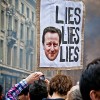
Cameron at large: Want Not to Become a Terrorist? Speak Fluent English!
“Do you speak English fluently? No? Then you risk to become a terrorist!.” IPS posed this dilemma to some young Muslim women living in Cairo, while explaining that this appears to be UK prime minister David Cameron's formula to judge the level of Muslim women's risk to fall, passively, into the horrific trap of extremism.« Previous Page — Next Page »


The Week with IPS

NEXT STOP - SDGs
Tracking global progress towards a sustainable world
Tracking global progress towards a sustainable world
