Languages
Friday, November 27, 2026



News and Views from the Global South
Food and Agriculture
OP-ED: Expanding Deserts, Falling Water Tables and Toxins Driving People from Homes
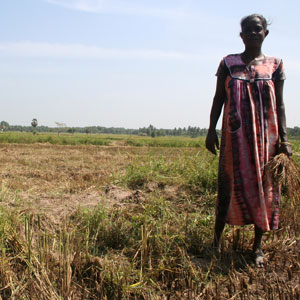
People do not normally leave their homes, their families, and their communities unless they have no other option. Yet as environmental stresses mount, we can expect to see a growing number of environmental refugees. Rising seas and increasingly devastating storms grab headlines, but expanding deserts, falling water tables, and toxic waste and radiation are also forcing people from their homes.
ECONOMY-ZIMBABWE: Good Policies Make for Good Business
With effective political and economic policies, Africa can be a haven for multinational companies (MNCs) even in the continent's least developed countries.
KENYA: Lime Improves Maize Harvest
As the world’s worst food security crisis continues across the Horn of Africa, including in Kenya, some smallholder farmers in the western part of the country are still feeding their families with last year’s abundant harvest.Brazil Revs Up South-South Cooperation
As one of the world's emerging economic powerhouses, Brazil is vigourously pursuing one of the key economic objectives on the U.N.'s development agenda: South-South Cooperation.
SOMALIA: Massive School Dropouts As Famine Continues
Jamaal Abdi, an eight-year-old boy at the Badbaado camp on the outskirts of Mogadishu, would like to have an education. He has his own dreams for the future.
MALAWI: Giving Up on Tobacco
Malawi is reducing the production of tobacco following huge losses by smallholder tobacco farmers and commercial estates trading the crop on the country’s only official tobacco markets, the auction floors.
CUBA: Dreams and Progress in a Rural Community
The day that electricity arrived in the Cuban village of Jova, there were shouts, laughter and tears of joy, even among the most incredulous, who had doubted it was possible. "I didn’t know what to do; it actually made me nervous," Carmen Carvallosa confessed.
MOZAMBIQUE: Climate Change Threatens Smallholder Farmers
Long after the wintry sun set over her patch of crops outside the Mozambican capital Angelina Jossefa keeps pulling out weeds. Much of her lettuce, carrots and beetroot died during a cruel winter, which means she has to work harder to feed her three children.
NEPAL: Adapting to Climate Change Can be Simple
Saraswoti Bhetwal’s terraced fields stand out in the sub-Himalayan Lamdihi village as a mosaic of shapes and colours formed by beans, bitter gourd, chilly, tomato, lady’s fingers and other crops.
SOMALIA: City in Need of More Aid
The shelling and gunshots, once a common sound in Mogadishu, no longer ring out in the city's streets. The surprise withdrawal on Aug. 6 of the Islamist extremist group Al Shabaab from their stronghold in Mogadishu has meant that people now move about the city, for the first time in two years, without fear of constant attack.
NAMIBIA: No Option but to Adapt to a Changing Climate
Extreme weather conditions predicted because of climate change in Namibia are likely to have a tremendous effect on the 70 percent of the country’s people who live in rural areas and depend heavily on agriculture.
School Gardens Promote Learning While Fighting Hunger
"Yesterday I planted 20 broccoli plants at home. God willing, they will grow and we will be able to eat them," said 12-year-old Juan Francisco Ordóñez, a student at a school in San Cristóbal Totonicapán where a school garden has been established in an attempt to alleviate hunger.
HORN OF AFRICA: U.N. Shares Responsibility in Famine, Experts Say
The United Nations Human Rights Council should accept responsibility, on behalf of the world forum, for the famine spreading through eastern Africa, and should call for member countries' cooperation to overcome the desperate food crisis there, experts said.
Somali Women Bear Superhuman Burden
While the exit of the Al-Qaeda-backed rebel group Al Shabaab has led to the first U.N. relief airlift in five years in the capital of famine-wracked Somalia, the situation for women and children remains precarious, humanitarian workers warn.
KENYA: Relief Food Sourced from Local Farmers
Mourid Abdi Dolal and Wilson Rotich are both small-scale farmers who grow staple crops. But while one sells his produce at the local village market, the other farms to feed the growing number of refugees in Kenya.
BRAZIL: Soy Boom Drives Westward Expansion of Railroads
Despite challenges like high interest rates and high household electricity tariffs, the Brazilian economy has been growing at the highest rates seen in decades. Another problem that, although it has not stood in the way of growth, must be overcome is the costly use of roads for transporting farm products – an issue that is being addressed by the expansion of railway networks.DR CONGO: Fresh Start for DR Congo’s Coffee Producers
Long years of civil war and instability set off a crippling decline in coffee production in the Democratic Republic of Congo: the country's output in 2010 was less than a tenth the harvest twenty years earlier. Now the DRC government has a strategy to bolster recovery of the sector.
COLOMBIA: Paramilitaries Dig in to Fight Return of Stolen Land
While President Juan Manuel Santos described his government's land restitution policy as "a veritable revolution" during a speech in northwest Colombia, some 300 far-right paramilitaries were taking up positions less than 100 km from there to fight the effort to return land to small farmers displaced by the violence, human rights activists say.NORTH KOREA: Food At Last for the Hidden Hungry
"Even if 100,000 people die of starvation in North Korea, foreigners working there will not see it," says a humanitarian worker who spent three years in the impoverished, communist country.SOMALIA: U.S. Greenlights Aid to Shabaab-Controlled Areas
The Barack Obama administration promised Tuesday that the U.S. would not prosecute relief agencies for delivering aid to parts of Somalia controlled by the Islamist insurgent group al- Shabaab, despite concerns that unrestricted aid in the failed state would be diverted to the wrong hands.
MALAWI: Water Drives Integrated Agriculture on Small Farm
When the original owners of a 3.5 hectare piece of land put it up for sale because it was too waterlogged to farm on, Diana Sitima and her husband, Wilson, jumped to buy it.« Previous Page — Next Page »


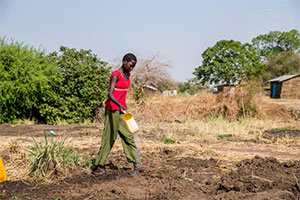 Farming on the Outskirts of Juba. Credit: UN Photo/JC McIlwaine
Promoting human and planetary health is a central focus of the United Nations, as laid out in the 2030 Sustainable Development Goals (SDGs). World hunger and unsustainable farming practices continue to be pressing concerns for the world. According to the 2025 State of Food Security and Nutrition in the World report by the Food and Agriculture Organization (FAO), 673 million people faced hunger in 2024. There are stark regional disparities, with the FAO projecting that 60% of the world population facing hunger will reside in Africa by 2030. Globally, the prevalence of food insecurity has remained consistently higher for women than men.
Sustainable and efficient national food systems are essential in preserving health, education, environmental well-being, peace, economy, and security. However, creating sustainable food systems can be a challenging endeavor, as food production takes a heavy toll on the environment. The agricultural sector accounts for a significant portion of greenhouse gases. Finding safe, sustainable, and ethical strategies to feed the world is crucial in ensuring planetary longevity. A recent initiative from 2023, the EU Regulation on Deforestation-free Products (EUDR), seeks to advocate for sustainable food systems. The main driver of deforestation is the expansion of agricultural land used to produce commodities like cattle, wood, cocoa, coffee, etc. The EUDR is part of the 2020 European Green New Deal and the EU Biodiversity Strategy for 2030 and aims to limit Europe’s consumption of products linked with deforestation by requiring that companies prove that their products are deforestation-free. Despite aiming to achieve major strides in sustainability, policies such as EUDR also raise socioeconomic concerns for targeted countries. Many emerging Latin American economies are impacted by the policy, and have raised the question of how developing countries can grapple with the tensions between economic development and advancing sustainability.
IPS has been at the forefront of providing compelling and insightful stories on communities facing hunger as well as the cost of food production. IPS uses statistics from FAO, the World Food Programme (WFP) and the International Fund for Agricultural Development (IFAD) to bring relevant and hard-hitting facts to readers. This gathering of information and data from such organizations helps bring the best stories from IPS journalists working in the different regions in consultation with experts on the ground.

The Week with IPS

NEXT STOP - SDGs
Tracking global progress towards a sustainable world