Languages
Monday, September 21, 2026



News and Views from the Global South
Food and Agriculture

Addressing the Cow in the Room, Lowing for Nutrition and Livelihoods
Meat, milk, and eggs are bad for you, and livestock is bad for the environment. Growing negative narratives about cattle’s contribution to climate change are shrinking the growth of the strategic livestock sector on which the livelihoods of more than 1.3 billion people in the world depend.
Small Farmers in Peru Combat ‘Machismo’ to Live Better Lives
"My father was very ‘machista’, he used to beat my mother... It was a very sad life," said Dionisio Ticuña, a resident of the rural community of Canincunca, on the outskirts of the town of Huaro, in the southern Peruvian highlands region of Cuzco more than 3,000 meters above sea level.
Nepal Government, UN Agency Seek Investors for Latest Cash Crop to Boom in Country’s East
Two and a half hours’ drive north from Kakarbhitta, Nepal’s eastern-most border crossing with giant neighbour India, lies the hilly hamlet of Salakpur where lives Kaushila Moktan, a famed farmer of large cardamom.
Hard Hit By Climate Change, Villagers Raise a Forest on Their Own
Some ten years ago, Sheemanto Chatri, a 39-year-old farmer hailing from India's northeastern state of Meghalaya, was reeling with distress. The unseasonal rainfall had washed away all the crops he had cultivated after year-long labor in his far-off hamlet.
Go and Tell the Hungry that Their Food Is Being Thrown in the Garbage
These are facts, not guesses: about 1.3 billion tons of food is wasted and lost… every single year, the equivalent of one ton per each of the one billion hungry people, many of them are those who produced the food.
We Need Urgent Commitment, Resources & Action to Tackle Hunger Crisis
Last week, as world leaders gathered in New York for the 77th United Nations General Assembly, one topic came up more than most: looming famine. That’s because despite a global commitment to make famine a relic of the past, it is once again knocking at our door.
Cuban Innovator Uses Sunlight to Create a Model Sustainable Space
After making a model for a solar heater, installing solar panels and creating a device to dehydrate food with the help of the sun, Félix Morffi is turning his home into a space for the production and promotion of renewable energies in Cuba.
A World of One Billion Empty Plates
Have you eaten today – or are sure you will? The answer depends on where you were born and where you live now. If you are Spanish or live here, you likely did or will, provided that you are not one of this European country’s 900.000 inhabitants who face some sort of hunger, malnutrition or undernourishment.
Pacific Community’s Agricultural Gene Bank Wins Global Award
Safeguarding plentiful, nutritious supplies of food for the present generation of Pacific Islanders and those who come in the future is a frontline goal in the wake of the pandemic and the continual threat of climate extremes to island farming. But the region, where 50 to 70 percent of people depend on agriculture and fisheries for sustenance and income, is now one step ahead in that objective. The region’s agricultural gene bank, established by the development organisation, Pacific Community (SPC), is now acclaimed as world-class and a leader in building future food supplies.
Reimagining Urban Agriculture With Vertical Farming
Cities across the world including New Jersey and California, a State that is home to a multi-billion dollar agricultural industry, have continued to experience climate change linked extreme events including scorching temperatures, extreme heat events, heavy storms and flooding with devastating impacts on agriculture, food security, and food systems.
Remedy in Sight to Subdue an Invasive Poisonous Enemy in Kenya’s Drylands
Hannah Sakamo is worried. She is about to lose yet another goat in less than a month. A pastoralist in Eldepe village, Marigat Sub-County, Baringo County in Kenya’s Rift Valley region, her household’s lifeline is at stake. The goat in question, whose days are now numbered, has consumed pods, or the fruits of the invasive species, Prosopis juliflora, locally known as mathenge.
Africa Needs More Action, Fewer Words to Secure Food and Nutrition
For more than five years, Ritta Achevih was harvesting one bag of maize or less from her small plot each season. She could hardly provide enough healthy food for her big family.
In the Face of Scarcity, Cubans Dream of Once Again Drinking Their Daily Cup of Coffee
While the Cuban government's plans to increase production begin to bear fruit, Mireya Barrios confesses that she seeks every possible way to enjoy a cup of coffee every day, in the face of high prices and scarcity.
Developing Countries Must Grow More Food
Climate change and war on Ukraine a wake-up call
As our planet continues to heat up, extreme weather has affected many of us. From the west coast of North America across Europe, the Middle East and Asia to Pakistan and New Zealand, wildfires and flash floods have destroyed homes and property and disrupted the daily lives of millions.

Malawian Farmers Reap More from Sunflower, Chillies
Having harvested and graded their sunflower crop instead of taking it to market, every member of Zikometso Productive and Innovation Centre (IPC) brings their produce to the factory for cooking oil production. The IPC falls under the National Smallholder Farmers Association of Malawi (Nasfarm).
Africa Should Trade its Carbon Credits to Fund Renewable Energy – UNECA
Africa needs to trade in carbon credits to reduce greenhouse gas emissions, finance the transition to renewable energy, and boost economic development, the United Nations Economic Commission for Africa (UNECA) says.
Kofi Time: The Podcast

About the Podcast
Regarded as one of the modern world’s icons of diplomacy, what is Kofi Annan’s legacy today? What can we learn from him, and how can we prepare for tomorrow, based on his vision for a better world? In this exclusive 10-part podcast, Ahmad Fawzi, one of Kofi Annan’s former spokespersons and communication Advisor, will examine how Kofi Annan tackled a specific crisis and its relevance to today’s world and challenges. Apple Podcasts, Spotify and SoundCloud Brought to you by the Kofi Annan Foundation and the United Nations Information Service.Kofi Time: The Official Trailer
Join us as we take a journey of discovery about Kofi Annan’s leadership style and what makes it so relevant and important today.Multilateralism: Then & Now | Kofi Time with Lord Mark Malloch-Brown | Episode 1
In this episode, Lord Malloch Brown shares insights with podcast host Ahmad Fawzi on how Kofi Annan strengthened the United Nations through careful diplomacy and bold reforms, and how significant advances were made during his tenure as Secretary-General. He comments on the state of multilateralism today, as the organization is buffeted by the crisis in Ukraine and the paralysis of the Security Council.Making Peace: Then & Now | Kofi Time with Christiane Amanpour | Episode 2
In this episode of Kofi Time, host Ahmad Fawzi interviews renowned journalist Christiane Amanpour. Together, they discuss a world in turmoil, and what would Kofi Annan – who did so much for peace – do today? Christiane shares her thoughts on the ‘Kofi Annan way’, the difficult job mediators and peacebuilders face, and the courage they must show. With Ahmad, they deliberate whether there is a type of ‘calling’ for those who work in this field.Health Crises: Then & Now | Kofi Time with Dr Peter Piot | Episode 3
In this episode of Kofi Time, our special guest is Dr Peter Piot. Dr Piot discusses how he and Kofi Annan worked together to reverse the HIV/AIDs tide that swept through Africa in the 1990s, through patient but bold diplomacy, innovative partnerships and an inclusive approach that brought to the table previously marginalized communities. Dr Piot and podcast host Ahmad Fawzi discuss whether this approach be replicated today as the world enters the third year of the COVID-19 pandemic and must prepare for future heath emergencies.Fighting Hunger: Then & Now | Kofi Time with Catherine Bertini | Episode 4
In episode 4 of Kofi Time, our special guest is Catherine Bertini. Ms. Bertini discusses how she worked with Kofi Annan to fight hunger and malnutrition around the world. Not only is access to food far from universal, but it is also severely impacted by conflicts and climate change. As food prices increase and access becomes even more challenging, how can we replicate Kofi Annan’s approach to improving food systems to make sure no one gets lefts behind on the path to food security globally?Leadership: Then & Now | Kofi Time with Michael Møller | Episode 5
In episode 5 of Kofi Time, host Ahmad Fawzi interviews diplomat Michael Møller on Kofi Annan’s special kind of leadership. A respected leader among his peers and the public, Kofi Annan served the people of the world with courage, vision and empathy. Embodying moral steadfastness and an acute political acumen, his leadership was one of a kind. What drove him, and how can we emulate his leadership style to face today’s global challenges?Human Rights: Then & Now | Kofi Time with Zeid Raad Al Hussein | Episode 6
In episode 6 of Kofi Time, our special guest is Zeid Raad Al Hussein. Zeid discusses his friendship with Kofi Annan and how they worked together to protect human dignity and promote human rights. Through the creation of the Human Rights Council and International Criminal Court, Kofi Annan played a critical role in establishing the mechanisms that we have today to protect human rights and fight impunity. How can we uphold Kofi Annan’s legacy and ensure that respect for human rights is not just an abstract concept but a reality?Podcast Host & Guests
Ahmad Fawzi Kofi
Time Podcast Host Mr Fawzi is the former head of News and Media at the United Nations. He worked closely with Kofi Annan both during his time as Secretary-General and afterwards, on crises including Iraq and Syria. Before joining the United Nations, he worked for many years in broadcast journalism, as a news editor, reporter and regional news operations manager. From 1991 to 1992, he was the News Operations Manager for the Americas for Visnews -- now Reuters Television. Also with Reuters Television, Mr Fawzi served as Regional News Manager for Eastern Europe, based in Prague, from 1989 to 1991 -- a time of tumultuous political change in that region. Concurrently with his assignment in Prague, he coordinated coverage of the Gulf war, managing the war desk in Riyadh, as well as the production centre in Dahran, Saudi Arabia. In 1989, Mr Fawzi was Reuters Television Bureau Chief for the Middle East, based in Cairo. Prior to that, he worked in London as News and Assignments Editor for Reuters Television. Previously, he was Editor and Anchor for the nightly news on Egyptian Television.Lord Mark Malloch-Brown
Episode 1 Guest Mark Malloch‐Brown is the president of the Open Society Foundations. He has worked in various senior positions in government and international organizations for more than four decades to advance development, human rights and justice. He was UN Deputy Secretary‐General and chief of staff under Kofi Annan. He previously Co-Chaired the UN Foundation Board. Malloch-Brown has worked to advance human rights and justice through working in international affairs for more than four decades. He was UN deputy secretary‐general and chief of staff under Kofi Annan. Before this, he was administrator of the UNDP, where he led global development efforts. He covered Africa and Asia as minister of state in the United Kingdom’s Foreign Office. Other positions have included World Bank vice president, lead international partner in a political consulting firm, vice-chair of the World Economic Forum, and senior advisor at Eurasia Group. He began his career as a journalist at the Economist and as an international refugee worker. He was knighted for his contribution to international affairs and is currently on leave from the British House of Lords. Malloch-Brown is a Distinguished Practitioner at Oxford University’s Blavatnik School of Government, an adjunct fellow at Chatham House’s Queen Elizabeth Program, and has been a visiting distinguished fellow at the Yale Center for the Study of Globalization.Christiane Amanpour
Episode 2 Guest Christiane Amanpour is a renowned journalist, whose illustrious career has taken her from CNN where she was Chief international correspondent for many years, to ABC as a Global Affairs Anchor, PBS and back to CNN International for the global affairs interview program named after her. She has received countless prestigious awards, including four Peabody Awards, for her international reporting and her achievements in broadcast journalism. She served as a member of the board of directors of the Committee to Protect Journalists and a UNESCO Goodwill Ambassador for Freedom of Expression and Journalist Safety. She is also an honorary citizen of Sarajevo and was made a Commander of the British Empire in 2007 by Her Majesty Queen Elizabeth.Dr Peter Piot
Episode 3 Guest Dr Peter Piot co-discovered the Ebola virus in Zaire in 1976. He has led research on HIV/AIDS, sexually transmitted diseases, and women's health, mostly in sub-Saharan Africa. Peter Piot was the founding Executive Director of UNAIDS and Under-Secretary-General of the United Nations from 1995 until 2008. Under his leadership, UNAIDS has become the chief advocate for worldwide action against AIDS. It has brought together ten organizations of the United Nations system around a common agenda on AIDS, spearheading UN reform Peter Piot was the Director of the Institute for Global Health at Imperial College; London and he held the 2009/2010 "Knowledge against poverty" Chair at the College de France in Paris. He is a Fellow of the Academy of Medical Sciences and was elected a foreign member of the National Academy of Medicine of the US National Academy of Sciences.Catherine Bertini
Episode 4 Guest An accomplished leader in food security, international organization reform and a powerful advocate for women and girls, Catherine Bertini has had a distinguished career improving the efficiency and operations of organizations serving poor and hungry people in the United States and around the world. She has highlighted and supported the roles of women and girls in influencing change. She was named the 2003 World Food Prize Laureate for her transformational leadership at the World Food Programme (WFP), which she led for ten years, and for the positive impact she had on the lives of women. While in the US government, she expanded the electronic benefit transfer options for food stamp beneficiaries, created the food package for breastfeeding mothers, presented the first effort to picture healthy diets, and expanded education and training opportunities for poor women. As a United Nations Under-Secretary-General, and at the head of the World Food Programme for ten years (1992 to 2002), she led UN humanitarian missions to the Horn of Africa and to Gaza, the West Bank, and Israel. During her time serving with WFP, Catherine Bertini was responsible for the leadership and management of emergency, refugee, and development food aid operations, reaching people in great need in over 100 countries, as well as advocacy campaigns to end hunger and to raise financial resources. With her World Food Prize, she created the Catherine Bertini Trust Fund for Girls’ Education to support programs to increase opportunities for girls and women to attend school. At the Maxwell School of Citizenship and Public Affairs at Syracuse University, where she is now professor emeritus, she taught graduate courses in humanitarian action, post-conflict reconstruction, girls’ education, UN management, food security, international organizations, and leadership. She served as a senior fellow at the Bill and Melinda Gates Foundation early in its new agricultural development program. Bertini is now the chair of the board of the Global Alliance for Improved Nutrition (GAIN). Concurrently, she is a Distinguished Fellow at the Chicago Council on Global Affairs. She has been named a Champion of the 2021 United Nations Food Systems Summit. She is a professor emeritus at Syracuse University.Michael Møller
Episode 5 Guest Mr Møller has over 40 years of experience as an international civil servant in the United Nations. He began his career in 1979 with the United Nations High Commissioner for Refugees and worked for the United Nations in different capacities in New York, Mexico, Iran, Haiti, Cyprus and Geneva. He worked very closely with Kofi Annan as Director for Political, Peacekeeping and Humanitarian Affairs in the Office of the Secretary-General between 2001 and 2006, while serving concurrently as Deputy Chef de Cabinet of the Secretary-General for the last two years of that period. Mr Møller also served as the Secretary-General’s Special Representative for Cyprus from 2006 to 2008 and was the Executive Director of the Kofi Annan Foundation from 2008 to 2011. From 2013 to 2019, Mr Møller served as Director-General of the United Nations Office at Geneva as well as Personal Representative of the United Nations Secretary-General to the Conference of Disarmament. He currently is Chairman of the Diplomacy Forum of Geneva Science and Diplomacy Anticipator. A Danish citizen, Mr Møller earned a Master’s degree in International Relations from Johns Hopkins University, and a Bachelor’s degree in International Relations from the University of Sussex, in the United Kingdom.Zeid Raad Al Hussein
Episode 6 Guest Zeid Ra’ad Al Hussein is IPI’s President and Chief Executive Officer. Previously, Zeid served as the UN’s High Commissioner for Human Rights from 2014 to 2018 after a long career as a Jordanian diplomat, including as his country’s Permanent Representative to the UN (2000-2007 & 2010-2014) and Ambassador to the United States (2007-2010). He served on the UN Security Council, was a configuration chair for the UN Peace-Building Commission, and began his career as a UN Peacekeeper in the former Yugoslavia. Zeid has also represented his country twice before the International Court of Justice, served as the President of the Assembly of State Parties to the Rome Statute of the International Criminal Court from 2002-2005, and in 2005, authored the first comprehensive strategy for the elimination of Sexual Exploitation and Abuse in UN Peacekeeping Operations while serving as an advisor to Secretary-General Kofi Annan. Zeid is also a member of The Elders, an independent group of global leaders working together for peace, justice and human rights, founded by Nelson Mandela. Zeid holds a PhD from Cambridge University and is currently a Professor of Practice at the University of Pennsylvania.
Thinking Like a Tree – A Tribute to Life Sustainers
When I was a child, a friend asked me: “How would you describe a tree to someone who has never seen one?” I looked at the trees surrounding us and realised it was impossible, considering their versatility, beauty and utter strangeness. Since that time, I have often wondered about trees, as well as I have been worried by the indiscriminate destruction of trees and forests.
Millions Go Hungry– While Billions Worth of Food Go into Landfills
The ominous warnings keep coming non-stop: some of the world’s developing nations, mostly in Africa and Asia, are heading towards mass hunger and starvation. The World Food Programme (WFP) warned last week that as many as 828 million people go to bed hungry every night while the number of those facing acute food insecurity has soared -- from 135 million to 345 million -- since 2019. A total of 50 million people in 45 countries are teetering on the edge of famine.
Chinese Fleet Threatens Latin America’s Fish Stocks
Illegal and excessive fishing, mainly attributed to Chinese fleets, remains a threat to marine resources in the eastern Pacific and southwest Atlantic, as well as to that sector of the economy in Latin American countries bathed by either ocean.
The Hunger Factory (II): The Modern Horsemen of the Apocalypse
While often too quickly attributing -quasi exclusively- the world unprecedented hunger tragedy to the current proxy war in Ukraine, other major causes remain hidden in plain sight.« Previous Page — Next Page »


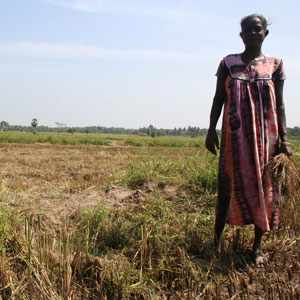
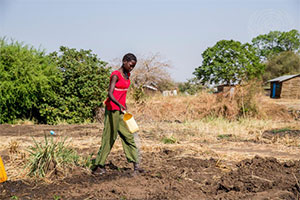 Farming on the Outskirts of Juba. Credit: UN Photo/JC McIlwaine
Promoting human and planetary health is a central focus of the United Nations, as laid out in the 2030 Sustainable Development Goals (SDGs). World hunger and unsustainable farming practices continue to be pressing concerns for the world. According to the 2025 State of Food Security and Nutrition in the World report by the Food and Agriculture Organization (FAO), 673 million people faced hunger in 2024. There are stark regional disparities, with the FAO projecting that 60% of the world population facing hunger will reside in Africa by 2030. Globally, the prevalence of food insecurity has remained consistently higher for women than men.
Sustainable and efficient national food systems are essential in preserving health, education, environmental well-being, peace, economy, and security. However, creating sustainable food systems can be a challenging endeavor, as food production takes a heavy toll on the environment. The agricultural sector accounts for a significant portion of greenhouse gases. Finding safe, sustainable, and ethical strategies to feed the world is crucial in ensuring planetary longevity. A recent initiative from 2023, the EU Regulation on Deforestation-free Products (EUDR), seeks to advocate for sustainable food systems. The main driver of deforestation is the expansion of agricultural land used to produce commodities like cattle, wood, cocoa, coffee, etc. The EUDR is part of the 2020 European Green New Deal and the EU Biodiversity Strategy for 2030 and aims to limit Europe’s consumption of products linked with deforestation by requiring that companies prove that their products are deforestation-free. Despite aiming to achieve major strides in sustainability, policies such as EUDR also raise socioeconomic concerns for targeted countries. Many emerging Latin American economies are impacted by the policy, and have raised the question of how developing countries can grapple with the tensions between economic development and advancing sustainability.
IPS has been at the forefront of providing compelling and insightful stories on communities facing hunger as well as the cost of food production. IPS uses statistics from FAO, the World Food Programme (WFP) and the International Fund for Agricultural Development (IFAD) to bring relevant and hard-hitting facts to readers. This gathering of information and data from such organizations helps bring the best stories from IPS journalists working in the different regions in consultation with experts on the ground.

The Week with IPS

NEXT STOP - SDGs
Tracking global progress towards a sustainable world
Tracking global progress towards a sustainable world