Languages
Friday, November 20, 2026



News and Views from the Global South
Green Economy

Jordan’s Farmers Struggle to Weather Climate Change
Abu Waleed isn't quite sure where to begin his litany of grievances. Bugs that chomp their way through the mint he grows, or the dry well that forces him to pump water from a half kilometre away? Or perhaps the 160 dinars he spent on spinach seeds only to see scant growth after planting.
Women Find a Green Midas Touch
On a hot and humid day in northwestern Bangladesh, Anisa Begum sits with a group of 25 homemakers, explaining how to use natural fertilisers to increase grain yield.
Nuclear Called a Lesser Evil than Fossil Fuels
Four prominent climate and energy scientists are calling on environmentalists to rethink their longstanding opposition to nuclear energy, warning that there is no “credible path to climate stabilization that does not include a substantial role for nuclear power”.
New Policies Beyond Austerity and Stimulus
It is time to move the global policy debate beyond the binary options of “austerity” versus “stimulus.” Both these macroeconomic policies have caused untold harm to millions and produced dangerous policy stalemates in Europe and the U.S., Japan and other countries.
Building a Better World, One Block at a Time
One evening in the small village of Ashton Hayes in Cheshire, England, someone started a conversation about climate change and energy at the local pub. It was 2005. Two years later, residents had cut their carbon dioxide emissions and energy costs by 20 percent.
How to Tell the Biggest Stories of Our Times
What does gorilla conservation have in common with the provision of contraceptives to women? How does rural-urban migration contribute to global warming? What does city planning in Kenya have to do with coastal erosion in the Philippines?
Mayors Leading an Urban Revolution
With presidents and prime ministers failing to take meaningful action to avert a planetary-scale climate crisis, the mayors of cities and towns are increasingly stepping up to enact changes at the local level.
CO2 Reshaping the Planet, Meta-Analysis Confirms
Greenland will eventually truly become green as most of its massive ice sheet is destined to melt, the authoritative U.N. Intergovernmental Panel on Climate Change (IPCC) reported Friday.
U.S. Projects 17-Percent Emissions Cut by 2020
The United States has formally told the United Nations that it is on track to reduce its greenhouse gas emissions by 17-percent by the end of the decade, assuming that currently proposed regulations are implemented.
Rising Temperatures Hurt Pollination – and Food Production
A rise in temperature modifies the physiological features of some plants – a consequence of climate change that is less perceptible than stronger and more frequent hurricanes, but just as harmful to food production.
Sunshine Gets Slowly More Energetic in Zimbabwe
On top of a small wooden cabin in Norton, a dormitory town outside the capital of Zimbabwe, is a solar panel that Silvester Ngunzi uses to light up his household.
TransBrasil Could Boost Integration in Rio de Janeiro
The TransBrasil bus rapid transit system, which will connect poor suburbs with the centre of Rio de Janeiro, will be the high-speed bus corridor that serves the largest number of commuters in the world.
OP-ED: Sustainable Development Goals After 2015
Reducing the proportion of undernourished people by half until 2015 was one of the Millennium Development Goals that the international community set in 2000. It will not be reached: At least 870 million people worldwide – and one child in five – still go hungry; this in a world where we already produce enough food today to feed nine billion people in 2050.
Tallying the Benefits of Climate Action
More than a half-dozen governments on Tuesday launched a yearlong collaborative investigation into the economic benefits of taking broad action to combat global climate action.
Pressure Mounts to Cap Airline Emissions
A contentious global agreement on how to limit greenhouse gas emissions from the global airline industry will be at the top of the agenda over the next two weeks at an international summit, potentially solidifying details that have yet to emerge after more than a decade and a half of talks.
Forest Communities Draw a REDD Line
As the ink dries on a 3.6 million dollar agreement between Uganda and the World Bank to support the country's preparations for REDD, some analysts are pessimistic over the mechanism's potential.
U.S. Debates Climate Impact of Development Investments
A debate is heating up here over the extent to which U.S. government-facilitated private-sector development investments should be required to take into account how those ventures impact on climate change.
Q&A: “The Last Great Exploration Is to Survive on Earth”
Newly arrived from London, Robert Swan is facing a promise he made to famed marine researcher and conservationist Jacques Cousteau decades ago.
Pashmina Withers on the Roof of the World
The famed pashmina shawl that keeps the cold away – in style and at a price – could itself have become the victim of winter. Thousands of goats whose fine wool is weaved into pashmina have perished in extreme cold being associated with climate change.
Q&A: Everyone Loses in War Over Amazon Dams
In the war over major hydropower dams in the Amazon jungle, everyone loses - even the winners who manage to overcome the opposition and build them, but who suffer delays, costs that are difficult to recoup, and damage to their image.
Exclusive Bus Lanes Speed Things Up in Buenos Aires
A new system of exclusive lanes for bus rapid transit appears to be benefiting public transport passengers and bus drivers in the most congested part of the centre of the Argentine capital.« Previous Page — Next Page »


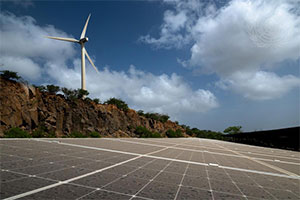 Renewable Energy in Cabo Verde. Credit: UN Photo/Mark Garten
A green economy is an economic model that aims to reduce environmental risks and build a sustainable future. Many of the UN SDGs seek to facilitate a green economy, such as ensuring access to affordable and reliable clean energy, building sustainable cities and communities, and implementing urgent action to combat climate change. Various key negotiations have strived to achieve a green economy, such as the Green New Deal and the Inflation Act of 2022. COP30, held in Belém, Brazil in 2025, agreed to mobilize $1.3 trillion annually for climate action and launched the Belém Mission to 1.5°C. However, the conference was not able to develop a fossil fuel reduction roadmap. Recent years have witnessed a sharp transformation in the geopolitical landscape of international sustainability cooperation. In March 2025, the United States stepped back from formal multilateral support for the SDGs, while China is on the rise as an international leader in renewable energy production. The actions of these global powers may shape shifting alliances on environmental governance. IPS is dedicated to sharing timely news on international developments in building a sustainable future.

The Week with IPS

NEXT STOP - SDGs
Tracking global progress towards a sustainable world
Tracking global progress towards a sustainable world
