Languages
Saturday, November 21, 2026



News and Views from the Global South
Green Economy

New Initiative Aims to Integrate Agriculture and Conservation
It took Brazil four decades to overcome food insecurity and earn a place as a major global food supplier. Now its experiences will contribute to the evidence base for a new initiative that seeks to reconcile agriculture and the conservation of biological diversity.Cheap Power Stymies Renewables in Kyrgyzstan
Almost five years ago, as his village in northern Kyrgyzstan endured daily power outages, rays of light always emitted from Sabyr Kurmanov’s garage. They came from his egg incubator, a 12-volt contraption powered by something he and his neighbours have in abundance – wind.
Five Caribbean States Join Pilot for Energy Efficiency
Every year, the Caribbean's electric sector burns through approximately 30 million barrels of fuel. Overall, the region imports in excess of 170 million barrels of petroleum products annually.
GM Seeks New Pastures in Pakistan
After a string of setbacks in India in recent years, the genetically modified seed industry is now targeting Pakistan as its next frontier, say activists.
Sustainable Technologies Safeguard the Soil in Cuba
The furrows are hard to make out in fields of the Finca de Semillas, a farm on Havana’s outskirts, because its administrators, Esmilda Sánchez and Raúl Aguilar, protect every centimetre of soil with mulch.
Ecological Cuban Recipes Boost Sustainable Agriculture
Vilda Figueroa and her husband, José Lama, live in Marianao on the outskirts of Havana, where they share hundreds of recipes based on Cuban-grown foods and sun-drying, along with other ecological food preservation methods.
Critics Push to Stall New Obama “Social Cost of Carbon” Calculations
The U.S. Department of Energy has announced it is accepting a petition from a conservative advocacy group critical of a recent substantial increase to official calculations of the so-called “social cost of carbon”.
India and China Oil Palms Dangerously
When there is feasting in India, Pakistan and Bangladesh, there could just be a connection between the celebrations and the fires on Indonesia’s Sumatra Island that trigger frequent transboundary smog.
Cameroonians See REDD
Uncertainty over property rights and access to forest land is potentially a major stumbling block for implementing the United Nations collaborative initiative on Reducing Emissions from Deforestation and forest Degradation in Cameroon.
Ancient Kings Fight Climate Change
Life for a widow with young children in Sri Lanka’s poor agrarian areas can be harsh. Families in remote areas like Anuradhapura in the North Central Province barely eke out a living through paddy cultivation or through vegetable and other crops planted in cleared jungle shrub - Chena cultivation as it is called.
Environmentalists Alarmed at Tourism Plans for Small Islands
The Venezuelan government’s plans to develop tourism infrastructure on virtually uninhabited highly biodiverse small islands in the southern Caribbean have triggered warnings from environmentalists.
New York Wants Your Potato Peels
Ask a random New Yorker what their city is famous for and “composting” is about as likely to make the list as “cheap housing” and “warm winters”. But if it is up to Mayor Michael Bloomberg, this will soon change.
Biochar Could “Turn Back Clock” on Climate
Even as policymakers around the world wrestle with how to cut future emissions of global greenhouse gases, some scientists and environmentalists are increasingly turning their attention to the carbon dioxide that is already in the atmosphere, trying to discern ways that this level can be efficiently and safely brought down.
Poland’s Shale Gas Bubble ‘Bursting’
Since Jun. 3, inhabitants of the village Zurawlow in Grabowiec district in southeastern Poland have been occupying a field in their locality where the U.S. company Chevron plans to drill for shale gas. The farmers’ resistance is just the latest blow to shale gas proponents in the country.
Civil Society Pushes for More Active Participation in Green Climate Fund
The Green Climate Fund (GCF), created under the auspices of the United Nations to finance the huge investments demanded by climate change, was opened up to participation by civil society and private sector representatives as observers in March.
Measuring CO2 in Green Ecosystems of the Mexican Caribbean
Jungles, forests, mangroves, swamps and lagoons are natural carbon storehouses or “sinks” in the Caribbean regions of Mexico. But now studies are being conducted to measure their capacity for absorbing carbon dioxide from the atmosphere.
Caribbean Bananas: Organic Production vs. Disease Control
FAO is currently supporting two seemingly contradictory projects in Caribbean countries: while one seeks to promote organic production, the other involves the use of chemical fungicides to fight black sigatoka, the worst enemy of this key food crop.
REDD a ‘False Solution’ for Africa
REDD – reducing emissions from deforestation and forest degradation – would seem to be a mitigation strategy that perfectly matches Africa's needs.
EU Bank ‘Funding Polluters’
The European Investment Bank, the largest institutional bank in the world, is facing criticism for its funding of fossil fuel projects and for weaker standards for lending to coal plants than currently proposed in both the U.S. and Canada.
Biofuels Get a Dubious Boost
In an unexpected move, European parliamentarians have approved a new biofuel regulation that will take emissions from indirect land use change into account. The new text allows the biofuel sector to expand, sending a clear signal to world food markets and jeopardising food security for the world's poorest.
Climate Change Takes Centre Stage in U.S.-China Talks
The United States and China have agreed on a suite of potentially far-reaching initiatives aimed at cutting greenhouse gas emissions in the world’s two largest economies and largest polluters.« Previous Page — Next Page »


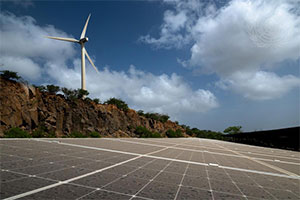 Renewable Energy in Cabo Verde. Credit: UN Photo/Mark Garten
A green economy is an economic model that aims to reduce environmental risks and build a sustainable future. Many of the UN SDGs seek to facilitate a green economy, such as ensuring access to affordable and reliable clean energy, building sustainable cities and communities, and implementing urgent action to combat climate change. Various key negotiations have strived to achieve a green economy, such as the Green New Deal and the Inflation Act of 2022. COP30, held in Belém, Brazil in 2025, agreed to mobilize $1.3 trillion annually for climate action and launched the Belém Mission to 1.5°C. However, the conference was not able to develop a fossil fuel reduction roadmap. Recent years have witnessed a sharp transformation in the geopolitical landscape of international sustainability cooperation. In March 2025, the United States stepped back from formal multilateral support for the SDGs, while China is on the rise as an international leader in renewable energy production. The actions of these global powers may shape shifting alliances on environmental governance. IPS is dedicated to sharing timely news on international developments in building a sustainable future.

The Week with IPS

NEXT STOP - SDGs
Tracking global progress towards a sustainable world
Tracking global progress towards a sustainable world
