Languages
Friday, August 28, 2026



News and Views from the Global South
Labour

Stagflation Threat: Be Pragmatic, Not Dogmatic
“If your only tool is a hammer, every problem looks like a nail”. Still haunted by the clever preaching of monetarist guru Milton Friedman’s ghost, all too many monetary authorities address every inflationary threat or sign they see by raising interest rates.
Informal Workers Face Up to the Crisis in Latin America
Doris Martínez was a cook in a Venezuelan restaurant that closed its doors; she emigrated to Colombia, got sick from working long hours standing in front of a stove, and returned to her country where, together with her husband and children, she runs a busy fast food kiosk on a road in Valles del Tuy, near the Venezuelan capital.
Over 60% of World Workers Not Recognised, Not Registered, Not Protected
More than 60 percent of the world’s adult labour force –or about 2 billion workers– work in the informal economy. “They are not recognised, registered, regulated or protected under labour legislation and social protection. The consequences can be severe, for individuals, families as well as economies.”
Lessons from Liberia for Scaling Poverty Reduction Globally
For the past three years, BRAC International has been piloting in Liberia an adaptation of its acclaimed Graduation approach, whose impact on reducing extreme poverty was first proven in Bangladesh. The success of the Liberia pilot, which I managed, provides not only further proof of impact but vital lessons that can enhance and accelerate scaling of the approach globally.
Inflation Targeting Constrains Development
All too many developing countries have been persuaded or required to prioritize inflation targeting (IT) in their monetary policy. By doing so, they have tied their own hands instead of adopting bolder economic policies for growth, jobs and sustainable development.
International Women’s Day, 2022
War, Want, Weather and Wellbeing: Where Are We Now?
WAR The world is currently facing a devastating war with dire prospects for our global security. Men are waging this war while women seek peace and security for their families, communities and our global society. Women are give birth and nurture while some men actively seek death and destruction. This is one of the fundamental differences between the sexes which underpins patriarchy and generates inequality on many levels. Women and girls bear the brunt of this unbalanced approach to life.

International Women’s Day, 2022
Women are the Answer to Sustainable Development
When countries improve their Global ranking, there is rejoicing within the community that progress has been made at last.. but has it and why does it matter ?

It’s Time to Step up for Street Vendors’ Rights
In the second week of January 2022, Purushottam—locally known as Prashant—a street vendor in central Delhi’s Connaught Place area, died by suicide. It was later discovered that the reason for his death was his inability to pay certain debts.
Young Argentine Women Forge a Future in Cooperative Factory
"We started making shampoos and soaps in the kitchen of a friend’s house in 2017. We were five or six girls without jobs, looking for a collective solution, and today we are here," says Letsy Villca, standing between the white walls of the spacious laboratory of Maleza Cosmética Natural, a cooperative that brings together 44 women in their early twenties in the Argentine capital.
Inflation Targeting Voodoo
All over the world, people expect policies by central bankers trained in economics to have a sound scientific base. But in fact, inflation targeting is an article of faith with neither theoretical nor empirical basis.
Migrant Workers’ Remittances Fund Development-Make It Easier for Them: Podcast
 I hope you had a chance to listen to our last episode, Environmental disasters creating more migrants within countries. We talked about the rising number of people who are forced out of their homes because of climate or environmental disasters. Nearly 30 million men, women and children in 149 countries were displaced in 2020, temporarily or for good and the signs are, that those numbers will only grow.
Pandemic Hit Domestic Workers Especially Hard in Brazil
"Woman, poor, black and illiterate" - most domestic workers suffer quadruple discrimination in Brazil, which made them more vulnerable to the COVID-19 pandemic, says one of their leaders, Gloria Rejane Santos.
Financialization at Heart of Economic Malaise
COVID-19 has exposed major long-term economic vulnerabilities. This malaise – including declining productivity growth – can be traced to the greater influence of finance in the real economy.
International Accreditation in Education Can Bring Huge Benefits to the Pacific- If It Is Done Right
All over the world, students who attend tertiary education do so with the belief that the investment of their time, money and effort will provide them with returns on that investment that will change their lives and the lives of their families for years to come. As qualified graduates, those students emerge from their tertiary programmes with recognised skills and knowledge making them employable in their chosen fields, moving them forward along a career pathway and in many cases, bringing recognition to the institutions that trained them as they experience success and achievements related to their expertise.
ONE OCEAN SUMMIT – An Opportunity For Blue Transformation
The ocean covers more than 70 percent of our planet. There is no question it is critical for our health and well-being. It provides half the earth’s oxygen supply and every organism in existence depends on it to survive.
Pro-rich Policies Buoy Billionaires’ Rise in India
If India ranks among the world’s fastest growing economies it is also where inequity is growing the fastest, thanks to endemic features unique to the country such as the caste system.
Resist Inflation Phobia Coup
Calls, even screams, to fight inflation above all else are getting shriller. Thankfully, even The Economist (5 Feb. 2022) reminds all, Fighting inflation could put the world in a slump. No inflation consensus International Monetary Fund (IMF) Managing Director Kristalina Georgieva doubts the world faces a runaway inflation threat. She urges policymakers to carefully calibrate fiscal and monetary policies, with more “specificity”, as not ‘one size fits all’.
Teleworking: All That Glitters Is Not Gold
Now it comes to teleworking, the double-edged, relatively recent phenomenon imposed by COVID-19 lockdowns. On the one hand, it improves work-life balance, opportunities for flexible working hours and physical activity, reduced traffic and commuting time, and a decrease in air pollution. So far so good, but…
Up to 70% of Children in Developing Countries to Be Left Unable to Read?
“Unless we take action, the share of children leaving school in developing countries who are unable to read could increase from 53 to 70 percent.”
Count Me in: Working Together for Disability Inclusion in Guatemala
“Persons with disabilities are capable and equal. It is time the world understands that,” says Antonio Palma, a UN Volunteer at the Resident Coordinator’s Office in Guatemala. Antonio, who has a visual impairment, expresses what many other persons with disabilities feel. Ignored, mistreated, misunderstood, underestimated, condescended to.
How Place of Birth Shapes Chances of Going to University
Many newly independent African countries in the 1960s inherited regional and ethnic inequalities in formal educational attainment. These new states bound together sub-national regions of diverse ethnic and religious communities. The regions differed in their exposure to missionary activity – the main vector in the spread of formal western education in the colonial era.« Previous Page — Next Page »


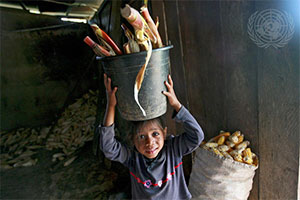 Timorese Girl with Fresh-Picked Corn. Credit: UN Photo/Martine Perret
A global common denominator is the need for a decent job. The economic realities of each country determine just how difficult it is to find one. Despite the labour movement's achievements, serious challenges persist: gender discrimination, child labour, worker migration, the digital divide and AI automation, evaporating pensions, unsafe workplaces, corporate pressure against union organising, negative impacts of trade agreements, and the precariousness of informal employment. The 2025 UN SDG Report identifies jobs and social protections as one of the six priority areas requiring urgent action, with progress either stalled or reversing in many developing nations.
In recent years, the fight to protect labour equality has taken on new dimensions with the rise of Environmental, Social and Governance standards. With the Social aspect aiming to promote equality and human rights, ESG principles have strengthened labour advocacy within corporate and governmental regulatory landscapes. In particular, ESG has become much more institutionalized in emerging economies such as Brazil and China. IPS follows the world’s workers as they confront these challenges - their setbacks and their successes.

The Week with IPS

NEXT STOP - SDGs
Tracking global progress towards a sustainable world
Tracking global progress towards a sustainable world
