Languages
Wednesday, November 11, 2026



News and Views from the Global South
Labour
U.S. Regulatory System “Stymied by Special Interests”
A broad-based alliance of public interest and other groups is warning that years of attacks by business interests has made the U.S. regulatory so inefficient that public safety is being put at risk.
Labour Violations Under Tight Wraps in Thailand
Next time you visit Walmart and throw that packet of frozen shrimp in your shopping cart, pause a moment.How to Close Latin America’s Rich-Poor Chasm
Latin American governments have increasingly been working to lessen inequality in the region, but new data suggests their efforts vary widely in quality and impact.
Q&A: Women Hardest Hit by Growing Austerity Measures
The widespread financial crisis in Europe, and its negative fallout in the developing world, has triggered severe austerity measures worldwide.
Kenya’s Flower Farms No Bed of Roses
Catherine Mumbi knows the difficulties of working in Kenya’s flower sector. She was fired as a casual worker at a flower farm after taking time off to recover from complications of the liver. But that was just the start of her problems.
First Prisoners’ Trade Union Defends Rights in Argentina
The first prisoners’ union in Argentina, a country with a strong organised labour tradition, fights for the rights of inmates.
Battle Against Hunger Lost Without Gender Empowerment
When the United Nations launched its Millennium Development Goals (MDGs) back in 2001, two of its primary objectives were to halve extreme poverty and hunger by 2015 and promote gender empowerment worldwide.
Palestinian Child Labourers Face Grim Future
Hazem Maher, 16, from Hebron in the southern West Bank, works a backbreaking 12-hour day in the fruit and vegetable market in the city of El Bireh, next to Ramallah. He earns just over 15 dollars a day as a porter.
Africa Leading the New Patterns of Growth
The old theories governing the way that countries produce and trade are being replaced. The pattern of trade is being transformed by increasingly sophisticated technology and innovations in transportation; and the topography of actors is shifting to reflect new poles of growth.Workers Strike in Support of Turkey Protests
Thousands of public sector workers in Turkey are on a two-day strike in support of anti-government demonstrations.
Japan Seeks to Remake Asia-Africa Relationship
Acutely aware of China’s strong presence in resource-rich Africa, Japan, the world’s third largest economy, is beefing up its relations with the continent. Participants at a high-level donor conference hosted by Japan this week stressed the need for closer engagement, not through the traditional grants and assistance loans that have hitherto defined the relationship, but rather through trade and investment led by the Japanese private sector.
Walmart, Gap Seek Separate Safety Standards for Bangladesh Factories
Top U.S. companies are now in negotiations to agree on new safety standards for their clothing-producing contractors in Bangladesh, a month after a garment factory’s collapse in Dhaka killed more than 1,100 workers.
Despite Push by Obama, Minimum Wage Hike Stagnating
During his State of the Union address earlier this year, U.S. President Barack Obama spoke about the need to increase the federal minimum wage, which Congress has not voted to raise since 2007.
Child Malnutrition Costs Global Economy Billions Yearly – Report
In addition to the serious health problems it causes, child malnutrition is costing the global economy tens of billions of dollars a year by depriving its victims of the ability to learn basic skills, according to a new report released Tuesday by Save the Children (STC).
Key Land Reform Accord in Colombia’s Peace Talks
Colombian government and guerrilla delegates have announced an agreement on the question of land reform – an important step in the peace talks that began six months ago in Havana.
Poverty Down in Argentina – But By How Much?
In the 10 years since late president Néstor Kirchner, who was succeeded by his wife Cristina Fernández de Kirchner in 2007, first took office in Argentina, poverty has fallen, employment has climbed and educational coverage has expanded, although there is no agreement on the exact statistics.
Pakistani Doctors Earn “Only Gratitude” for Treating Fistula
Sherhshah Syed is a highly qualified doctor and president of the prestigious Pakistan National Forum on Women’s Health (PNFWH) but his income does not match his qualifications.
Australian Retailers Feel Heat of Bangladesh Tragedy
Australia’s largest textile workers’ union and activist groups are up in arms that the country’s leading retail chains, who source most of their fashion labels from Bangladesh, are refusing to sign a legally binding accord that will help to improve labour and safety standards in Bangladeshi garment factories.
Q&A: “From Slaves to Generals and Rulers”
Say "Africa" and myriad images flood our minds. Like its landscape and peoples, the continent's history is rich and diverse. While numerous books have been written and films made on the African slave trade in the West, a lesser-known aspect of the continent’s history lies in India.
Life Terms Urged in Bangladesh Building Collapse
Those responsible for the Bangladesh building collapse that killed more than 1,000 garment workers should be given life in prison, a government-appointed committee has said.
Groaning Under Power Cuts, Scorching Temps in Pakistan
Raheel Tauseef is feeling quite powerless this summer. Frequent power outages in the industrial city of Faisalabad in the Punjab province of eastern Pakistan, where the 29-year-old and his family run three hosiery factories, are taking a heavy toll on their business.« Previous Page — Next Page »





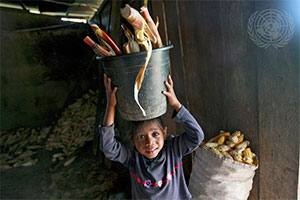 Timorese Girl with Fresh-Picked Corn. Credit: UN Photo/Martine Perret
A global common denominator is the need for a decent job. The economic realities of each country determine just how difficult it is to find one. Despite the labour movement's achievements, serious challenges persist: gender discrimination, child labour, worker migration, the digital divide and AI automation, evaporating pensions, unsafe workplaces, corporate pressure against union organising, negative impacts of trade agreements, and the precariousness of informal employment. The 2025 UN SDG Report identifies jobs and social protections as one of the six priority areas requiring urgent action, with progress either stalled or reversing in many developing nations.
In recent years, the fight to protect labour equality has taken on new dimensions with the rise of Environmental, Social and Governance standards. With the Social aspect aiming to promote equality and human rights, ESG principles have strengthened labour advocacy within corporate and governmental regulatory landscapes. In particular, ESG has become much more institutionalized in emerging economies such as Brazil and China. IPS follows the world’s workers as they confront these challenges - their setbacks and their successes.

The Week with IPS

NEXT STOP - SDGs
Tracking global progress towards a sustainable world
Tracking global progress towards a sustainable world
