Languages
Friday, November 13, 2026



News and Views from the Global South
Natural Resources

U.N.’s Energy Funding Falls Short of Target by Billions
When the United Nations inaugurated the first-ever global forum on renewable energy last week, it provided a laundry list of financial pledges aimed at achieving one of the world body's most ambitious goals: sustainable energy for all (SE4ALL) by 2030.Donors to Assist Developing Countries Negotiate Extractives Contracts
Major donor countries will unveil next week a new initiative aimed at strengthening the ability of developing countries’ governments to negotiate complex contracts, particularly around the extractives sector.
Latin America’s Forests Need Laws – and Much More
Latin America’s parliaments have failed to protect the forests and to guarantee their sustainable use, despite the fact that a number of countries have laws on forests, legislators from the region said at a global summit in the Mexican capital.
When Nature Gets a Price Tag
How much does a forest cost? What’s the true economic value of an ocean? Can you pay for an alpine forest or a glacial meadow? And – more importantly – will such calculus save the planet, or subordinate a rapidly collapsing natural world to market forces?
Venezuelans Thirsty in a Land of Abundant Water
Although Venezuela has 520 long rivers, taps often run dry, many poor neighbourhoods depend on tanker trucks, water rationing remains a reality, and in some areas water quality is very poor.
U.S. Corporate Conflict Minerals Reports “Historic” But Incomplete
For the first time, nearly 1,300 U.S. companies have filed reports on whether the products they manufacture or sell are made with minerals that have bankrolled conflict in the Great Lakes region of central Africa.
World Applauds Ambitious U.S. Carbon Cuts
New efforts by the U.S. to reduce its carbon emissions are being welcomed around the world. On Monday the U.S. Environmental Protection Agency (EPA) announced a plan to cut carbon emissions from power plants 25 percent from 2005 levels by 2020.
Flexible Biofuel Policies for Better Food Security
Modern biofuels have become a fact of life, part of a quest for more cost-effective and environmentally sustainable businesses and lifestyles. But to be truly sustainable, biofuel production must strike a balance between its benefits and its potential hidden costs, between energy security and food security.
China Casts A Long Shadow Over Latin America
In the past 15 years, China has gone from being a relatively insignificant economic partner in Latin America to the number-one trading partner of some of the largest economies in the region.
Let There Be Light, Implores U.N. Chief
When night falls, there are over 1.3 billion people, mostly in the developing world, who live in virtual darkness because they have no access to electricity.
Climate Legislation Up Against ‘Abenomics’ in Japan
Undaunted by Japan’s national consensus to boost the economy, which has been mired in lackluster growth for decades, environmentalists are taking baby steps towards incorporating climate change into national legislation.
Pakistan’s Coal Rush: A Bubble Waiting to Burst
Mukhtar Ali is one of the many Pakistanis who are furious at politicians and authorities for failing to provide citizens with a regular supply of electricity during the smouldering summer months.
Sri Lanka Waits in Vain for the Rain
Stuck in mid-day rush hour traffic, commuters packed tight into a tin-roofed bus in Sri Lanka’s capital, Colombo, peer expectantly up at the sky that is beating a savage heat down on the city.
Rural Communities Push El Salvador Towards Ban on Mining
Mining is not viable in this country, say Salvador Sánchez Cerén - who will be sworn in as the new president of El Salvador on Jun. 1 - and his team of environmental advisers.


Wary of Climate Change, Indonesia Looks to Lawmakers for Solutions
Comprised of over 17,000 islands that are highly susceptible to rising seas, Indonesia is taking stock of its position as the world’s third leading emitter of greenhouse gases after the United States and China.
Is Ankara Getting Deeper Into The Iraqi Quicksand?
The decision late Thursday by the Kurdistan Regional Government (KRG) to proceed with its first shipment of crude oil to Europe out of the port of Ceyhan in southern Turkey has received mixed reactions from all the parties concerned.
Peaceful Transitions From The Nuclear To The Solar Age
Japanese Buddhist and president of Soka Gakkai International (SGI) Daisaku Ikeda’s Peace Proposal 2014 elevated my focus from the daily news to my longer term concerns for more peaceful, equitable and sustainable human societies to assure our common future. These broader concerns are now shared by millions of humans who have transcended purely personal, local and nationalistic goals and become prototypical global citizens.
Hemp Defies Hurdles to Make a Comeback in Spain
Spain is experiencing a resurgence of hemp, one of the species of cannabis with the lowest THC content, which has been used for millennia to produce textile, medicinal and food products.
U.N. Decries Water as Weapon of War in Military Conflicts
The United Nations, which is trying to help resolve the widespread shortage of water in the developing world, is faced with a growing new problem: the use of water as a weapon of war in ongoing conflicts.
Conflict with Local Communities Hits Mining and Oil Companies Where It Hurts
Conflicts with local communities over mining, oil and gas development are costing companies billions of dollars a year. One corporation alone reported a six billion dollar cost over a two-year period according to the first-ever peer-reviewed study on the cost of conflicts in the extractive sector.« Previous Page — Next Page »


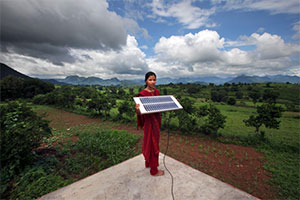 Bringing clean energy to rural India. Credit: Abbie Trayler-Smith / Panos Pictures / Department for International Development
Large reserves of oil, gas and minerals in developing countries generate opulent revenues. They could be used to stimulate economic growth and reduce poverty, but often result in environmental destruction and conflict, benefiting large companies and corrupt governments. Furthermore, competition over natural resources often manifests through geopolitical conflict. For example, before the US-Iraq war, Iraq’s domestic oil industry was nationalized. With US aggression came weakened Iraqi institutions and foreign intervention, thus eventually leading to the privatization of Iraqi oil, leaving the industry now largely dominated by Western companies. As another example, China’s rising investments within the lithium sector in South America are increasing the US-China rivalry across the Western Hemisphere. Notably, Bolivia has the largest reserves of lithium in the world, and the nation’s state-owned lithium extraction firm recently signed a contract with China’s CBC Consortium, while rejecting the entry of Western firms into the nation. In Bolivia’s case, rising Chinese investment in the nation’s lithium sector also raises concerns about environmental sustainability and the sociopolitical rights of Indigenous communities. More broadly, Sub-Saharan Africa holds nearly 30% of global reserves of critical minerals required for low-carbon technologies. Despite this, the region attracts less than 10% of global exploration investment, depicting a critical barrier to both the clean energy transitions and Sub-Saharan Africa’s economic development. Furthermore, resource wealth continues to fuel conflict like Sudan’s civil war, which has led to 9.1 million internally displaced people and is intensely connected to competition over gold, water, and agricultural land. IPS covers news about major oil, gas, and mining projects, their effects on the environment and local communities, and the ideas and actions of the interest groups involved.

The Week with IPS

NEXT STOP - SDGs
Tracking global progress towards a sustainable world
Tracking global progress towards a sustainable world
