Languages
Friday, November 13, 2026



News and Views from the Global South
Natural Resources

El Niño Triggers Drought, Food Crisis in Nicaragua
The spectre of famine is haunting Nicaragua. The second poorest country in Latin America, and one of the 10 most vulnerable to climate change in the world, is facing a meteorological phenomenon that threatens its food security.
Shea Harvesting Good for Income, Bad for the Environment in Ghana
The shea tree, a traditional African food plant, represents a major source of income for women in Ghana's Northern, Upper West and Upper East regions, but they are helping to destroy the very resource that gives them money by cutting it down to produce charcoal.
New Data Sends Wake-Up Call on Caribbean Reefs
Marine environmentalist Eli Fuller, who for the past two decades has been exploring the coastline of Antigua and Barbuda, warns that while there has been “dramatic changes” to coral reefs since he was a little boy, “it’s getting worse and worse.”
Greek Privatisation of Key Sectors Meets Strong Opposition
Plans by the Greek government to sell companies that handle the key resources of energy and water face serious obstacles and its policy to offer investors exceptional privileges in an effort to boost interest in privatisation is coming under strong pressure.
At the Crucial Nexus of Water and Energy
Global institutions are still in the learning phase when it comes to successfully managing water and energy in an integrated manner as part of the quest for sustainable development.
Problems Inspire Ingenious Solutions in Peruvian Amazon Town
He may look like a rapper, but 33-year-old José Antonio Bardález is the mayor of Jepelacio, in the Peruvian Amazon. His ingenious innovations in the municipality include transforming waste management into a source of income and making spring water a source of drinking water.
Indonesia’s Presidential Hopefuls Face Up to Deforestation
As the world’s third-largest democracy heads to the polls next week to elect a new president, environmental activists remain sceptical of the candidates’ commitment to tackle climate change.
No Limits to Shale Gas Chemicals in Mexico
The new legal framework for Mexico’s oil industry has not placed controls on the use of harmful chemicals in the extraction of unconventional fossil fuels, and environmentalists and experts fear their consumption will increase in an industry that is opening up to private capital.
After Losing Vote, U.S.-EU Threaten to Undermine Treaty
The United States and the 28-member European Union (EU) have assiduously promoted - and vigourously preached - one of the basic tenets of Western multi-party democracy: majority rules.
Adapting to a Dry Season That Never Seems to End
The Caribbean region’s bid to become food secure is in peril as farmers struggle to produce staple crops under harsh drought conditions brought about by climate change.
Zimbabwe’s Unfolding Humanitarian Disaster – We Visit the 18,000 People Forcibly Relocated to Ruling Party Farm
As the villagers sit around the flickering fire on a pitch-black night lit only by the blurry moon, they speak, recounting how it all began. They take turns, sometimes talking over each other to have their own experiences heard. When the old man speaks, everyone listens. “It was my first time riding a helicopter,” John Moyo* remembers.
EU Aims to Scuttle Treaty on Human Rights Abuses
When the United Nations began negotiating a Code of Conduct for Transnational Corporations (TNCs) back in the 1970s, the proposal never got off the ground because of vigourous opposition both from the powerful business community and its Western allies.
Siberian Global Warming Meets Lukewarm Reaction in Russia
People in Siberia must prepare to face frequent repeats of recent devastating floods as well as other natural disasters, scientists and ecologists are warning, amid growing evidence of the effects of global warming on one of the world’s most ecologically diverse regions.
U.S. Turns Attention to Ocean Conservation, Food Security
A first-time U.S.-hosted summit on protecting the oceans has resulted in pledges worth some 800 million dollars to be used for conservation efforts.
Picture the World as a Desert
Try to imagine an expanse of barren land, stretching for miles, with no trace of greenery, not a single bough to cast a sliver of shade, or a trickle of water to moisten the parched earth. Now imagine that desert expanding by 12 million hectares a year. Why? Because it’s already happening.
South Sudan’s Wildlife Become Casualties Of War and Are Killed to Feed Soldiers and Rebels
While South Sudan’s President Salva Kiir and his former deputy Riek Machar agreed last week to end the country’s devastating six-month conflict by forming a transitional government within the next two months, it may come too late for this country’s wildlife as conservation officials accuse fighters on both sides of engaging in killing wild animals to feed their forces.
Natural Gas – Both Crisis and Solution in Chile
In April 2004, Argentina began to steadily cut natural gas exports to neighbouring Chile, triggering a major energy crisis and revealing structural problems in this vital sector.
Germany’s New Energy Revolution Still Moving Ahead
Germany has now become the world’s first modern renewable energy economy, according to the experts. The Federal Republic of Germany already obtains 29 percent of its electricity from renewable sources, meaning photovoltaic, hydro and wind power, and power produced by burning wood or other biomass.
Obama’s Free Trade Strategy Falters in Asia
Amid simmering territorial conflicts across the Western Pacific, specifically between China and its neighbours in the South and East China Seas, coupled with China rising to the rank of top trading partner with Japan, South Korea, Australia and the Association of Southeast Asian Nations (ASEAN), the Obama administration has been hard-pressed to re-assert its strategic footprint in the region.
Renewable Energy for “Cold” Areas
Although most of Iceland already uses renewable energy for its heating and electricity, a handful of places are still reliant on oil. But, at least on Grimsey island in the north, this could change in the future.
Chile’s Patagonia Celebrates Decision Against Wilderness Dams
The Chilean government rejected Tuesday the controversial HidroAysén project for the construction of five hydroelectric dams on rivers in the south of the country. The decision came after years of struggle by environmental groups and local communities, who warned the world of the destruction the dams would wreak on the Patagonian wilderness.« Previous Page — Next Page »


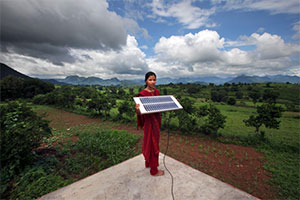 Bringing clean energy to rural India. Credit: Abbie Trayler-Smith / Panos Pictures / Department for International Development
Large reserves of oil, gas and minerals in developing countries generate opulent revenues. They could be used to stimulate economic growth and reduce poverty, but often result in environmental destruction and conflict, benefiting large companies and corrupt governments. Furthermore, competition over natural resources often manifests through geopolitical conflict. For example, before the US-Iraq war, Iraq’s domestic oil industry was nationalized. With US aggression came weakened Iraqi institutions and foreign intervention, thus eventually leading to the privatization of Iraqi oil, leaving the industry now largely dominated by Western companies. As another example, China’s rising investments within the lithium sector in South America are increasing the US-China rivalry across the Western Hemisphere. Notably, Bolivia has the largest reserves of lithium in the world, and the nation’s state-owned lithium extraction firm recently signed a contract with China’s CBC Consortium, while rejecting the entry of Western firms into the nation. In Bolivia’s case, rising Chinese investment in the nation’s lithium sector also raises concerns about environmental sustainability and the sociopolitical rights of Indigenous communities. More broadly, Sub-Saharan Africa holds nearly 30% of global reserves of critical minerals required for low-carbon technologies. Despite this, the region attracts less than 10% of global exploration investment, depicting a critical barrier to both the clean energy transitions and Sub-Saharan Africa’s economic development. Furthermore, resource wealth continues to fuel conflict like Sudan’s civil war, which has led to 9.1 million internally displaced people and is intensely connected to competition over gold, water, and agricultural land. IPS covers news about major oil, gas, and mining projects, their effects on the environment and local communities, and the ideas and actions of the interest groups involved.

The Week with IPS

NEXT STOP - SDGs
Tracking global progress towards a sustainable world
Tracking global progress towards a sustainable world
