Languages
Thursday, October 1, 2026



News and Views from the Global South
Trade & Investment

OPINION: Testing Time for Tourism
It is testing time for global tourism. The ongoing political conflicts across North Africa, compounded by military action in the Middle East, Ukraine and Afghanistan, and the spread of the Ebola virus disease in West Africa have put to the test the ability of international tourism to continue to grow amidst crises.Global Summit Urged to Focus on Trillion-Dollar Corruption
New analysis suggests that developing countries are losing a trillion dollars or more each year to tax evasion and corruption facilitated by lax laws in Western countries, raising pressure on global leaders to agree to broad new reforms at an international summit later this year.
Indigenous Peoples Seek Presence in Post-2015 Development Agenda
The world's 370 million indigenous people, who say they were marginalised in the Millennium Development Goals (MDGs), want to play a key role in the U.N.'s post-2015 development agenda, which will be finalised next year.
OPINION: Sanctions and Retaliations: Simply Unconscionable
The crisis in Ukraine is a man-made disaster created by world leaders who have been trying to pull Ukraine apart - either towards Europe or Russia.
With Sewing and Sowing, Self-reliance Blooms in Central Asia
In the small rural village of Svetlaya Polyana, not far from the city of Karakol in Issyk Kul Province, north-eastern Kyrgyzstan, there is no sewage system and 70 percent of households lack access to hot water.
OPINION: Africans’ Land Rights at Risk as New Agricultural Trend Sweeps Continent
Agriculture in Africa is in urgent need of investment. Nearly 550 million people there are dependent on agriculture for their livelihoods, while half of the total population on the continent live in rural areas.
Africa-U.S. Summit – Catching Up With China?
A few years ago, nobody could have imagined that some 50 Heads of States and Prime Ministers from Africa would meet the President of the United States for a summit. Yet, the first Africa/United States Summit took place in Washington from August 4 to 6, making headlines around the world.
Large Dams “Highly Correlated” with Poor Water Quality
Large-scale dams are likely having a detrimental impact on water quality and biodiversity around the world, according to a new study that tracks and correlates data from thousands of projects.
Mexico’s Wind Parks May Violate OECD Rules
Four wind farm projects in the southern Mexican state of Oaxaca, operated or financed by European investors, could violate Organisation for Economic Cooperation and Development (OECD) rules, say activists.
India: A Race to the Bottom with Antibiotic Overuse
In 2011, the World Health Organisation (WHO) warned: "Combat Drug Resistance - No Action Today, No Cure Tomorrow.” The slogan was coined in honour of World Health Day, urging governments to ensure responsible use of antibiotics in order to prevent drug-resistant viruses and bacteria, or ‘super bugs’.
OPINION: Building a Sustainable Future – The Compact Between Business and Society
Can we envision a day when a critical mass of companies is investing in a better world? Where business is delivering value for the long-term – not just financially, but also socially, environmentally and ethically? Over a decade ago, it was hard to imagine, but we can now say with confidence that a global movement is underway.
When Land Restoration Works Hand in Hand with Poverty Eradication
Tugging at the root of a thorny shrub known as ‘juliflora’, which now dots the village of Chirmiyala in the Medak District of southern India’s Telangana state, a 28-year-old farmer named Ailamma Arutta tells IPS, “This is a curse that destroyed my land.”
Innovation Offers Hope in Sri Lanka’s Poverty-Stricken North
In this dust bowl of a village deep inside Sri Lanka’s former conflict zone, locals will sometimes ask visitors to rub their palms on the ground and watch their skin immediately take on a dark bronze hue, proof of the fertility of the soil.
Cuba Sees Its Future in Mariel Port, Hand in Hand with Brazil
The Mariel special economic development zone, the biggest construction project undertaken in decades in Cuba, emerged thanks to financial support from Brazil, which was based on political goodwill, a strategy of integration, and business vision.
In Saving a Forest, Kenyans Find a Better Quality of Life
When Mercy Ngaruiya first settled in Kasigau in south eastern Kenya a decade ago, she found a depleted forest that was the result of years of tree felling and bush clearing.
Mining Firms in Peru Mount Legal Offensive Against Inspection Tax
The leading mining companies in Peru have brought a rash of lawsuits to fight an increase in the tax they pay to cover the costs of inspections and oversight of their potentially environmentally damaging activities.
What’s More Important, the War on AIDS or Just War?
They say there is a war on and its target is the deadly human immunodeficiency virus (HIV).
What Do the World Bank and IMF Have to Do With the Ukraine Conflict?
Mostly unreported as the Ukraine conflict captures headlines, international financing has played a significant role in the current conflict in Ukraine.
Zimbabwe’s ‘Casualisation of Labour’ Leads to a New Form of Exploitation
Ethel Maziriri, 27, holds an Honours Degree in Social Work from the University of Zimbabwe, but instead of working in her chosen profession, she works as a cashier in one of the country’s leading clothing retail company. And it’s not by choice.
Zimbabwean Women Breathe New Life into Private Transport Sector
Mavis Gotora from Mabvuku high-density suburb, in Zimbabwe’s capital, Harare, walks up and down, as she persuades one passer-by after another to board the private taxi cab she drives.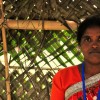
Women Warriors Take Environmental Protection into Their Own Hands
Aleta Baun, an Indonesian environmental activist known in her community as Mama Aleta, has a penchant for wearing a colourful scarf on her head, but not for cosmetic reasons.« Previous Page — Next Page »


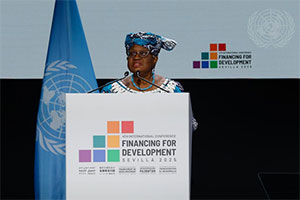 Opening of 4th International Conference on Financing for Development. Credit: UN Photo/Mariscal
International trade and investment are crucial elements of the world economy. While they can be powerful stimulators of development, they can also lead to global imbalances and dynamics of exploitation. In 2025, international trade entered a period of immense disruption, driven in part by a new wave of United States tariffs that reshaped global supply chains and investment flows. The increase in the US tariff rate, the highest since the 1930s, has forced bilateral renegotiations with global trading partners. Furthermore, the debt crisis in developing nations has accelerated while Official Development Assistance (ODA) has substantially dropped 7.3% in 2024.
In the 21st century, advancements in economic diversification in formerly colonized nations have propelled them into more central roles in the global economy. For example, both China and Mexico were able to develop their manufacturing sector and channel this development into booming export flows, thus advancing into the position of emerging economies. Foreign investment also plays an essential role in providing capital for developing countries, although they are oftentimes accompanied by social and environmental exploitation. For example, rising Chinese investments in natural resources in Latin America have often been met with tension as these investment projects fail to properly mitigate environmental risks and protect workers’ rights. In a more multifaceted vein, Sino-African relations have led to infrastructure development in Sub-Saharan Africa while also heightening the region’s economic dependency on China. IPS reports on global news in trade and investment, while shining a light on the nuanced nature of these endeavors.

The Week with IPS

NEXT STOP - SDGs
Tracking global progress towards a sustainable world
Tracking global progress towards a sustainable world
