
Tuesday, October 6, 2026



News and Views from the Global South
Farming Crisis: Filling An Empty Plate

Wanted: Climate-Smart Agriculture
As the links between food security and climate change become increasingly inextricable, the necessity for sustainable agriculture is now a universal concern.Trust Deficit – Worst Fallout of Fukushima
Kazuya Tarukawa, 36, left a secure job in the Japanese capital to tend to his family’s organic farm located 100 km away from the crippled Fukushima Daiichi nuclear reactor.
Bangladesh Braves Climate Change With Community Radio
"Welcome to Krishi (farming) Radio. You are listening to FM 98.8 megahertz and I am your hostess Shahnaz Parvin," the local community radio crackles over the mobile phones and transistors of residents in coastal Barguna district.UGANDA: Rural Women’s Banks Ease Tough Times
For most Ugandan women, obtaining a commercial loan to start a business has been very difficult. Many do not have the required collateral of land title deeds and many cannot afford the interest rates charged by commercial banks.AFRICA: Miracle Tree is Like a Supermarket
When a food crisis hits the continent, African countries tend to look to the international donor community to mobilise aid. But a fast-growing, drought- resistant tree with extremely nutritious leaves could help poor, arid nations to fight food insecurity and malnutrition on their own.Progress Towards a Food-Secure Africa
A growing number of African countries are making significant progress towards eradicating extreme hunger and poverty. Ghana, Liberia, Malawi, Rwanda, Sierra Leone and South Africa are some of the countries that have made tremendous achievements towards achieving these goals.
Moving Towards a Food-Secure Ghana
In Dundo village in Nyankpala district, Northern Ghana, 10 women are busy weeding a rice field on a piece of land donated to them by the village chief.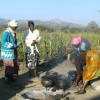
CLIMATE CHANGE: Waiting for the “Heavens to Weep”
Duduzile Sibanda takes a break from preparing her long stretch of land for her maize crop in rural Mberengwa, in Zimbabwe’s Midlands province. She wipes her brow under the scorching sun and looks upwards. The sparse clouds are a cause of concern as she studies the sky and wonders aloud when the "heavens will weep."
A Recipe for Carbon Farming
Civil society has warned of the danger of turning Africa's food-producing lands into "carbon farms" so that rich countries can avoid making cuts in their carbon emissions.
No Agriculture, No Deal
Zambian dairy farmer, Effatah Jele, does not believe in farming luck but in pragmatism because of climate change.
CLIMATE CHANGE: Kashmiri Farmers Left High and Dry
Sammad Sheikh of Tangchekh village in north Kashmir cannot understand why the rice fields that his family cultivated for generations are drying up.
CLIMATE CHANGE-AFRICA: Farming By Phone
Francis Mburu used to keep indigenous cattle in Entasopia village in the semi- arid Kajiado region, 160 kilometres southwest of Nairobi. However, increasing temperatures and frequent droughts in Kenya have made this difficult in recent years.
Q&A: ‘New Donors Can Help Farming Sector’
Rising food prices, natural disasters and an energy crisis that is turning wheat into ethanol instead of bread have raised the spectre of inadequate global food supply that hits the poor. This grim reality has finally turned the spotlight on agricultural aid and its link to development effectiveness.
CLIMATE CHANGE: Making a Hot Cup of Rooibos Tea Unaffordable
South Africa’s Rooibos tea has become a popular drink all around the globe. But prices of the herbal brew could shoot up within the next decade, as the Rooibos plant can only grow in one small region in the world – which is severely affected by climate change.
Aid Not Effectively Reaching Africa’s Poor
Kenyan tea and coffee farmers remain disgruntled about the minimal profits they make selling their cash crops, the country’s leading foreign currency earners, as the government receives millions in funding for training and subsidies that most of these farmers are yet to see materialise.
SOUTH AFRICA: Acid Mine Drainage Water Can Be Put to Use
Toxic water from derelict gold and uranium mines has reportedly destroyed Elize Strydom's dream to be a farmer in her retirement.
AFRICA: Change the Donors Climate
When donor-funded horticultural projects failed in Kalacha village at the edge of the Chalbi Desert in North Eastern Province, Kenya, the local pastoralist community proposed their own idea, which turned out to be the solution to their problems.
Africa’s farmers still face serious challenges
 Stakeholders in agriculture from Western and Central Africa are meeting in Gabon for the 6th International Fund for Agricultural Development (IFAD) regional forum. As Zukiswa Zimela reports, they are talking about the challenges facing smallholder farmers.

Q&A: “Grabbing of Drylands is a Serious Concern”
Designated Drylands Ambassador, United Nations Convention for Combating Desertification (UNCCD), at its 10th Conference of the Parties (COP10) in South Korea in October, Dennis Garrity is mandated to raise awareness of land degradation.
G20 Remiss in Tackling Food Security
Last Friday Benoit Miribel, President of Action Against Hunger, delivered a strong indictment of the outcome of the Group of 20 (G20) summit in the south of France: "The G20 meeting in Cannes has been a missed opportunity."
INDIA: Kashmir’s Fence Eats Crops
Touseef Bhat’s seven-acre farm in this scenic alpine valley of Bandipora district has an incongruous feature – an electrified barbed wire fence running through it.« Previous Page — Next Page »





Today, one in six people on the planet go hungry, according to United Nations statistics. The food crisis and now the global economic crisis, together, have increased the number of undernourished people in the world to more that one billion for the first time since the 1970’s. Much of southern Africa continues to face severe food shortages, largely the result of one of the worst droughts in a decade followed by erratic rains. While the Latin American and Caribbean region as a whole is a net food exporter, food price inflation is still having a detrimental impact on the income, nutrition, and health of poor consumers. Solutions must be carefully crafted in each region, country and community taking into account local priorities. The complex web of issues surrounding food security and rural development include farmers access to markets, the adoption of international trade rules, technology transfer, the sustainable use of limited resources, and the application of traditional knowledge, among others. Establishing a prosperous, sustainable economic future for the world means placing a spotlight on agriculture - and giving a voice to farmers. IPS News is covering the food crisis, its causes and its effects, from both a local and a global perspective.

This website is funded through the support of the International Fund for Agricultural Development (IFAD).
