Languages
Saturday, October 10, 2026



News and Views from the Global South
Asia-Pacific

Why We Need a Digital Safe Space for LGBTQ Youth – Thoughts from Asian Teens
Recently, I watched a documentary titled Why We Can’t See Disabled People [in Korea].
Reimagining Ageing: Older Persons as Agents of Development
Older persons are highly visible across Asia and the Pacific: they work in agricultural fields producing our food supplies, peddle their wares as street vendors, drive tuk-tuks and buses, exercise in our parks, lead some of the region’s most successful companies and form an integral part of our families.
Digital Training in Pakistani Villages Yields Bumper Participation
Farmer Abdul Waheed, 32, has been using his cell phone for everything but work for the past seven years. But after a recent training session he has installed six farming apps and says the move has paid off.
Bangladesh Flood Victims Cry for Relief
After losing everything in the recent devastating flood that swept the northeastern districts in Bangladesh, pregnant mother Joynaba Akter, her three children and her husband took refuge in a shelter centre at Gowainghat in Sylhet.
Sharing Minds Can Change the World
Parasite, a Korean black comedy film directed by Bong Joon-ho, shows the story of a poor family who infiltrated the household of an affluent family by getting employment by pretending to be highly qualified persons.
Healthy Planet Needs ‘Ocean Action’ from Asian and Pacific Countries
As the Second Global Ocean Conference opens today in Lisbon, governments in Asia and the Pacific must seize the opportunity to enhance cooperation and solidarity to address a host of challenges that endanger what is a lifeline for millions of people in the region.
Digital Tools Complement Organic Farming at Islamic School in Indonesia
It appears to be business as usual at the Al-Ittifaq pesantren, the local term for an Islamic boarding school. Yadi and Rezki, both 18, join the subuh, pre-dawn prayer, in the local mosque. After a session of religious meditation, along with other santris, or students, the two study science in a pre-dawn class for about 30 minutes.
Digital Technology Buoys Indonesian Catfish Farmers
For years Indramayu has been known as one of Indonesia’s rice centres. The district in West Java is the country’s number one rice producer, generating 1.3 million tonnes of husked rice in 2021, according to Indonesia’s Centre of Statistics (BPS). The country’s total rice production was 54 million tonnes.
Across Asia and the Pacific, Digitalization of Rural Communities is Leading the Way to a Better Future – But the Goal is to Leave No One Behind
It wasn’t that long ago that Internet connectivity faded the moment one left a populated area like a city or big town – “no service” was the take-away message back then. But thanks to 3G, 4G and now 5G mobile technology, coupled with widespread installation of cellular towers in rural areas region-wide, that little message shows up much less frequently.
New and Old Afghan Refugees Make the Best of Life in Neighbouring Pakistan
“We came here in 1979 after Russia’s invasion of Afghanistan. My children and grandchildren have grown up here and they don’t want to go back to that war-ravaged country. I go there occasionally to mourn the deaths of near and dear ones,” says Muhammad Jabbar, 67, a former resident of Kabul, capital of Afghanistan.
Afghanistan’s Devastating Earthquake Exacerbates Dire Humanitarian Crisis
Early estimates in the Afghan provinces of Khost and Paktika indicate that the earthquake took lives of over a thousand people, with the death toll likely to rise. Many more have been injured, lost their homes and everything they owned.
Plastic Pollution Will Kill All of Us!
Have you ever watched the movie “Free Willy”? A young boy, Jesse, had an Orca whale friend named Willy. Jesse freed Willy into the wild ocean believing that it was the best decision to make for his friend. Well, that was a long time ago.
The Battle for Covid-19 Vaccines: the Rich Prevail Over the Poor
The 164-member World Trade Organization (WTO) has implicitly rubber-stamped a widely-condemned policy of “vaccine apartheid” which has discriminated the world’s poorer nations, mostly in Africa and Asia, depriving them of any wide-ranging intellectual property rights. As Max Lawson, Co-Chair of the People’s Vaccine Alliance and Head of Inequality Policy at Oxfam, said at the conclusion of the WTO’s ministerial meeting last week: “The conduct of rich countries at the WTO has been utterly shameful”.
Taliban: The Return of Misogynistic Gynophobes in Afghanistan
 Gynophobia is defined as an intense and irrational fear of women or hatred of women, it may be characterized as a form of specific phobias, which involves a fear that is centered on a specific trigger or situation, which in the case of gynophobia is women.
Death Sentences in Myanmar
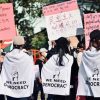
"The illegal military junta provides further evidence to the international community of its disregard for human rights as it prepares to hang pro-democracy activists," said Thomas Andrews and Morris Tidball-Binz, UN special rapporteurs in Myanmar for human rights and extrajudicial arbitrary executions, respectively on June 10, 2022.
How to Stop the ‘Hunger Pandemic’ During COVID-19
Johnny, living in the United States (US), goes to his school and gets free breakfast and lunch there. There may not be enough food for dinner at home. But he knows that he can get fed at school. Sadly, however, after the pandemic, schools were closed, which meant no breakfast and no lunch for him.
Should Sri Lanka Join the Ranks of the “Poorest of the World’s Poor”?
As one of the world’s foremost international humanitarian organizations, the United Nations has pledged to provide food and medicines to cash-strapped Sri Lanka --a country suffering from a major financial crisis. As of last week, a UN team, led by the Resident Coordinator in Colombo, Hanaa Singer-Hamdy has appealed to international donors for more than $47 million in “life-saving assistance” to 1.7 million people in a country with a population of over 22 million.
Will Apex Court Ruling Remove Stigma for Sex Workers in India?
Social activists, including Lucknow-based Tahira Hasan, have welcomed the Indian Supreme Court’s recent ruling recognising sex work as a profession.
Meaningful Dialogue Amplifies Youth Issues, Leads to Change
Young people are often the first to rebuild their communities. However, youths' diverse challenges cannot be addressed without meaningful dialogue, says Klaus Beck, Regional Director of UNFPA APRO ai.
Public Land Protection Cells in India: A New Hope for Our Commons
Common lands are natural resources that are used collectively by a community, such as forests, pastures, ponds, and ‘wastelands’. They act as a resource base for non-cash, non-market economies that provides fodder, fuelwood, water, oils, fish, medicinal herbs, and a wide variety of fruits and vegetables to the local communities.
Climate Change in South East Asia: Where are we and What are we Bound for?
It is increasingly clear that human health and wellbeing are being threatened everywhere because of global warming and environmental damage. Extreme weather events, sea level rise, increasing scarcity of freshwater, drought and high temperatures, combined with loss of biodiversity and other aspects of ecological degradation such as soil erosion and coral bleaching are all features of anthropogenic self-harm and an increasingly inhospitable planet for human society.« Previous Page — Next Page »





The Week with IPS

NEXT STOP - SDGs
Tracking global progress towards a sustainable world
Tracking global progress towards a sustainable world
