Languages
Monday, October 26, 2026



News and Views from the Global South
South-South

U.S. and China Formally Join Paris Agreement in Show of Unity
The world’s super-polluters - the United States and China - have formally joined the Paris Agreement on climate change in a symbolic show of unity.
UN Negotiations Focus on What Lies Beneath the High Seas
The high seas - oceans which fall beyond the jurisdiction of any country - make up about two thirds of the world’s ocean and half of the total surface of planet earth.
The Economic Partnership Agreement has never made much sense for Tanzania
The EPA issue has once again re-emerged when, in early July, Tanzania informed East African Community( EAC) members and the European Union (EU) that it would not be able to sign the Economic Partnership Agreement (EPA) between European Union (EU) and the six EAC member states.
Developing Nations Seek Tax Body to Curb Illicit Financial Flows
Despite Western opposition, the 134-member Group of 77 is continuing to pursue a longstanding proposal for an inter-governmental UN-affiliated tax body aimed at combating corporate tax dodging and curbing illicit financial flows, including money laundering and off-shore banking.
UNCTAD’s Roles Reaffirmed, but Only after Significant Wrangling
The United Nations’ leading development organisation UNCTAD recently obtained a renewed mandate for its work, but not without difficulty. This is because the developed countries are now much more reluctant to give concessions to the developing countries, thus showing up the present shaky state of North-South relations and of development cooperation.
New Alliance to Shore Up Food Security Launched in Africa
As over 20 million sub-Saharan Africans face a shortage of food because of drought and development issues, representatives of the U.N. Food and Agriculture Organisation (FAO) and the Pan African Parliament (PAP) met in Johannesburg to forge a new parliamentary alliance focusing on food and nutritional security.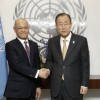
Q&A: Representing Developing Countries at the United Nations in New York
IPS spoke with the Virachai Plasai, Ambassador and Permanent Representative of the Kingdom of Thailand to the United Nations and Chair of the Group of 77 about what it’s like to represent 134 developing countries, including China, at UN meetings in New York. Plasai spoke about some of the group’s priorities for 2016, including the selection of the ninth UN Secretary-General, the 2030 Development Agenda, including the 17 Sustainable Development Goals, and the implementation of the Paris Climate Change Agreement.
UN Trade and Development Conference a “Big Win” for Multilateralism
The UN Conference on Trade and Development (UNCTAD) concluded its five-day meeting in Nairobi on a positive note—the launch of a new e-trade initiative and a multi-donor trust fund on trade and productive capacity.
President of UN General Assembly Continues Push for Openness, Transparency
The President of the 70th Session of the UN General Assembly, Mogens Lykketoft, has helped spearhead a push for a more open and transparent selection process for the next UN Secretary-General.
African Leaders Driving Push for Industrialisation: UN Official
Industrialisation in Africa is being driven by African leaders who realise that industries as diverse as horticulture and leather production can help add value to the primary resources they currently export.
Beyond Rhetoric: UN Member States Start Work on Global Goals
UN member states “are going beyond rhetoric and earnestly working to achieve real progress” towards the Sustainable Goals, the members of the Group of 77 and China said in a ministerial statement delivered here on 18 July.Global Coalition Seeks Ban on Mercury Use
A coalition of over 25 international non-governmental organizations (NGOs) has launched a global campaign to end a longstanding health and environmental hazard: the use of mercury in dentistry.
Is a Referendum a Valid Tool for Democracy?
William Shakespeare would have loved to witness the Brexit. Many of his themes are evidently present: friendship and treason; truth and lies; deception and betrayal.
Brexit – Perceptions and Repercussions in the Americas
The hopes of many of those who confidently expected the British electorate to vote, by a slender margin, for the country to remain in the EU have been dashed. All that is left to do now is to ponder the causes and background of this regrettable event, and consider its likely consequences, especially for relations with the United States.
What is Missing on the Global Health Front?
The last World Health Assembly (WHA) in Geneva (23-28 May) discussed the manifold global health crises that require urgent attention, and adopted resolutions to act on many issues. We are currently facing many global health related challenges, and as such multiple actions must be taken urgently to prevent these crises from boiling over.
A Healthy Trading System Requires Progress and Engagement at All Levels
This is a challenging time for global trade. According to the current World Trade Organization (WTO) new trade forecasts, global goods trade is expected to grow by 2.8%, making 2016 the fifth consecutive year of sub 3% growth. The gross domestic product (GDP) is still the most critical variable in the trade expansion equation, and as long as GDP growth remains low, trade numbers are likely to follow a similar trend.
Climate Change Compounds Humanitarian Crises in Global South
As the Global South works to overcome a history of weak institutions, armed conflict and poverty-driven forced exodus, key causes of its humanitarian crises, developing countries now have to also fight to keep global warming from compounding their problems.
Many Cities Don’t Know How Dangerous Their Air Pollution Is
China and India are not the only countries with an air pollution problem. Ninety-eight percent of cities in developing countries don’t meet World Health Organization (WHO) air quality standards, according to new research published by the UN body.
Progress of The World’s Least Developed Countries to be Reviewed
The United Nations will undertake a major review of progress made in the world’s 48 Least Developed Countries (LDCs) later this month.
West Papuans Turn to Africa for Support in Freedom Bid
For more than half a century, the indigenous people of West Papua, located on the western side of the island of New Guinea, who are related to the Melanesians of the southwest Pacific Islands, have waged a resistance to governance by Indonesia and a relentless campaign for self-determination.
“Together, Civil Society Has Power”
When Tamara Adrián, a Venezuelan transgender opposition legislator, spoke at a panel on inclusion during the last session of the International Civil Society Week held in Bogotá, 12 Latin American women stood up and stormed out of the room.« Previous Page — Next Page »





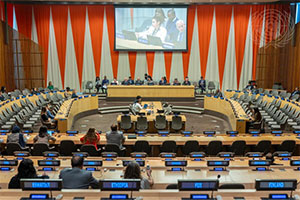 Panel Discussion on International Day for South-South Cooperation 2023. Credit: UN Photo/Cia Pak
South-South cooperation – collaboration between developing countries – is a growing and dynamic phenomenon, an important process that is vital in confronting shared challenges. Led by emerging giants, India, Brazil and South Africa (IBSA), the Global South is a tremendous source of tested solutions to development challenges, including the Millennium Development Goals (MDGs). China’s Belt and Road Initiative (BRI), launched in 2013, has further transformed South-South cooperation by enhancing infrastructure, trade, and investment linkages across Asia, Africa, and Latin America. Meanwhile, new platforms like the expansion of BRICS to include other countries such as Thailand, Nigeria, and Cuba are reshaping global economic governance and offering alternatives to traditional Western-led institutions. The Nairobi Outcome of the 2009 High-Level United Nations Conference on South-South Cooperation in Nairobi, Kenya highlights growing political and economic ties within the developing world, as countries from the Global South assume leading roles in decision-making on hot global issues ranging from economic recovery to food security, energy transitions, debt relief, and climate change. Today, the African Continental Free Trade Area and India’s “Voice of the Global South” summits have advanced frameworks for regional self-reliance, while G77 has reaffirmed commitments to resilient and inclusive economies ahead of the 16th UN Conference on Trade and Development.
Updated by Yilan Batista and Shuli Wong August 2026

The Week with IPS

NEXT STOP - SDGs
Tracking global progress towards a sustainable world
Tracking global progress towards a sustainable world
