Languages
Thursday, October 15, 2026



News and Views from the Global South
The Information Society
OP-ED-MEDIA: Colombian Law Sets Dangerous Precedent
Colombian lawmakers are studying the "Lleras law", the latest effort by that country to secure a free trade agreement with the United States by submitting to U.S. demands to comply with U.S. intellectual property laws. The bill is currently being fast-tracked with little input or consultation from Colombian citizens.
COLOMBIA: Risky Games Against National Peace Meeting
One of Colombia's most popular national radio stations broadcast the wiretapped telephone conversations of a leader of a regional movement of displaced persons, David Martínez, misreporting that the voices heard were those of "guerrilla ringleaders".
Q&A: “When People Are Mad, They Start to React” to Corruption
The fight against corruption has taken centre stage in the government of Brazilian President Dilma Rousseff, and has led to the resignation or dismissal of several ministers over just a few months.EGYPT: People-Funded TV Challenges Big Business
Egypt’s most organised political group, the Muslim Brotherhood, is tapping crowds as a new financing method for its nascent TV station and media outlets to be able to compete with well-oiled challengers in corporate and government- run media.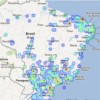
LATIN AMERICA: Citizens Chart Crime Using Online Maps
"I was walking down the street, talking on my cell phone, when a guy on a motorbike came by and grabbed the phone out of my hand. I ran after him but I couldn't catch him. He had probably been following me."U.S.: Major Telecom Firm in Struggle With Striking Workers
As unemployed young rioters rage across London and frustrated homeless people in Holon burn tires on the streets of Israel, the great capitalist democracy across the Atlantic is also feeling repercussions from its own floundering economy.
SWAZILAND: Impossible for Children to Access Public Information
Many public officials in Swaziland do not think that access to information is a public right, but rather a privilege – which can be withdrawn at anytime.CHINA: Microbloggers Launch Long March to Freedom
China’s rapidly growing legion of microbloggers is proving a worthy foe against ongoing government efforts to monitor, influence and censor information on the country’s vast Internet. Government efforts have failed to curb an outpouring of anger and grief in the wake of the recent Wenzhou train disaster.People Find Online Power Now in Malaysia
Following a major rally involving tens of thousands of protesters calling for electoral reforms in Malaysia, someone set up a Facebook page calling for Prime Minister Najib Razak to step down. Within ten days, the number of people who said they "like" the page crossed 200,000.Freedom of Expression Can Be Limited Only in “Exceptional Circumstances”
The United Nations Human Rights Committee confirmed the central role of freedom of expression in human rights, making it clear that it can only be limited in the most exceptional circumstances, and calling for the first time for unrestricted public access to official information.
MEXICO: Women Journalists Face Double Threats
The murder of journalist Yolanda Ordaz, whose body was found Tuesday in the eastern Mexican city of Veracruz, once again threw into relief the dangers that reporters face in this country, which in the case of women are compounded by discriminatory and sexist treatment.BELARUS: Clap Again This Wednesday
For the past nine weeks, Belarusians have been getting out in the hundreds into the main squares of big and small cities across the country on Wednesdays at seven in the evening. They clap, or let their mobiles ring all at once. The ‘Revolution through Social Networks- movement’ started by five students, and growing on the Russian equivalent of Facebook, Vkontakte, is posing a new threat to the Lukashenko regime.ECUADOR: President Wins Defamation Suit Against Newspaper Execs
President Rafael Correa of Ecuador has won a libel suit against the newspaper El Universo over an op-ed column that referred to him as the "Dictator" and accused him of committing "crimes against humanity."E-Waste Hits China
Despite new government regulations, China, for decades the dumping ground for the world’s electronic waste, still struggles to treat and process millions of tonnes of e-waste, prompting health and environmental concerns.
Q&A: CAPTCHA Creator Would Like to Tap Crowdsourcing to Fight Crime
If you use the internet, you will have come across CAPTCHA, a test to determine whether the computer user is human or a machine. What you may not know is that one of its inventors, mathematician Luis von Ahn, comes from one of the poorest countries in Latin America, Guatemala.Brooks to Face Phone-Hacking Questions
Rebekah Brooks, the former head of media mogul Rupert Murdoch's British newspaper wing, will face questioning by British parliamentarians on Tuesday following her release on bail on suspicion of bribing police and illegally intercepting voicemail messages.
Q&A: The Full Impact of Wikileaks Will Be Felt a Few Years Down the Road
Even before he was hired as spokesman for the Wikileaks whistleblower web site in July 2010, 49-year-old investigative journalist Kristinn Hrafnsson realised that the new initiative would have the power to bring about transformations simply by informing society, starting in his own country, Iceland.
BRAZIL: Women in Favelas Broadcast Peace
Local women's voices have begun to be heard over a community radio station now broadcasting in Complexo do Alemao, a clump of favelas or shantytowns on the north side of this Brazilian city that were ruled until recently by armed drug gangs.Cuban Twitterers Meet Face-to-Face
"I want to meet @salvatore300 and @elainediaz2003" was a comment overheard at #TwittHab, the first meeting in Cuba of social network users. After years of being connected only via the web, the internet is now being used to facilitate real-world contact between citizens of this socialist island nation.CUBA: Video Games Spread Despite Limitations
Despite the many limitations on access to digital-age technology in Cuba, a taste for computer games is spreading in this country, giving rise to a youthful movement that is beginning to conquer new public spaces.
Q&A: “Africa Can Provide More Than Minerals in South-South Trade”
South-South co-operation is firmly on Africa’s agenda. Leading the way is South Africa, which has recently joined up with Brazil, Russia, India and China’s BRIC formation to form a new global grouping of emerging markets, known as BRICS.« Previous Page — Next Page »





The Week with IPS

NEXT STOP - SDGs
Tracking global progress towards a sustainable world
Tracking global progress towards a sustainable world
