Languages
Sunday, November 8, 2026



News and Views from the Global South
Active Citizens

What Pakistani Women Want
As Pakistan inches closer to the May 11 elections, and the accompanying heat and dust get even thicker, it is pertinent to stop for a moment and ask: what do women voters in Pakistan want?
Islamists Lay Siege to Dhaka
Adding to a long list of domestic woes, including a factory collapse that left hundreds dead last month, Bangladesh is now grappling with a wave of violence that threatens to deepen the gulf between secular sections of society and religious fundamentalists.
Mexico – Ground Zero in the Fight for the Future of Maize
In the 2011 action-thriller "Unknown", scientists are persecuted by the biotech industry because they plan the open release of a drought- and pest-resistant strain of maize that could help eradicate world hunger.
Rape Cases Highlight “Colonial” Police Practices
Harsh police handling of public protests erupting across India over a spate of sensational rapes since December has resulted in renewed demands to reform a force that retains the repressive features of its colonial origins.
Women Taking the Lead in Northern Pakistan Province
“Women in Pakhtun society have traditionally helped their men in hard times,” declares former Pakistani lawmaker Shagufta Malik. They are doing so again, and how, going by their hectic campaigning activity in northern Pakistan's Khyber Pakhtunkhwa province.
Skilled Midwives May be the Key to Healthy Babies
The story goes like this: a young mother lies quietly in a dimly lit room having just given birth to her baby. For the next seven days she watches over the child with caution, nursing and swaddling it patiently. Fearful that the infant will not survive past a few days, she refuses to give it a name.
An Election for Iran or the Supreme Leader?
As the five-day registration period for presidential candidates began here Tuesday, the question of whether Iran’s upcoming election will represent the will of Supreme Leader Ayatollah Ali Khamenei or the people of Iran is uppermost on many people’s minds, including those of the potential candidates.
Climate Change Adaptation: A Race Against Time
Adaptation and mitigation. Identified by the United Nations Framework Convention on Climate Change and by scientists as the two major responses to address the problem, these were also the twin preoccupations of a climate change conference held recently in Dhaka.
Critics Slam California “Forest Offset” Plan
More than two dozen environmental organisations are urging California Governor Jerry Brown to disregard recommendations from a United Nations task force to include so-called forest “offsets” in the state’s new emissions-trading scheme.
Climate Change Makes Life Tougher for Solomon Island Farmers
Life is difficult enough for communities on the remote southern Weather Coast of Guadalcanal in the Solomon Islands. Sustaining a livelihood from the land is a daily struggle on the steep coastal mountain slopes that plunge to the sea, made worse by the absence of adequate roads, transport and government services. And now, climate change is taking its toll on the already precarious food situation here.
Migrant Children Struggle to Learn
In the hustle and bustle of Thailand’s capital, Bangkok, a small learning centre located in the Bang Bon district is helping children hailing mostly from the war-torn provinces of Myanmar (Burma) gain access to a basic education.
Rich Countries Drag Feet at Climate Talks
Another week of international climate negotiations ended in Bonn, Germany last Friday, but there was little mid-level bureaucrats could do when world leaders remain in thrall to the fossil fuel industry, say environmentalists.
‘Pirates’ Contest Icelandic Elections – And Win
With an unprecedented number of political parties contesting Iceland's latest elections, Icelanders are discovering that if they are passionate about a particular issue, they need simply to find like-minded people and establish a political party.
Mexico’s Community Radio Stations Fight for Survival and Recognition
Radio Totopo was founded in February 2006 in the Pescadores neighbourhood, the oldest and poorest part of the city of Juchitán in the southern Mexican state of Oaxaca. But the authorities closed it down in late March, even though Congress is debating a constitutional reform that would recognise community radio stations.
Free and Fair Elections – Except for Ahmadis
Twenty-five-year-old Syed Hasan, a doctor practicing in a private hospital in Lahore, plans to spend most of May 11, Pakistan’s long-awaited Election Day, in bed.
From Herders to Cultivators
 When the food-strapped Democratic People’s Republic of Korea (DPRK) appealed to the Mongolian government for food last month, it signaled a major turning point in the public image of this Central Asian country, which has long struggled to feed its own population of three million.

Hunger Rises in Great Britain
The social consequences of austerity economics have been most visible in Europe’s southern periphery. In the UK, the coalition government has brought in sharp cutbacks in welfare state provision in the name of dealing with the financial crisis. Their impact is becoming increasingly visible.
Going to School Away From School
As the Czech government comes under fire for apparently backtracking on commitments to inclusive education, Roma children and teenagers continue to be systematically shut out of Eastern Europe’s mainstream education system.
U.N. Finds “Little Appreciation” for Human Rights among U.S. Businesses
A United Nations expert group is warning that too many gaps remain in implementing new safeguards among businesses based in the United States, both in terms of their domestic and international operations, to ensure the protection of human rights of workers and communities affected by those operations.
Few Meaningful Changes in Wake of Dhaka Factory Collapse
Worker advocacy groups here are calling on some of the most high-profile U.S.-based clothing companies to make drastic reforms to their international labour practices in the wake of the factory collapse that killed more than 420 workers in Dhaka last week.
U.N. Harnesses Social Media to Reach Outside World
As the world continues to turn digital, so does the United Nations - slowly but steadily.« Previous Page — Next Page »





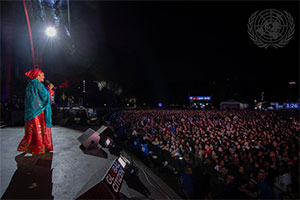 Global Citizen Festival in New York. Credit: UN Photo/Eskinder Debebe
Active citizens are committed to social change because they know that it is achievable. However, major political challenges face active citizens across the world. For example, in authoritarian regimes in Latin America where the hegemonic party has been in power for decades on end, protestors and human rights activists face enormous repression and struggle to materialize their advocacy into concrete results. The same can be said for Africans, where a shift towards elected government in recent decades has yet to translate into an effective voice in decision-making. Now, the Strengthening Citizen Demand for Good Governance, which uses evidence-based approaches – funded by DFID's Governance and Transparency Fund – seeks to raise their voices.
In 2025, the CIVICUS Monitor’s People Power Under Attack report revealed that civic freedoms are severely limited in 122 of 198 countries and territories, and only 7.2% of the global population now lives in countries where civic space is open. Through partnership with the Overseas Development Institute (ODI) and CIVICUS, IPS reporters across the continent will seek to define the extent and limits of state capability, government accountability and the responsiveness of leaders to the needs of citizens.

The Week with IPS

NEXT STOP - SDGs
Tracking global progress towards a sustainable world
Tracking global progress towards a sustainable world
