Languages
Saturday, October 10, 2026



News and Views from the Global South
Active Citizens

Authoritarian Govts Tighten Grip on Press Freedom
The 25th celebration of World Press Freedom Day will be led by UNESCO and the government of Ghana in Accra on May 2-3. The theme is “Keeping Power in Check: Media, Justice and The Rule of Law,” covering the issues of media in respect to the judicial system and transparent political processes.
Working Together Is Key to Meeting Water Targets by 2030
Mutual collaboration and coordination among the various stakeholders are tools to accelerate the actions necessary to meet the 6th Sustainable Development Goal (SDG) in the 2030 Agenda, which states the need to ensure access to clean water and sanitation for all.
Forest Communities Join Forces to Fight Land Degradation in Mexico
Forest communities play a fundamental role in Mexico in combating land degradation, but they need more support to that end.
Women Miners Stake a Claim in Zimbabwe
Tapiwa Moyo, 40, religiously leaves her home each day when the first cock crows and joins a throng of women who have taken up artisanal mining in her community.
Women Lead the Fight for Housing in Brazil
"Here we empower women and we do not tolerate domestic violence, which we treat as our own, not as an intra-family, issue," says Lurdinha Lopes, a leader of the squatting movement in Brazil.
In Latin America “Me Too” Doesn’t Always Mean the Same Thing
From the Argentine slogan "Ni una menos" (Not one [woman] less)" to Colombia’s “Now is not the time to remain silent”, activism against gender violence has grown in Latin America since 2015, with campaigns that have social and cultural differences from the "MeToo" movement that emerged later, in 2017, in the United States.
Women Peace Laureates Condemn Inaction on Rohingya “Genocide”
Nobel Laureates Mairead Maguire, Shirin Ebadi and Tawakkol Karman met with more than 100 women refugees in camps in the coastal Cox’s Bazar region of Bangladesh this week, as well as travelling to the “no man’s land” where thousands of Rohingya have been stranded between Myanmar and Bangladesh.
Argentina’s Patagonia Rebels Against Oil Field Waste Pits
A project to install a huge deposit of oil field waste pits has triggered a crisis in the north of Argentina’s southern Patagonia region, and brought the debate on the environmental impact of extractive industries back to the forefront in this Southern Cone country.
Ethnic Violence in Ethiopia Stoked by Social Media from U.S.
In Ethiopia social media is a double-edged sword: capable of filling a sore need for more information but also of pushing the country toward even greater calamity.
Wars, Crises and Catastrophes Drive Immigration to Brazil
The war in Angola, the earthquake in Haiti, Venezuela’s political crisis and shortages and the political repression in the Democratic Republic of the Congo are the main driving factors behind the recent waves of immigration to Brazil.
Argentina Continues to Seek Truth and Justice, Despite the Hurdles
Thirty-four years after Argentina’s return to democracy, more than 500 cases involving human rights abuses committed during the 1976-1983 military dictatorship are making their way through the courts. This high number not only shows that the process of truth and justice is ongoing, but also reflects the delays and the slow process of justice.
Argentina’s Law on Forests Is Good, But Lacks Enforcement
Never in the parliamentary history of Argentina had something similar happened: one and a half million people in 2007 signed a petition asking the Senate to pass a law to reduce deforestation. The law was quickly approved, and promulgated on Dec. 26 of that year. But 10 years later, it has left a bittersweet taste.
Argentine Soldiers Rest in Peace in the Malvinas/Falkland Islands
Julio Aro, a veteran of the 1982 Malvinas/Falklands war, returned to the islands in 2008. When he visited the Argentine Military Cemetery he found 121 tombs that read: "Argentine soldier only known by God", and he resolved to return their identity to his fellow soldiers. Today he can say that, to a large extent, he has achieved his goal.
Uncertainty Surrounds Renegotiation of NAFTA and Its Consequences for Mexico
The first few months of 2018 will be key to defining the future of the North American Free Trade Agreement (NAFTA), whose renegotiation due to the insistence of U.S. President Donald Trump has Mexico on edge because of the potential economic and social consequences.
Using Data to Combat Prejudice Against Immigrants
What are the contributions of migrants to trade, to the economy of their countries of destination and origin? This is an angle that is generally ignored in the international debate on the subject, which usually focuses more on issues such as the incidence of foreigners in crime or unemployment.
Debate on Glyphosate Use Comes to a Head in Argentina
In and around the city of Rosario, where most of Argentina's soybean processing plants are concentrated, a local law banned the use of glyphosate, the most widely-used herbicide in Argentina. But two weeks later, producers managed to exert enough pressure to obtain a promise that the ban would be overturned.
Lawmakers Impose Gender Parity in Argentina’s Congress, By Surprise
It was an unexpected move by a group of women in the lower house of the Argentine Congress. At one o'clock in the morning, during a long parliamentary session, they demanded the approval of a stalled bill for gender parity in political representation. There was resistance and arguments, but an hour later, the initiative became law by a large majority.
Women Activists are Targets of Gender-Biased Violence
Veiled and direct threats, defamation, criminalisation of activism, attacks on their private lives, destruction of property and assets needed to support their families, and even murder are some forms of gender violence that extend throughout Latin America against women defenders of rights.
Conservative Onslaught Undermines Gender Advances in Latin America
A "conservative and fundamentalist onslaught" in Latin America against a supposed "gender ideology" is jeopardising advances in the fight against violence towards women, feminist activists complain.
The World is Losing the Battle Against Child Labour
The IV Global Conference on the Sustained Eradication of Child Labour, which drew nearly 2000 delegates from 190 countries to the Argentine capital, left many declarations of good intentions but nothing to celebrate.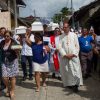
Victims of El Salvador’s Civil War Demand Reparations
Among the sea of names of victims of the Salvadoran civil war, engraved on a long black granite wall, Matilde Asencio managed to find the name of her son, Salvador.« Previous Page — Next Page »





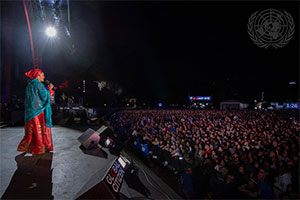 Global Citizen Festival in New York. Credit: UN Photo/Eskinder Debebe
Active citizens are committed to social change because they know that it is achievable. However, major political challenges face active citizens across the world. For example, in authoritarian regimes in Latin America where the hegemonic party has been in power for decades on end, protestors and human rights activists face enormous repression and struggle to materialize their advocacy into concrete results. The same can be said for Africans, where a shift towards elected government in recent decades has yet to translate into an effective voice in decision-making. Now, the Strengthening Citizen Demand for Good Governance, which uses evidence-based approaches – funded by DFID's Governance and Transparency Fund – seeks to raise their voices.
In 2025, the CIVICUS Monitor’s People Power Under Attack report revealed that civic freedoms are severely limited in 122 of 198 countries and territories, and only 7.2% of the global population now lives in countries where civic space is open. Through partnership with the Overseas Development Institute (ODI) and CIVICUS, IPS reporters across the continent will seek to define the extent and limits of state capability, government accountability and the responsiveness of leaders to the needs of citizens.

The Week with IPS

NEXT STOP - SDGs
Tracking global progress towards a sustainable world
Tracking global progress towards a sustainable world
