Languages
Friday, October 9, 2026



News and Views from the Global South
Active Citizens

Cuba’s Youth Were the Target of USAID’s ZunZuneo
The generations born in Cuba in the last two or three decades, permeated by the influences of societies that differ radically from the one their government is trying to build, are in the eye of the ideological storm that feeds the conflict between Havana and Washington.
Italian Doctors Abort a Law
Two out of three doctors in Italy are ‘conscientious objectors’ to abortion, according to new data. The Italian Ministry of Health reveals that in 2011, 69.3 percent of doctors refused to carry out abortions, with peaks of over 85 percent in some regions.
Brazilian Dams Accused of Aggravating Floods in Bolivia
Unusually heavy rainfall, climate change, deforestation and two dams across the border in Brazil were cited by sources who spoke to IPS as the causes of the heaviest flooding in Bolivia’s Amazon region since records have been kept.
Getting into CAR, When so Many Want to Get Out
In a country suffering from what the U.N. has called “ethno-religious cleansing”, a “disappeared” state structure and “unacceptable sectarian brutality,” gaining access to the population of the Central African Republic has proven a difficult and sometimes deadly task for humanitarian workers.
OP-ED: “Cli-Fi” May Be No Stranger Than Reality
When we read novels or short fiction in any language, we read to understand the story. We read to learn something new, and hopefully to get some kind of emotional uplift through the words on the page and the skills of the storyteller.
Misgivings Rise Over Afghan Poll
“If Abdullah will become president, the will of [the] Afghan people will be respected. Otherwise – especially if Zalmai Rassoul will be indicated as the winner – a new conflict will start and our country will become more insecure.” The remark by Abdullah Abdullah supporter Qazi Sadullah Abu Aman is typical of the uncertainties and accusations rising as election day draws close on Saturday.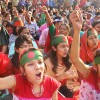
Youth Around the World See Meagre Opportunities
Although half the world’s population is under 25 years old, young people in more than two dozen countries feel that their opportunities for educational, economic and societal advancement are limited, according to new research released here Thursday.
U.N. Aims at Treaty to Protect Marine Biodiversity
At a political level, when the United Nations speaks of a "high seas alliance", it is probably a coalition of countries battling modern piracy in the Indian Ocean.
California Cities Gear Up to Fight “Big Soda”
Mexico is fighting obesity and accompanying diseases with a one-peso per litre tax on sugar-sweetened beverages that kicked in Jan. 1. France implemented its “cola tax” in 2012. Several U.S. states tax sugar-sweetened beverages, including Vermont, Rhode Island, Arkansas, Tennessee, West Virginia and Virginia. Illinois legislators are considering such a tax.
Rural Costa Rican Women Plant Trees to Fight Climate Change
Olga Vargas, a breast cancer survivor, is back in the countryside, working in a forestry programme in the north of Costa Rica aimed at empowering women while at the same time mitigating the effects of climate change.
Afghans Set to Vote on Ethnic Lines
Ethnicities will come to the fore in the Afghan elections due Saturday this week, even though it appears that the young are beginning to break away from such loyalties.
Donors Repeatedly Postpone Major Aid Effectiveness Report
Major foreign assistance donors have once again delayed the release of a report meant to measure transparency, accountability and cooperation of aid effectiveness.
What Nepal Doesn’t Know About Water
Water is a critical resource in Nepal’s economic development as agriculture, industry, household use and even power generation depends on it. The good news is that the Himalayan nation has plenty of water. The bad news - water abundance is seasonal, related to the monsoon months from June to September.
Q&A: “Bolivia Marked the Start of a Major Indigenous Awakening”
He describes himself as someone who was drawn to Marxism as a result of his commiseration with the plight of indigenous people in his country, and he is considered one of the most influential Latin American thinkers of the 21st century.
The Lady’s Allure Is Challenged
For over a quarter of a century Uhla Min has lived under the spell of “The Lady”, the popular nickname for Nobel Peace Laureate Aung Sung Suu Kyi.
Exploring the Path Towards a Nuclear-free World
This past February, the Second Conference on the Humanitarian Impact of Nuclear Weapons was held in Nayarit, Mexico, as a follow-up to the first such conference held last year in Oslo, Norway. The conclusion reached by this conference, on the basis of scientific research, was that “no State or international organisation has the capacity to address or provide the short and long term humanitarian assistance and protection needed in case of a nuclear weapon explosion.”
Fighting Now Brings Disease
For just that moment, the refugees in Yarmouk camp in Damascus made news. After months of facing starvation and death in the shadows of the Syrian civil war came packets of food and aid in January - with cameras in tow.
OP-ED: Egypt’s Death Sentences Test U.S. Resolve
The summary mass trial and sentencing of 529 Egyptians to death this week is yet another example of Egypt’s descent into lawlessness and blatant miscarriage of justice.
To Spy To Live
“If you want to live and receive medical treatment, you have my number, so you can call me and agree to my request. You will then get medical help, and survive.” The request, the patient said, was from an Israeli intelligence officer looking to recruit him in exchange for treatment.
Executions on the Upswing
The number of recorded executions carried out worldwide rose 14 percent last year, as anti-terrorism measures in Iraq and hardline drug polices in Iran accounted for more than half of all reported government-sanctioned killings in 2013.
In Venezuela, a Popular Uprising, or Class Warfare?
This much is known: at least 33 people are dead and 461 have been wounded. The rest – questions of who, why and what next for Venezuela – has largely been a matter of speculation.« Previous Page — Next Page »





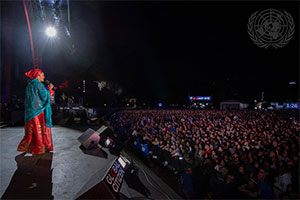 Global Citizen Festival in New York. Credit: UN Photo/Eskinder Debebe
Active citizens are committed to social change because they know that it is achievable. However, major political challenges face active citizens across the world. For example, in authoritarian regimes in Latin America where the hegemonic party has been in power for decades on end, protestors and human rights activists face enormous repression and struggle to materialize their advocacy into concrete results. The same can be said for Africans, where a shift towards elected government in recent decades has yet to translate into an effective voice in decision-making. Now, the Strengthening Citizen Demand for Good Governance, which uses evidence-based approaches – funded by DFID's Governance and Transparency Fund – seeks to raise their voices.
In 2025, the CIVICUS Monitor’s People Power Under Attack report revealed that civic freedoms are severely limited in 122 of 198 countries and territories, and only 7.2% of the global population now lives in countries where civic space is open. Through partnership with the Overseas Development Institute (ODI) and CIVICUS, IPS reporters across the continent will seek to define the extent and limits of state capability, government accountability and the responsiveness of leaders to the needs of citizens.

The Week with IPS

NEXT STOP - SDGs
Tracking global progress towards a sustainable world
Tracking global progress towards a sustainable world
