Languages
Thursday, October 8, 2026



News and Views from the Global South
Active Citizens

Uruguay Not a ‘Pirate’
The Uruguayan government has made a controversial move to regulate the production and sale of cannabis. The government believes that this will help in the fight against drug-related crime and in dealing with public health issues.
Afghanistan Turns a Political Corner
The Afghanistan presidential election is turning out to be a tale of two narratives. The more positive and democratic one could be winning the day.U.S. Tribe Looks to International Court for Justice
An indigenous community in the United States has filed a petition against the federal government, alleging that officials have repeatedly broken treaties and that the court system has failed to offer remedy.
Ending Modern Slavery Starts in the Boardroom
Modern-day slavery can be eradicated from multinational supply chains, but only if global businesses contribute to greater transparency and collaboration, according to new recommendations by Sedex Global and Verite.
OP-ED: Beyond the Street Protests: Youth, Women and Democracy in Latin America
Women’s empowerment and political participation are not only crucial for women: they are essential for effective democratic governance, one which promotes human rights and equity. The same can be said about the importance of boosting youth political participation.
Russian Law Corners Drug Users
As local authorities prepare to put an end to opioid substitution treatment (OST) programmes in the newly annexed Crimean peninsula, drug users there say they are being forced to choose between a return to addiction and becoming refugees.
Is Puerto Rico Going the Way of Greece and Detroit?
Puerto Rican society has been shaken to its foundations by the announcement in February by Standard & Poor's and Moody's credit rating agencies that they had downgraded the island's creditworthiness to junk status.
Conflict Fuels Child Labour in India
Early in the morning, 14-year-old Sumari Varda puts on her blue school uniform but heads for the village pond to fetch water. “I miss school. I wish I could go back,” she whispers, scared of being heard by her employer.
Yakama Nation Tells DOE to Clean Up Nuclear Waste
The Department of Energy (DOE), politicians and CEOs were discussing how to warn generations 125,000 years in the future about the radioactive waste at Hanford Nuclear Reservation, considered the most polluted site in the U.S., when Native American anti-nuclear activist Russell Jim interrupted their musings: “We’ll tell them.”
Whales Find Good Company
Posters with the words “Do you know who caught your seafood?” are now appearing on buses, trains and other venues in Boston. They are part of a campaign organised by a coalition of U.S. environmental groups called Whales Need Us, to draw attention to the links between Icelandic whalers and fish sold in the U.S.
Taliban Screens a New Silence
Mushfiq Wali, a 22-year-old shoemaker in northern Pakistan, loves watching films in the local Pashto language. But he says the Taliban are a killjoy: their bomb attacks have led to the closure of movie theatres, again. “They don’t spare anything that brings happiness.”
Iraqi Sunnis Seek a Say
Sunni Muslims have set up a new party amidst uncertainties as to whether elections can be held as scheduled in the troubled western regions of Iraq. Polling for the 328-seat Iraqi parliament is due Apr. 30.Government, Opposition in Televised Group Therapy in Venezuela
Government and opposition leaders in Venezuela held a nationally televised debate as a first step to working towards solutions for the economic, social and political crisis marked by over two months of protests.
“Sanitation for All” a Rapidly Receding Goal
World leaders on Friday discussed plans to expand sustainable access for water, sanitation and hygiene, focusing in particular on how to reach those in remote rural areas and slums where development projects have been slow to penetrate.

Soaring Child Poverty – a Blemish on Spain
“I don’t want them to grow up with the notion that they’re poor,” says Catalina González, referring to her two young sons. The family has been living in an apartment rent-free since December in exchange for fixing it up, in the southern Spanish city of Málaga.
Indigenous Leaders Targeted in Battle to Protect Forests
Indigenous leaders are warning of increased violence in the fight to save their dwindling forests and ecosystems from extractive companies.
New Treatments May Defuse Viral Time Bomb
Mohamed Ibrahim first learned he had hepatitis C when he tried to donate blood. Weeks later he received a letter from the blood clinic telling him he carried antibodies of the hepatitis C virus (HCV). He most likely acquired the disease from a blood transfusion he received during surgery when he was a child.
U.S.-Colombia Labour Rights Plan Falls Short
Three years after Colombia agreed to U.S. demands to better protect labour rights and activists, a “Labour Plan of Action” (LPA) drawn up by the two nations is showing mixed results at best, according to U.S. officials and union and rights activists from both countries.
Colombia’s Breadbasket Feels the Pinch of Free Trade
“Things are getting worse and worse,” Enrique Muñoz, a 67-year-old farmer from the municipality of Cajamarca in the central Colombian department of Tolima, once known as the country’s breadbasket, said sadly.
Biofortified Beans to Fight ‘Hidden Hunger’ in Rwanda
Joane Nkuliye considers herself an activist. She is part of a select group of farmers producing biofortified crops on a commercial scale in Rwanda.
Political Web Spun for ‘Youngistan’
As India votes in its 16th general election Apr. 7-May 12, the youth, comprising nearly half the country’s 814 million voters, could prove decisive. And the internet is being used increasingly to target youth in the world’s largest democratic exercise.« Previous Page — Next Page »





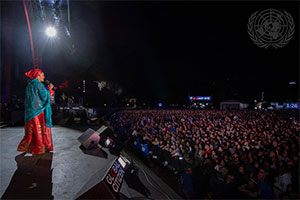 Global Citizen Festival in New York. Credit: UN Photo/Eskinder Debebe
Active citizens are committed to social change because they know that it is achievable. However, major political challenges face active citizens across the world. For example, in authoritarian regimes in Latin America where the hegemonic party has been in power for decades on end, protestors and human rights activists face enormous repression and struggle to materialize their advocacy into concrete results. The same can be said for Africans, where a shift towards elected government in recent decades has yet to translate into an effective voice in decision-making. Now, the Strengthening Citizen Demand for Good Governance, which uses evidence-based approaches – funded by DFID's Governance and Transparency Fund – seeks to raise their voices.
In 2025, the CIVICUS Monitor’s People Power Under Attack report revealed that civic freedoms are severely limited in 122 of 198 countries and territories, and only 7.2% of the global population now lives in countries where civic space is open. Through partnership with the Overseas Development Institute (ODI) and CIVICUS, IPS reporters across the continent will seek to define the extent and limits of state capability, government accountability and the responsiveness of leaders to the needs of citizens.

The Week with IPS

NEXT STOP - SDGs
Tracking global progress towards a sustainable world
Tracking global progress towards a sustainable world
