Languages
Monday, November 16, 2026



News and Views from the Global South
Civil Society

Conserving the Hilsa
Bangladesh has decided to set up a Hilsa Conservation Trust Fund (HCTF) to protect this fish from over-exploitation due to population growth and effects of climate change.
Ethiopia’s Smoldering Oromo
The Ethiopian government's most serious domestic political crisis in more than a decade began over a scruffy football field appropriated by local officials for development.Clash or Dialogue?
The emergence of a global village, where people from different civilisational bacle grounds are coming together in increasing numbers to work, study, and live together, is creating fault lines that often erupt in violence.
Saving Beira
Mozambique’s second largest city, Beira, is heading for climate change-induced disaster. Cyclones, floods, storm surges and the rising sea level are threatening to annihilate this important Indian Ocean coastal city; a city which is strategic for landlocked countries like Zimbabwe and Zambia.
Temple Tantrums
Women comprise nearly half of India's 1.2 billion population, yet gender bias and patriarchal mindsets continue to plague them well into the 21st century. Even holy places -- temples and mosques -- it seems aren't free from discriminating against the fair sex.
Climate Change Dries Up Nicaragua
A three-year drought, added to massive deforestation in the past few decades, has dried up most of Nicaragua’s water sources and has led to an increasingly severe water supply crisis.
Balancing Economic Potential of Marine and Social Life
When Africa’s oldest protected marine area, Tsitsikamma -- the largest in the world, incorporating 80 km of rocky coastline, bustling with marine life, much of it endangered -- was opened as a pilot for public fishing on December 15, 2015, there was a big outcry.
The Arab Spring: Five Years On
Five years ago the Arab world blew up, and the flames are still raging. What at first had been euphoria quickly turned to chaos. What cannot be denied, though, is that the uprisings were the spark of an epochal change.
Women Benefit From Simple Economic Ventures
Angelina Chiziane starts her day by getting her husband ready for work in a small village in the southern province of Gaza, Mozambique, some 216 kilometers away from the capital, Maputo.
Heavy Rains Once Again Scatter the Poor in Asunción
Néstor Colman, 69, remembers the river overflowing its banks nine times in Bañado Sur, the poor neighourhood in the Paraguayan capital where he was born and has lived all his life. “A record,” he jokes.
Benefits of Backpack Biogas
Billions of dollars of aid has been pumped into Africa. Yet effective change too often remains an elusive outcome, leading to a vicious cycle: more needs, more aid but still little change. How to resolve this seemingly intractable dilemma?
Thaw with United States Will Put Cuba’s Agroecology to the Test
The United States has indicated a clear interest in buying organic produce from Cuba as soon as that is made possible by the ongoing normalisation of ties between the two countries. But farmers and others involved in the agroecological sector warn that when the day arrives, they might not be ready.
Press Freedom in Peril
A single phone call from an irate security official is enough to shutdown a newspaper in Sudan. Security agents sometimes employ unorthodox methods: they storm the premises of a newspaper or a printing press and confiscate print runs in full view of employees. No reasons are provided. And there is no legal recourse.
Challenges of Polio Vaccination
Pakistan and Afghanistan, the two remaining polio-endemic countries, have joined forces to eradicate poliomyelitis by vaccinating their children in synchronised campaigns.
Saving Children’s Lives Through Drones
The first successful test-flight of an unmanned aerial vehicle (UAV) or drone was an unhindered 10 km journey from a community health centre to the Kamuzu central hospital laboratory in the capital Lilongwe. Local community members watched with excitement as the drone rose into the sky, after being launched by the United Nations Children’s Emergency Fund (UNICEF) and government of Malawi at the area 25 health centre.
NGO Pledges $500 Million Towards Sustainable Development Goals
CMMB -Healthier Lives Worldwide– a leading international nonprofit health non-governmental organisation (NGO) – has pledged 500 million dollars to help implement the UN’s Sustainable Development Goals (SDGs)– with a specific focus on maternal, newborn, child and adolescent health.
Tree Regeneration Restoring Hope
Maurice Kaduka Lukaro, 54, is a farmer in Oljorai, an area with short grasses and small-scattered bushes in Nakuru county in Kenya’s Great Rift Valley. Crop production has declined tremendously in this region. Like the rest of the arid and semi-arid lands (ASAL) in the Sub Saharan region, Maurice Kaduka Lukaro, 54, is a farmer in Oljorai, an area with short grasses and small-scattered bushes in Nakuru county in Kenya’s Great Rift Valley. Crop production has declined tremendously in this region. Like like the rest of the arid and semi-arid lands (ASAL) in the Sub Saharan region, Kenya hosts a population worst hit by the reality of climate change. Kenya hosts a population worst hit by the reality of climate change.
Quake Fear Stalks Kathmandu
Early evening, there is a play of light and shadow over Kathmandu’s famous Durbar Square. The rising monuments, damaged by the April 2015 earthquake, appear as dark silhouettes while large flash lights streak through in between them.
The PELIS Factor
Peter Wainaina’s focus is on the fresh Irish potatoes he has just harvested. He assembles them into a 90-kilogramme bag while sorting out the unmarketable ones like sliced and tiny tubes. He lives on a small plot of land in Njabini, 600 metres away from a farm in Aberdares forest, west central Kenya, where he has been growing this fast-maturing crop for the past three months.
Build Healthy, Sustainable Food Systems to Fight Malnutrition
Creating healthy and sustainable food systems is key to overcoming hunger and all forms of malnutrition (undernourishment, micronutrient deficiencies, obesity) around the world. Food production has tripled since 1945 while average food availability per person has risen by 40 per cent. Current food systems are not delivering well on ensuring healthy diets for all. We have to fix the problem. The most efficient and sustainable approach will be to reshape and strengthen food systems that support healthy diets for all.
Water Crisis in Zimbabwe
A narrow dirty trail snakes through what used to be a small dam in Mpudzi Resettlement Scheme south of the eastern border city of Mutare. And what remains of this once perennial dam is just a small puddle of mudded water; the dirty water is completely covered with thick green algae.« Previous Page — Next Page »


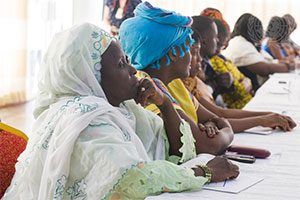 Representatives of Civil Society, Sierra Leone. Credit: UN Photo/Eskinder Debebe
Civil society faces mounting threats worldwide, even as it remains essential for democratic accountability, especially in countries struggling with economic instability and social inequality. However, at the same time, nations with weak democratic governance structures also systemically suppress the power of civil society. Human rights activists across the Global South frequently challenge issues such as political persecution and gender oppression, but in return face state-sanctioned punishment for their advocacy. Imprisonment and exile are common mechanisms of punishment that seek to erode the strength of civil society. The 2026 World Press Freedom Index has reached its lowest level in 25 years, with more than half of the world’s countries now falling into the "difficult" or “very serious” category for press freedom. IPS seeks to highlight the work of civil society across the Global South as well as the challenges that they face.
Updated by Yilan Batista and Shuli Wong August 2026

The Week with IPS

NEXT STOP - SDGs
Tracking global progress towards a sustainable world
Tracking global progress towards a sustainable world
