Languages
Monday, November 16, 2026



News and Views from the Global South
Civil Society

Choose Humanity: Make the Impossible Choice Possible!
We have arrived at the point of no return. At this very moment the world is witnessing the highest level of humanitarian needs since World War Two. We are experiencing a human catastrophe on a titanic scale: 125 million in dire need of assistance, over 60 million people forcibly displaced, and 218 million people affected by disasters each year for the past two decades.
Musicians Champion LGBT Rights
In a recently released music video by a Kenyan artist, a young gay and lesbian couple hold hands on separate dates at a park in Nairobi. The progress of their love from kisses to more graphic bedroom scenes are threaded with past images of anti-gay headlines and protests mainly from Uganda and Kenya.
Abortion Saga: Morality vs Choice
Malawi considers itself ‘a god fearing nation’ so much that any act ‘out of the ordinary’ is said to be either satanic, a sin or demonic. Even a drink or a walk could be satanic in the country if you are not careful!
Organised Civil Society Increasingly Hemmed In by Global Elites
Collusion, according to the dictionary, means “secret or illegal cooperation or conspiracy, especially in order to cheat or deceive others.” That is what the world’s political and economic elites engage in, according to Danny Sriskandarajah, secretary general of the international civil society alliance CIVICUS.
Mauritian Farmers Go Smart
Fifty year-old Prem Kanoosingh rages against his peers who excessively apply chemicals, mostly pesticides and fertilisers, to their crops. "They make cocktails from several products and they use them on their crops. They are criminals", he shouted at a function where the Food and Agricultural Research and Extension Institute launched a bio-farming project in early March 2016.
Any Ways to Combat Extremism?
“The objective of extremists is for us to turn on each other [and] our unity is the ultimate rebuke for that bankrupt strategy.”
Harvesting Rainwater to Weather Drought in Northeast Argentina
In a semiarid region in the northeast Argentine province of Chaco, small farmers have adopted a simple technique to ensure a steady water supply during times of drought: they harvest the rain and store it in tanks, as part of a climate change adaptation project.
Ecosystem Conservation Gives Hope to a Vulnerable Community
42 year-old Saraswati Subedi still remembers the night she almost died in a flash flood. “I heard the cries of my neighbours and ran out of the room with my two children. There was water all around and I thought we were going to die, so I started to pray,” says the mother of the three in Karki Tahara – a village by the river Harpan Khola in Nepal’s Kaski district.
Boosting the Future of the Food Movement
Investing in new entrepreneurs who bring a holistic approach to food sustainability is one way that the food movement can overcome mounting global challenges from environmental degradation to food waste.
South-South Cooperation Needed to Tackle Climate Change
As countries came together at the United Nations this week to sign the Paris Climate Change Agreement, partnerships were forged between countries of the global South to support the implementation of the global treaty.
Developing Countries Take Lead at Climate Change Agreement Signing
An unprecedented 175 countries signed the Paris Climate Change Agreement here Friday, with 15 developing countries taking the lead by also ratifying the treaty.
Forced Closure of Bedouin Settlements
Despite ostensibly freezing the Prawer Plan -- a proposed bill to 'regulate Bedouin settlement in the Negev’-- in 2013, Israel continues to push for forced closure of unrecognised Bedouin villages in this southern region. The village of Umm al-Heran, near the Bedouin township of Hura, is amongst those slated for demolition.
HIV Time Bomb Ticks On
Radhika Banarjee, a 24 year-old CSW, listened carefully at an advocacy gathering in the heart of Dhaka, Bangladesh’s capital.
Latin America to Redouble Its Climate Efforts in New York
The countries of Latin America will flock to sign the Paris Agreement, in what will be a simple act of protocol with huge political implications: it is the spark that will ignite actions to curb global warming.
Champions of Hygiene
Lydia Abuya, a tenant living in the Kaptembwa informal settlement west of Nakuru town, leaves one of the six on-plot toilets. She returns with a pail of water to splash away the waste.
Climate Change and the Middle East (II)
No Water in the Kingdom of the Two Seas—Nor Elsewhere
There is an oil producing country situated in the Gulf region, made of a cluster of islands. It is small, surface and population wise. But it holds the dubious privilege of ranking top of the list out of the 33 countries most likely to be water-stressed in the year 2040.

A World Drowning in Oil
Thanks to tensions between Saudi Arabia and Iran, major oil producers couldn’t come to an agreement in Doha to freeze their output to January levels to raise oil prices. The current low oil prices have a lot to do with the grim outlook for global economic growth while supply is growing. China, the second largest economy in the world, is slowing down. Not surprisingly, global oil demand is much lower at 94.8 million barrels a day vis-à-vis supply of 96.3 million barrels a day in the first quarter of 2016 according to the International Energy Agency.
Climate Change (I)
Will the Middle East Become ‘Uninhabitable’?
This is not about any alarming header—it is the dramatic conclusion of several scientific studies about the on-going climate change impact on the Middle East region, particularly in the Gulf area. The examples are stark.

Land Tenure Still a Challenge for Women in Latin America
Rural women in Latin America continue to face serious obstacles to land tenure, which leave them vulnerable, despite their growing importance in food production and food security.Female Engineers Defy the Odds
Nearly every aspect of modern life is a result of the work done by engineers; from running water to the internet, sky-scrapers to smartphone apps that people use for dating. Sadly, in Tanzania this profession attracts only a few women due to prevalent attitudes that it is a man’s job.
What the Panama Papers Mean for Global Development
The financial secrecy and tax evasion revealed by the Panama Papers has an extraordinary human cost in developing countries and threatens the realisation of the UN’s ambitious Sustainable Development Goals.« Previous Page — Next Page »


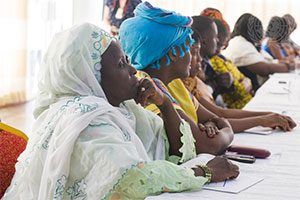 Representatives of Civil Society, Sierra Leone. Credit: UN Photo/Eskinder Debebe
Civil society faces mounting threats worldwide, even as it remains essential for democratic accountability, especially in countries struggling with economic instability and social inequality. However, at the same time, nations with weak democratic governance structures also systemically suppress the power of civil society. Human rights activists across the Global South frequently challenge issues such as political persecution and gender oppression, but in return face state-sanctioned punishment for their advocacy. Imprisonment and exile are common mechanisms of punishment that seek to erode the strength of civil society. The 2026 World Press Freedom Index has reached its lowest level in 25 years, with more than half of the world’s countries now falling into the "difficult" or “very serious” category for press freedom. IPS seeks to highlight the work of civil society across the Global South as well as the challenges that they face.
Updated by Yilan Batista and Shuli Wong August 2026

The Week with IPS

NEXT STOP - SDGs
Tracking global progress towards a sustainable world
Tracking global progress towards a sustainable world
