Languages
Tuesday, November 17, 2026



News and Views from the Global South
Civil Society

Pilgrimage for Peace on 50th Anniversary of Camilo Torres’ Death
The police cut down trees at six different points to block the road to the spot in northeast Colombia where priest-turned-guerrilla Camilo Torres was killed 50 years ago, and local residents protested the attempt to pay homage to him.Children of Alcoholics – Hidden Human Rights Crisis & Crucial SDGs Issue
Children of alcoholics are the forgotten victims of someone else’s alcohol use. All too often they do remain invisible and alone, neglected by their parents, overlooked by teachers, down prioritized and ignored by governments and authorities.
Sterilisation of HIV-Positive Women
Mayimuna Monica* has been living with HIV for over 10 years and wants to have a baby. But she can’t because her uterus was removed against her will at a government hospital where she had gone to deliver her last child now aged eight. “My uterus was removed in 2007. When I got pregnant and went for medical check-up, the doctor asked me why I was pregnant. I told him I want to have a third child. The doctor said, you people living with HIV at times annoy us because you understand your situation but you come to disturb us.” Mayimuna narrates.
El Salvador Pension Reform Could Take Women into Account
El Salvador is debating reforms of the country’s privatised pension system, which could introduce changes so that it will no longer discriminate against women.
The tragedy of Darfuri asylum-seekers in Uganda
After escaping the genocide in Sudan’s Darfur region during which his father and two brothers were killed and his mother and sister displaced, Adam (named changed), began a new chapter. But it was a life “in limbo”. Over a decade later, he remains trapped in a strange country where he struggles to prove his identity; cannot find work or receive financial support.
Latin America’s Indigenous Peoples Find an Ally in the Pope
“We want Pope Francis’ message to come true…We want the rights of indigenous people to be supported, respected and strengthened,” Yuam Pravia, a representative of the Misquito native people, said in this city in southern Mexico.
Radio rage in India
It is 8 am in Anugondanahalli village about 70 kms from India's IT hub of Bengaluru, capital of the southern Indian state of Karnataka. A group of farmers are huddled around a radio set sipping hot tea and tuned in to Sarathi Jhalak, a local community radio station (CRS) broadcasting on FM 90.4. On air is a programme about climate change that has everybody hooked. Experts are sharing simple tips on how farmers can pro-actively minimise the impact of erratic weather on their crops.
Women’s Empowerment in Bangladesh
On a gloomy weather in a hilly suburb in Tarabonia, three women keep themselves busy stitching clothes. The informal shop-cum tailoring outlet is the only one of its kind in the neighbourhood and so the shop has a good record of sales of apparels. Minu Bai Marma, a 27 year-old housewife who runs the rented shop, gives a smile and attends to her regular customers. Customers keep ordering for new dresses, especially before festivals and Minu and her husband earn a fairly good amount of profits to run the family.Rise of Middle Class Undermined in East Europe & Central Asia
The UN’s post-2015 development agenda, which was adopted by world leaders at a summit meeting last September, includes a highly ambitious goal: the eradication of extreme poverty by the year 2030. The decline in poverty, as reflected in the UN’s Millennium Development Goals (MDGs) which ended last December, had one positive fallout: the rise of a new middle class graduating largely from the ranks of the poor.
UN Chief Focuses on World’s First Humanitarian Summit
As the global humanitarian crisis continues to devastate civilian lives in conflict zones, UN Secretary-General Ban Ki-moon appealed to the international community to ensure “no-one in conflict, no-one in chronic poverty, and no-one living with the risk of natural hazards and rising sea levels, is left behind.”
Rural Youth Can Be Tomorrow’s Entrepreneurs
Bolstering widespread prosperity in Africa is a key necessity if the world is to achieve its commitments to eradicate poverty and hunger by 2030.
Microcephaly Revives Battle for Legal Abortion in Brazil
The Zika virus epidemic and a rise in the number of cases of microcephaly in newborns have revived the debate on legalising abortion in Brazil. However, the timing is difficult as conservative and religious groups are growing in strength, especially in parliament.
Dying for the News: Media Call for Help from Gov’t and Public against Attacks
“No story is worth dying for.” This comment at a landmark conference on media safety at UNESCO last Friday emphasised the bewilderment the media felt at the brutal slayings of journalists as they carry out their work.
Women of Haitian Descent Bear the Brunt of Dominican Migration Policy
A middle-aged woman arranges bouquets of yellow roses in a street market in Little Haiti, a slum neighbourhood in the capital of the Dominican Republic. “I don’t want to talk, don’t take photos,” she tells IPS, standing next to a little girl who appears to be her daughter.
Cameron at large: Want Not to Become a Terrorist? Speak Fluent English!
“Do you speak English fluently? No? Then you risk to become a terrorist!.” IPS posed this dilemma to some young Muslim women living in Cairo, while explaining that this appears to be UK prime minister David Cameron's formula to judge the level of Muslim women's risk to fall, passively, into the horrific trap of extremism.
Media Come Together to Discuss Safety of Journalists, Fight Against Impunity
Amid continuing attacks on journalists, media representatives from around the world will meet in the French capital this week to discuss how to reinforce the safety of those working in the sector. Organized and hosted by the United Nations cultural agency, UNESCO, this “unprecedented” meeting between media executives and the agency’s members states on Feb. 5 is an attempt to “improve the safety of journalists and tackle impunity for crimes against media professionals”, UNESCO said.
UN Hails Myanmar’s Historic New Parliament
When U.Thant of Burma (now Myanmar) was elected UN Secretary-General back in November 1962, he was the first Asian to hold that post after Trygve Lie of Norway and Dag Hammarskjold of Sweden. The appointment was also a historic moment for Asia, which waited for 45 long years for the second Asian to hold that position: Ban Ki-moon of South Korea, the current UN Secretary-General, who was elected in January 2007.
Women’s Rights First — African Summit
Despite the enormous challenges facing Africa now, the leaders of its 1.2 billion plus inhabitants have decided to spotlight the issue of Human Rights With a Particular Focus on the Rights of Women in their 26th summit held in Addis Ababa on 21-31 January this year. Why?
Hydropower at Front and Centre of Energy Debate in Chile, Once Again
The Chilean government’s approval of a hydroelectric dam in the Patagonia wilderness has rekindled the debate on the sustainability and efficiency of large-scale hydropower plants and whether they contribute to building a cleaner energy mix.
Activists Accuse India of Violating UN Convention on Child Rights
Civil rights groups and child welfare activists have strongly protested against the enactment of a new Juvenile Justice Act by the Indian parliament, lowering the age of a legally defined juvenile for trial from 18 to 16- years old in heinous crimes cases.
Mexico Creates First and Second-class Migrants
The Mexican government’s decision to grant humanitarian visas to Cuban migrants stranded in Costa Rica contrasts sharply with the poor treatment received by the tens of thousands of Central American migrants who face myriad risks as they make their way through this country on their long journey to the United States, social organisations and activists complain.« Previous Page — Next Page »


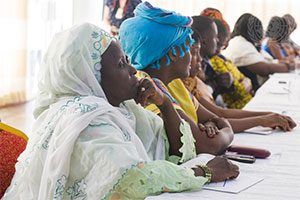 Representatives of Civil Society, Sierra Leone. Credit: UN Photo/Eskinder Debebe
Civil society faces mounting threats worldwide, even as it remains essential for democratic accountability, especially in countries struggling with economic instability and social inequality. However, at the same time, nations with weak democratic governance structures also systemically suppress the power of civil society. Human rights activists across the Global South frequently challenge issues such as political persecution and gender oppression, but in return face state-sanctioned punishment for their advocacy. Imprisonment and exile are common mechanisms of punishment that seek to erode the strength of civil society. The 2026 World Press Freedom Index has reached its lowest level in 25 years, with more than half of the world’s countries now falling into the "difficult" or “very serious” category for press freedom. IPS seeks to highlight the work of civil society across the Global South as well as the challenges that they face.
Updated by Yilan Batista and Shuli Wong August 2026

The Week with IPS

NEXT STOP - SDGs
Tracking global progress towards a sustainable world
Tracking global progress towards a sustainable world
