Languages
Friday, November 20, 2026



News and Views from the Global South
Civil Society

Fossil Fuel Subsidies Dampen Shift Towards Renewables
Despite evolving public awareness and alarm over climate change, subsidies for the production and consumption of fossil fuels remain a stubborn impediment to shifting the world’s energy matrix towards renewable sources.
Vieques Goes from Bombs to Beets
A decade after the United States Navy’s departure, the Puerto Rican island town of Vieques faces new challenges, and the rebirth of its agriculture sector is hampered by a legacy of toxic military trash that has uncertain consequences.Philippines Makes Tentative Truce With Islamists
After two years of intensive negotiations, the Philippine government and the country’s largest rebel group, the Moro Islamic Liberation Front (MILF), have signed a final peace agreement, which paves the way for a lasting resolution of one of the world’s longest-running intra-state conflicts.
Bursting the ‘Blood Bubble’
The longstanding Israeli practice of labelling settlement products “Made in Israel” is leading to mounting opposition to the occupation.
Small Ray of Hope in Mexico’s Forced Disappearances
Tita Radilla is waiting, somewhat sceptically, for Mexican military personnel accused of carrying out forced disappearances to be brought before civilian courts. It is a demand that has spanned the past five decades.
Doctors Resist Deadly Vaccine
A spate of sudden infant deaths following vaccination in India has prompted leading paediatricians to call for stronger regulatory mechanisms to evaluate new vaccines for safety and efficacy before their acceptance into the national immunisation programme.
Brazil’s ‘Rolezinhos’ Want Room in the Palaces of Consumerism
They poured into shopping malls en masse to have some fun. But the reaction, a mixture of fear, admiration and heavy-handed repression, brought a new youth movement into being in Brazil: the “rolezinhos.”
Energies Clash in Tokyo Election
Tokyo, one of the largest and most energy-guzzling cities in the world, is set to hold elections for a new governor Feb. 9. Analysts say it could prove crucial in stopping the Japanese government from restarting some nuclear reactors this year.
Suicide Brings Azerbaijan’s LGBT Community Out of the Closet
The suicide of a gay rights activist in Azerbaijan is prompting the country’s LGBT community to become more assertive in fighting for civil rights.
Poverty Wages Unraveling Cambodia’s Garment Industry
Cambodia’s garment industry is regularly plagued with strikes and protests. But when armed security forces opened fire on striking workers in the capital city of Phnom Penh on Jan. 3, killing five and injuring dozens, it suddenly became clear that this was not just another protest.
Egypt’s Generals Face a Watery Battle
Heavy reliance on water intensive crops, a major upstream dam project for the Nile basin, and rising groundwater levels pushing at pharaoh-era monuments will be pressing issues for the next Egyptian president - whether military or civilian.
U.S. Selling Coal Mining Rights at Undervalued Prices
The U.S. government is violating federal leasing policies when it sells land to certain coal-mining companies, according to a new audit from an official watchdog agency.
After Slowdown, Global Fight for Land Rights at Tipping Point
Global trends towards a strengthening of legal rights over land for local and indigenous communities appear to have slowed significantly in recent years, leading some analysts to warn that the fight for local control over forests has reached an inflection point with a new danger of backtracking on previous progress.
Pakistan Caught Between Talking and Fighting
Whether to make war or peace with the Taliban has become a dilemma for the Pakistani government.
Advocacy Groups Split on Republican Immigration Guidelines
Pro-immigration reform advocates here are seeking to capitalise on new federal momentum on the issue after conservative lawmakers ended months of dithering late last week and released an initial set of principles that they would be interested in pursuing in broader negotiations.
U.S. Urged to Conclude Longstanding Review on Landmines
The U.S. government is being urged to conclude a review of national policy on landmines that has dragged on for more than four years, a lag that some say has indirectly led to the injury or death of more than 16,000 people.
Moral Monday Protests Inspire Truthful Tuesdays
Moral Monday, the populist movement in North Carolina that saw a diverse coalition of thousands of progressive activists descend upon the state legislature, is now spreading throughout the U.S. South.
Living Again With the Ways of Tito and Stalin
One of the best kept secrets of former Yugoslavia is out in the open after the online release of the names of 16,101 inmates of Goli Otok, or the Naked Island, the country’s only gulag – a Soviet system of forced labour camps – created 65 years ago.
Dalit Women Face Multiplied Discrimination
Maya Sarki, a resident of Belbari in eastern Nepal, was returning home one summer evening last year when she was attacked. She was forced down on the ground and her attacker attempted to rape her.
HIV On a Dangerous Threshold in Sri Lanka
Four thousand HIV infections in a population of 20 million should not be a difficult figure to manage. But experts in Sri Lanka say social customs and strict laws are hindering them from carrying out prevention and awareness campaigns among high-risk groups.
Protesters Resist an ‘Indian Fukushima’
Activists opposed to India’s plans to massively increase civilian nuclear power production are aghast that a plan for an Indo-Japanese nuclear cooperation deal is gaining pace even while Japan is struggling to cope with the fallout of the March 2011 Fukushima nuclear disaster.« Previous Page — Next Page »


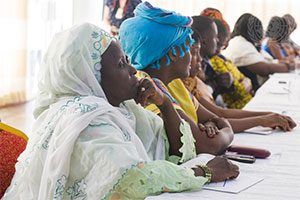 Representatives of Civil Society, Sierra Leone. Credit: UN Photo/Eskinder Debebe
Civil society faces mounting threats worldwide, even as it remains essential for democratic accountability, especially in countries struggling with economic instability and social inequality. However, at the same time, nations with weak democratic governance structures also systemically suppress the power of civil society. Human rights activists across the Global South frequently challenge issues such as political persecution and gender oppression, but in return face state-sanctioned punishment for their advocacy. Imprisonment and exile are common mechanisms of punishment that seek to erode the strength of civil society. The 2026 World Press Freedom Index has reached its lowest level in 25 years, with more than half of the world’s countries now falling into the "difficult" or “very serious” category for press freedom. IPS seeks to highlight the work of civil society across the Global South as well as the challenges that they face.
Updated by Yilan Batista and Shuli Wong August 2026

The Week with IPS

NEXT STOP - SDGs
Tracking global progress towards a sustainable world
Tracking global progress towards a sustainable world
