Languages
Friday, October 2, 2026



News and Views from the Global South
Aid

Donors Must Seize 2013 Opportunity in Sahel, U.N. Urges
Reporting that the worst of the food crisis in the Sahel region of Africa appears to have been averted, the United Nations’ top official on the area, David Gressley, warned on Wednesday that the potential passing of the immediate emergency should not divert international attention from what needs to be done in 2013, which he calls a critical year for building resilience in the region.
Social Inclusion the Key to Venezuela’s Elections
Whoever wins Venezuela's presidential elections on Sunday Oct. 7 will do so as a result of the idea of social inclusion, which has become dominant in an electorate whose social and political features have changed radically in the last decade.
Less Than Half of International Foreign Aid Is Transparent
As a major international deadline on foreign assistance transparency draws closer, a new index shows that while donors are becoming more open with their data, still less than half of foreign aid information is openly available.
Task Force to Kick Start Cairo Population Goals
Gathered at the Ford Foundation in New York Monday, international luminaries, family planning experts and women's rights activists repeatedly expressed a common sentiment: “I cannot believe that we are still having this discussion today."
Haiti’s Two-Million-Dollar Ghost Town
Just months after the Jan. 12, 2010, earthquake killed over 200,000 Haitians and drove another 1.3 million into squalid camps, the Building Back Better Communities (BBBC) project got the green light from the Interim Haiti Reconstruction Commission (IHRC), headed by former U.S. president Bill Clinton and then-Haitian prime minister Jean Max Bellerive.
HAITI: Housing Exposition Exposes Waste, Cynicism
The smells and scenes that greet a visitor to this eerily empty collection of over 60 brightly painted homes and buildings verge on the obscene.
Self-Financing that Works for the Poor
"We were used to losing, so a group of us said to ourselves: let's lose something here," said Carmen Caravallo, describing the start of a "bankomunal", a self-managed microfinance fund based on investment, in her rural community in eastern Venezuela.
For Development, Jobs May Outweigh Growth, World Bank Says
The World Bank warned Monday that over the next decade and a half, the world will need to create 600 million new jobs, particularly in Asia and Sub-Saharan Africa, just to maintain current employment rates.
Haitian Government Faces Mounting Popular Anger
Several thousand marchers demonstrated against Haitian President Michel Martelly on Sunday, the anniversary of a bloody coup d’état that toppled president Jean-Bertrand Aristide 21 years ago.
Gaza Looks For Work, Not Aid
“The overwhelming majority of people we work with tell us, 'We don't want the aid, we want to have an opportunity to work and earn money’. Especially people who had a decent job but lost it in the last many years: before asking for any aid, they ask for a job.”U.S. Accused of “Discouraging” Financial Transaction Tax
On Friday, 62 civil-society organisations charged the U.S. State Department with spreading “misinformation” regarding the feasibility of levying a small tax on stock sales and other financial transactions, revenues from which could be used for national and international public goods.
Q&A: “Women and Girls Must Be Front and Centre”
With the global population on track to reach a staggering nine billion people by 2050, according to U.N. figures, a stronger action plan is needed to address the challenges of ending poverty, ensuring a well-functioning health system and access to education, as well as guaranteeing social inclusion for all.
Delivering Promises to Africa’s Smallholder Farmers
Investment in rural infrastructure and support for Africa's millions of small-scale farmers have increased in the past decade. But as these farmers begin to see increased yields, the question of better access to markets comes to the fore.
Multilateralism is at a Crossroads
Multilateralism is at a crossroads. This is a crucial matter for environmental and sustainability issues, as we have seen in the Rio+20 Summit, and for trade and other economic matters. The G20 Summit in Los Cabos, Mexico, focused precisely on improving our collective response to the current economic turbulence, which is at the heart of developments in the European Union (EU) as well.
Arab Spring Teaches Food Security
African leaders should take note of the lessons learned from the Arab Spring and realise that ensuring good governance and food security will avoid crises on the continent, says Kofi Annan, chairman of the Africa Green Revolution Alliance.
Private Sector, U.N. Unite to Bring Millions into Classrooms
U.N. Secretary-General Ban Ki-moon Wednesday launched a new initiative aimed at giving education the highest political priority in the global agenda and ensuring progress towards the U.N.’s Millennium Development Goals (MDGs).
New Roadmap for NGOs in Haiti Aims to “Weed Out Bad Apples”
Haitian Prime Minister Laurent Lamothe and representatives from more than 50 non-governmental organisations, including actor-activist Sean Penn, met in New York on Monday to present a new roadmap for humanitarian aid in the country.
Giving Women Farmers the Tools to Prevent Food Insecurity
If women had equal access to productive farming resources, they could increase their yields by 20 to 30 percent and potentially raise total agricultural output in developing countries by 2.5 to four percent.

Will India Still Supply Cheap Drugs to the World?
India may be famous for the Taj Mahal, its religious ceremonies, Bollywood films and one of the highest economic growth rates in recent years. But more importantly, India has had a positive global impact through its supply of vast quantities of low-cost, good-quality generic medicines, which have saved or prolonged millions of lives.Côte d’Ivoire – New Cassava Varieties Bring Women Autonomy
Women farmers in Côte d'Ivoire are achieving greater autonomy and economic independence thanks to new varieties of cassava.
As Aid Shrinks, U.N.’s Development Goals Under Threat
If the developing world fails to meet the targets set in the eight Millennium Development Goals (MDGs) – relating mostly to poverty, hunger, education, health care, gender empowerment and the environment – the primary blame for the failure would be on Western donors who have reneged on their aid commitments, according to a new report released here.« Previous Page — Next Page »


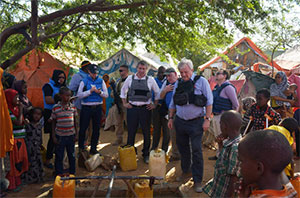 UN Emergency Relief Coordinator Visits Somalia. Credit: UN Photo/Tobin Jones
In recent years, conflicts have broken out across the world with no sign of slowing down or stopping. In times like this, millions of people globally are in dire need of humanitarian aid. Famine, warfare, natural disasters, and economic decline plague a host of nations, including Palestine, Sudan, Chad, Lebanon, and Haiti, to name a few. Humanitarian aid provides millions of people with critical services including healthcare, food, clean drinking water, psychosocial support, housing, and access to education. UN agencies such as the UNDP, UNICEF, the World Food Programme (WFP), UNHCR, UNRWA, and UNEP work with the UN Office for the Coordination of Humanitarian Aid (OCHA) and local organizations to come up with the best possible strategies to support affected communities. At the same time, humanitarian aid and those working on the frontlines are consistently threatened by both actors directly involved in conflict as well as those who are meant to contribute to the international humanitarian regime at large. The near-collapse of United States international aid structures in 2025, including the termination of 83% of USAID’s 6,300 global initiatives, has left millions of people without access to vital humanitarian assistance. 98 million people in 2025, only 65% of people targeted for humanitarian assistance, received the help they needed. In contrast, 123 million people received some form of humanitarian assistance in 2024, and OCHA’s 2026 Global Humanitarian Overview estimates that 239 million people are in need of assistance in 2026. IPS is well-positioned to discuss current initiatives to provide aid and relief through in-depth reporting and opinion content.

The Week with IPS

NEXT STOP - SDGs
Tracking global progress towards a sustainable world
Tracking global progress towards a sustainable world
