Languages
Wednesday, September 23, 2026



News and Views from the Global South
Aid

Afghan Mission Not Quite Ending
NATO member countries like Canada will continue to be asked to shoulder the burden of a military mission stuck in Afghanistan because of the continued vulnerability of the Kabul-based government.
First Steps to Save Burkina Faso’s Forests
Burkina Faso has just received a grant of 30 million dollars from the Forest Investment Programme to help protect the country's forests and reduce greenhouse gas emissions associated with deforestation.OP-ED: Egyptian Muslim Brotherhood: Exclusion Breeds Radicalism
The Egyptian military’s removal of the democratically-elected President Mohamed Morsi and the Muslim Brotherhood from power upended the MB’s 20-year old political participation programme. If the new regime aims to achieve genuine reconciliation and political consensus, the MB and its supporters must be included in the restructuring of Egyptian politics.
In Search of a New Pan-Africanism
Bridging the gap between Pan-Africanism and the African Renaissance has been a top priority for the African Union (AU).
Insuring Ghana’s Smallholder Farmers Against the Weather
Smallholder farmer Suleman Mustapha Simbia, 40, is pleased with the introduction of an insurance initiative called the Ghana Agriculture Insurance Programme. The programme is being implemented in this West African nation to help farmers who had been suffering from loss of income as a result of the bad weather conditions that affect their yields.U.S. Government-Funded News Comes Home
Following the amendment of a long-standing U.S. law, people in this country will now be exposed to news which is produced by the U.S. government.
U.S., U.K. Accused of Ignoring, Facilitating Abuses in Ethiopia
The U.S. and U.K. foreign assistance offices are being accused of ignoring, mischaracterising or downplaying testimony offered by ethnic communities in Ethiopia who accuse the Addis Ababa government of forcefully evicting them from their lands and violating their human rights in the name of mass development projects.
New EU Rules ‘Fail’ Against Shipbreaking Dangers
Hundreds of European vessels are scrapped under hazardous conditions in South Asia every year. European parliamentarians have approved a new regulation to tackle the problem - but critics say it will have very limited impact.
Hamas Strikes Just the Wrong Note
Mohammed Assaf is on to a winning track with recordings in Dubai and performances scheduled across Arab countries after winning the Arab Idol contest. But the 23-year-old who has become Gaza’s pride is virtually disowned by the government in Gaza.
EU Bank ‘Funding Polluters’
The European Investment Bank, the largest institutional bank in the world, is facing criticism for its funding of fossil fuel projects and for weaker standards for lending to coal plants than currently proposed in both the U.S. and Canada.
New Labour Norms Could Hurt Bangladesh
The decisions of the United States and the European Union to demand implementation of controversial labour standards in Bangladesh following the Sawa industrial tragedy pose a serious threat to the rule-based global trading system, says Dr Supachai Panitchpakdi, Secretary-General for United Nations Conference on Trade and Development.Obama’s Many Middle East Miseries Multiply
No doubt the administration of President Barack Obama had hoped that this week’s foreign policy news would be dominated by the high-level U.S.-China Strategic and Economic and Dialogue (S&ED) that just ended here Thursday.
Quakes Could Collapse Kathmandu
As the chief of building codes and earthquake safety of the Lalitpur Municipality, located about 10 km from Nepal’s capital, Kathmandu, Sainik Raj Singh has the tough job of cracking down on builders who fail to comply with the government’s construction regulations.
When Children Give Birth to Children
Radhika Thapa was just 16 years old when she married a 21-year-old boy three years ago. Now, she is expecting a baby and is well into the last months of her pregnancy. This is not the first time she has been with child – her first two pregnancies ended in miscarriages.
War or Peace, Sri Lankan Women Struggle to Survive
It has been four years since the guns fell silent in Sri Lanka’s northern Vanni region, after almost three decades of ethnic violence. Unfortunately peace does not mean the end of hardship for the most vulnerable people here: the women.
Lighting Up Kampala’s Informal Settlements
As he sits in the family lounge in Kamwokya, an informal settlement in Kampala, with the afternoon sunshine streaming through the door, Joseph Senkungu remembers a time when life, and his home, was very dark.
A Floral Touch to Employment in Kashmir
As a little girl, Rubeena Begum had big plans: she would become a doctor and secure a decent income working in one of the 30 hospitals in the Himalayan state of Kashmir in north India.
Nepal Scores Low on Quality Education
Sabitri Kumari Das, a middle-aged mother of two, is rightfully worried about her two young daughters: both girls attend a public primary school in Nepal’s capital, Kathmandu, and neither one of them seems to be advancing academically.
Egyptian Army’s Firepower Overwhelmingly U.S.-Supplied
When the dust settles from the ongoing deadly confrontations between the Egyptian armed forces and thousands of Islamist protesters in the streets of Cairo and Alexandria, the eventual winner will be the United States - specifically U.S.-made weapons systems in the hands of the country's 440,000-strong military.
Venezuela and Dominican Republic Come Calling at CARICOM
The Dominican Republic first expressed interest in joining the 15-member Caribbean integration grouping CARICOM in 1989. Now, 14 years later, the Spanish-speaking country with a population of nearly 10 million may finally get its wish.
Fighting Drought, One Pond at a Time
 Bangladesh, a country of 150 million people who depend on rice as their main staple, is gearing up for drought. Already huge areas of the rice-producing regions are on a knife's edge, as elusive rains and hotter temperatures team up on thirsty paddy fields and threaten to disrupt food supply.
« Previous Page — Next Page »


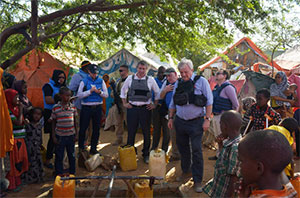 UN Emergency Relief Coordinator Visits Somalia. Credit: UN Photo/Tobin Jones
In recent years, conflicts have broken out across the world with no sign of slowing down or stopping. In times like this, millions of people globally are in dire need of humanitarian aid. Famine, warfare, natural disasters, and economic decline plague a host of nations, including Palestine, Sudan, Chad, Lebanon, and Haiti, to name a few. Humanitarian aid provides millions of people with critical services including healthcare, food, clean drinking water, psychosocial support, housing, and access to education. UN agencies such as the UNDP, UNICEF, the World Food Programme (WFP), UNHCR, UNRWA, and UNEP work with the UN Office for the Coordination of Humanitarian Aid (OCHA) and local organizations to come up with the best possible strategies to support affected communities. At the same time, humanitarian aid and those working on the frontlines are consistently threatened by both actors directly involved in conflict as well as those who are meant to contribute to the international humanitarian regime at large. The near-collapse of United States international aid structures in 2025, including the termination of 83% of USAID’s 6,300 global initiatives, has left millions of people without access to vital humanitarian assistance. 98 million people in 2025, only 65% of people targeted for humanitarian assistance, received the help they needed. In contrast, 123 million people received some form of humanitarian assistance in 2024, and OCHA’s 2026 Global Humanitarian Overview estimates that 239 million people are in need of assistance in 2026. IPS is well-positioned to discuss current initiatives to provide aid and relief through in-depth reporting and opinion content.

The Week with IPS

NEXT STOP - SDGs
Tracking global progress towards a sustainable world
Tracking global progress towards a sustainable world
