Languages
Wednesday, September 23, 2026



News and Views from the Global South
Aid

The Classrooms Are Full – but the Students Can’t Read
Many Pacific Island nations are celebrating the success of rising school enrolment rates, with 14 members of the 16-member Pacific Island Forum on target to meet Millennium Development Goal 2: achieving universal primary education by 2015.
Q&A: “The Middle Class Is Making Its Voice Heard in Brazil Today”
The protests on the streets of Brazil are the result of the expansion of the middle class, who want their demands to be heard, said Rebeca Grynspan after visiting the country to inaugurate the World Centre for Sustainable Development.Pro-Israel Advocates Push for Continued Aid to Egypt
Two days after a military coup ousted Egyptian President Mohamed Morsi, Washington appeared deeply divided over how to respond to what most experts believe is a critical moment for future relations between the U.S. and political Islam both in Egypt and throughout the Middle East.
Girls Fight Back Against Child Marriage
Shirin Aktar was just 13 years old when her parents decided it was time for her to get married.OP-ED: Egypt Coup Challenges U.S. Credibility
The military’s removal of democratically elected President Mohamed Morsi poses a serious challenge to Washington’s pro-democracy agenda and its ability to influence events in Egypt and the rest of the region.
Egypt Between a Public Movement and a Military Coup
In less than three days, Egypt moved from being under the rule of religious Islamists to being in different civilian hands as well as military ones. Mohamed Morsi, Egypt's first democratically elected president, was overthrown by the army on Wednesday after massive nationwide protests calling for his removal on the first anniversary of his election to power.
Leasehold Forestry Breathes New Life into Nepal
 Over 40 percent of Nepal is covered in thick forest, but most of it has been degraded. Rural communities that have traditionally relied on the forests for survival now live in abject poverty, struggling to secure the food necessary for survival. Most men have migrated to the Gulf in search of employment.

Oiling the Palms of Cameroon’s Farmers
In Maleke village, western Cameroon, an oil palm tree is considered to be “black gold”. At least, that is what Joseph Tesse, the local processor of oil palm, tells IPS.
/CORRECTED REPEAT*/U.S. Walks Tightrope in Wake of Egypt Coup
Wednesday’s coup d’etat against the elected government of Egyptian President Mohamed Morsi has placed the administration of President Barack Obama in an uncomfortable position on a number of fronts.
In the Land of the Gods, Disaster Response Falls Short of Divine
Over 580 bodies have so far been found. Hundreds more will likely never turn up. Survivors say they are suspended in a kind of nightmare, either haunted by memories of their brush with death or desperate for news of loved ones. At least 3,000 are reported to be missing.
A Latin America With Opportunity for All
Latin America has had a good decade. Over the last 10 years, economic growth averaged 4.2 percent, and 70 million people escaped poverty. Macroeconomic stability, open trade policies and pro-business investment climates have supported and will continue to support strong growth in the years to come.
What’s Good for Brazil Is Good for Africa
As Africa transforms its economy, it will need modern jobs and increased productivity to fight hunger on the continent, African leaders agreed at a two-day summit.
Q&A: Generating Global Governance to End Hunger
Sub-Saharan Africa may be home to six of the world's 10-fastest growing economies, but it also has a majority of the countries that are suffering from a food crisis.
Obama Plan to Electrify Africa Offers a “New Model” of Aid
During an eight-day trip to Africa, President Barack Obama unveiled an ambitious plan to improve access to electricity across the continent, a move the White House says is designed to lift Sub-Saharan Africa out of poverty and help the region develop a stable middle class.
Obama Calls for Compromise in Egyptian Crisis
U.S. President Barack Obama Monday called for both the Muslim Brotherhood-dominated government of Egyptian President Mohamed Morsi and opposition forces to compromise in the fast-developing political crisis.
Q&A: World Needs a Plan for Expected Waves of Climate Refugees
Untold thousands dead and thousands more stranded or missing - these are the latest figures from various reports on the devastation caused by flash floods in the Indian state of Uttarakhand.
China Leads Battle Against Poverty, Says U.N.
The United Nations has singled out China - the world's most populous country with over 1.3 billion people - as one of the key success stories in the longstanding battle against poverty.
Bright Ideas Will Help Feed Africa’s Poor
Across Africa, smallholder farmers, who are some of the world’s most impoverished people, are slowly being introduced to innovative approaches, such as entrepreneurial loan schemes and conservation practices, to combat food insecurity.
Tunisia Now Searches an Economic Spring
Nearly two-and-a-half years since the toppling of the autocratic regime of Zine el-Abidine Ben Ali in the first regime change of the now famous Arab Spring, the high expectations of change to come with the revolution have hardly been met.
Dreaming Big – But Who Will Fund Southern Africa’s Infrastructure Plans?
Mounds of sand and rubble are what are left of sections of Maputo’s beachfront road as bulldozers, manned by Chinese construction workers, tear up the road that is being rebuilt. Southern Africa is under construction and the reminders are everywhere.
Angola Slow on Drought Response as People Die of Hunger
Church groups, local NGOs and international aid organisations have launched appeals to get supplies to drought-stricken southern Angola where people are reported to be dying from a lack of food and water. It is estimated that between half a million and 800,000 people have been affected.« Previous Page — Next Page »


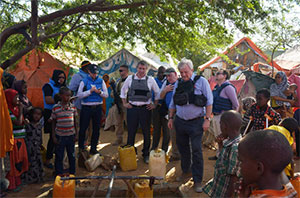 UN Emergency Relief Coordinator Visits Somalia. Credit: UN Photo/Tobin Jones
In recent years, conflicts have broken out across the world with no sign of slowing down or stopping. In times like this, millions of people globally are in dire need of humanitarian aid. Famine, warfare, natural disasters, and economic decline plague a host of nations, including Palestine, Sudan, Chad, Lebanon, and Haiti, to name a few. Humanitarian aid provides millions of people with critical services including healthcare, food, clean drinking water, psychosocial support, housing, and access to education. UN agencies such as the UNDP, UNICEF, the World Food Programme (WFP), UNHCR, UNRWA, and UNEP work with the UN Office for the Coordination of Humanitarian Aid (OCHA) and local organizations to come up with the best possible strategies to support affected communities. At the same time, humanitarian aid and those working on the frontlines are consistently threatened by both actors directly involved in conflict as well as those who are meant to contribute to the international humanitarian regime at large. The near-collapse of United States international aid structures in 2025, including the termination of 83% of USAID’s 6,300 global initiatives, has left millions of people without access to vital humanitarian assistance. 98 million people in 2025, only 65% of people targeted for humanitarian assistance, received the help they needed. In contrast, 123 million people received some form of humanitarian assistance in 2024, and OCHA’s 2026 Global Humanitarian Overview estimates that 239 million people are in need of assistance in 2026. IPS is well-positioned to discuss current initiatives to provide aid and relief through in-depth reporting and opinion content.

The Week with IPS

NEXT STOP - SDGs
Tracking global progress towards a sustainable world
Tracking global progress towards a sustainable world
