Languages
Monday, November 2, 2026



News and Views from the Global South
Aid

Europe Failing Syrian Refugees
Refugee rights organisations are demanding an EU-wide temporary protection regime for Syrian refugees. The announcement by some countries that they can take a few thousand refugees is not enough, the groups say.
Preoccupied with Syria, U.S. Still Saddled with Egypt
The United States, which is preoccupied with the ongoing political and military developments in Syria, is still saddled with an unresolved problem elsewhere in the Middle East: the military takeover of Egypt's first democratically-elected government.
Africa in Debt to Brazil: Forgiveness Isn’t Always Free
The Brazilian government projects the cancellation of nearly 900 million dollars in debt owed by a dozen African countries as a gesture of solidarity. But others simply see an aim to expand the economic and political influence of South America’s powerhouse.
Mugabe’s Policies Starve Zimbabweans
Tambudzai Javangwe from Mwenezi district in southern Zimbabwe, has run out of food and each day she begs for hand-outs from well-wishers so that she can feed herself an her six orphaned grandchildren.
Cash Transfers a Strong Tool Against Inequality
Latin America’s cash transfer programmes are a more effective weapon against poverty and social inequality than economic growth alone, according to a study by two Argentine economists.
Q&A: “We Need a Decisive Win Against Polio”
Africa and Pakistan are now battling outbreaks of polio, threatening the extraordinary progress the world has made in fighting the almost-extinct disease. In the Horn of Africa, there are now 121 reported polio cases. Last year, there were 223 worldwide. Siddharth Chatterjee has served as the chief diplomat, head of strategic partnerships and international relations at the International Federation of the Red Cross and Red Crescent Societies, the world’s largest humanitarian network, since June 2011.
Migrant Rights Defenders in Mexico Face Growing Pressure
"No one can stop me from working for migrants' rights, because no one is above my own conscience," said Mexican Catholic priest Alejandro Solalinde.
West Cold-Shoulders Rebuilding Southern Africa
The Southern African Development Community has had to revisit its plans to raise funding for its ambitious regional development plan in the wake of a cold-shoulder from western nations and multilateral finance institutions.
DR Congo Armed Groups Increase Child Recruitment
Over 2,000 children are still being used as soldiers by 27 armed groups in North Kivu in eastern Democratic Republic of Congo despite efforts by the United Nations Children’s Fund to remove them from the frontlines and return them to their homes.
Israeli Lobby Looks to 2008 Law to Justify Request for More U.S. Aid
Israel and its domestic U.S. lobby are already in the early stages of the next 10-year aid package, which would not go into effect until 2017 and will be the first since Congress passed the Naval Vessel Transfer Act of 2008, which requires in part that U.S. military aid to Israel ensure that Israel maintains its "Qualitative Military Edge" (QME) over any combination of states and non-state actors.
Zimbabwe Sails Close to Economic Rocks
For President Robert Mugabe to defeat the opposition in the Jul. 31 election by hook or by crook may have been a walk in the park, but beating the economic crisis will be another matter. The stock market fell 11 percent the day he was sworn in, the biggest fall in a day since 2009.
Q&A: Egypt’s Muslim Brotherhood Is Not Going Away
Almost 1,000 Egyptians have died, according to official count, since Aug. 14 when Egypt's armed forces began cracking down on Muslim Brotherhood-led protests against the military ouster of President Mohamed Morsi. That number well exceeds the 846 people officials say died during the 18 days of protests that ended Hosni Mubarak's 30-year rule in January 2011.
Opening Books Beneath Bombs
The school system in Syria’s largest Palestinian refugee camp Yarmouk, located in capital Damascus, has been shattered by the fighting that now bedevils the community and the siege that strangles the district. Some tenacious teachers are, however, refusing to leave the camp and are battling against odds to provide education to an ever-growing number of youngsters.Aid Cuts Childbirth Risks in Bangladesh
Seven months pregnant, 24-year-old Shumi Begum has travelled 220 km from her village with her paternal grandmother to consult a specialist on childbirth.
Washington’s Worries Grow Over Saudi Ties
As the administration of President Barack Obama continues wrestling with how to react to the military coup in Egypt and its bloody aftermath, officials and independent analysts are increasingly worried about the crisis's effect on U.S. ties with Saudi Arabia.
Musical Toilets for a Few While 2.5 Billion Lack Basics
Even as the United Nations laments the fact that more than 2.5 billion people in the developing world are still without adequate sanitation, both Japan and South Korea have gone upscale: offering automated toilets and piped-in classical music.
The World Trade Organisation after Eight Transformational Years
On Aug. 31, I will be stepping down after eight years as Director-General of the World Trade Organisation (WTO).
Poor and Disabled When Disaster Strikes
Upon first glance, the emergency checklist distributed in Haiti after the 2010 earthquake looks like any other. Organised into key categories like water, sanitation and hygiene, and psychosocial support, the information is typical of the kind circulated for emergency response.
Violence Against Civilians Peaks in Central African Republic
As Michel Djotodia took his oath as the new president of the Central African Republic (CAR) on Aug. 18, Séléka, the coalition of rebel groups that he led and that helped him overthrow the government on Mar. 23, were still looting and killing civilians.
Africa’s Largest Hydroelectric Project May Hit the Rocks
There are big aspirations for Africa’s largest hydroelectric project, the Inga III that is set to be built in the Democratic Republic of Congo. But analysts are sceptical that such an ambitious project will ever be realised.
U.S. Arms Industry Would Lose Big from Egypt Aid Cut-Off
The United States, which has refused to cut off its hefty 1.3 billion dollars in annual military aid to Egypt, continues to argue that depriving arms to the 438,500-strong security forces will only "destabilise" the crisis-ridden country.« Previous Page — Next Page »





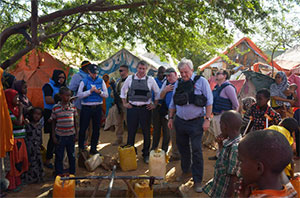 UN Emergency Relief Coordinator Visits Somalia. Credit: UN Photo/Tobin Jones
In recent years, conflicts have broken out across the world with no sign of slowing down or stopping. In times like this, millions of people globally are in dire need of humanitarian aid. Famine, warfare, natural disasters, and economic decline plague a host of nations, including Palestine, Sudan, Chad, Lebanon, and Haiti, to name a few. Humanitarian aid provides millions of people with critical services including healthcare, food, clean drinking water, psychosocial support, housing, and access to education. UN agencies such as the UNDP, UNICEF, the World Food Programme (WFP), UNHCR, UNRWA, and UNEP work with the UN Office for the Coordination of Humanitarian Aid (OCHA) and local organizations to come up with the best possible strategies to support affected communities. At the same time, humanitarian aid and those working on the frontlines are consistently threatened by both actors directly involved in conflict as well as those who are meant to contribute to the international humanitarian regime at large. The near-collapse of United States international aid structures in 2025, including the termination of 83% of USAID’s 6,300 global initiatives, has left millions of people without access to vital humanitarian assistance. 98 million people in 2025, only 65% of people targeted for humanitarian assistance, received the help they needed. In contrast, 123 million people received some form of humanitarian assistance in 2024, and OCHA’s 2026 Global Humanitarian Overview estimates that 239 million people are in need of assistance in 2026. IPS is well-positioned to discuss current initiatives to provide aid and relief through in-depth reporting and opinion content.

The Week with IPS

NEXT STOP - SDGs
Tracking global progress towards a sustainable world
Tracking global progress towards a sustainable world
