Languages
Sunday, September 27, 2026



News and Views from the Global South
Aid
‘Money Wasted Without Policy’
As European Commission leaders make calls for EU countries to raise their spending on development aid for the world’s poor, groups working in underdeveloped states have warned that without more effective aid policies and networks, extra financing may be wasted.
Bringing Kenya’s Government to the People
Like many Kenyans, Eunice Kemboi arrived at the Moi International Sports Centre in Nairobi on Tuesday Apr. 9 to witness the transition of power as Uhuru Kenyatta, an International Criminal Court suspect, was sworn in as the country’s new president.Obama Requests Modest Bump in Foreign Aid
U.S. President Barack Obama Wednesday asked Congress to approve some 52 billion dollars in foreign aid and international spending in 2014, slightly higher than the current year’s budget which was cut due to the partisan impasse over how to reduce the yawning federal deficit.EU Calls for New Plans Past the MDGs
The European Commission has unveiled a blueprint for global development aid and called on world leaders to replace the Millennium Development Goals (MDGs) with an international aid framework based on sustainable and inclusive development tackling poverty at its roots.
Access to Sanitation Still a Luxury for the Very Few
About 20 communities in Tillabéri, west Niger, have been declared open defecation-free zones as across the country, very few people have access to proper sanitation.
U.S. Global Health Cuts Threaten Gains on Lethal Diseases
A U.S.-based civil society coalition is calling on Congress and President Barack Obama’s administration to keep spending on global health aid at current levels, warning that recent budget cuts risk a dangerous backslide in health and development gains achieved over the past three decades.
Daring Woman Enters the Contest
“My sole motive is to serve my people, especially women who have had no role in politics so far. I feel we can make progress only by bringing in women into mainstream politics.”
World Bank to Strengthen Focus on Land Rights
The World Bank will be placing stronger emphasis on issues of land tenure and socially and environmentally sustainable agricultural investing, it announced Monday.
Why Focus on Babies?
I nearly died on the day I was born. My mother laboured for 24 hours in a bush hospital in northern Uganda that had no running water and no electricity. Fortunately, the midwife found a doctor, who had witnessed a Caesarian section, who managed to operate, saving my life and my mother’s. Today, had I been born in one of the many places across the world without adequate maternal and reproductive health care, I may not have survived my own day of birth.
The Other Side of the Coin in Spain
Wholemeal rye bread, lettuce and chard are some of the products on offer from the El Caminito urban vegetable garden at the small organic produce market in this southern Spanish city, with prices set in "comunes", one of more than 30 social currencies circulating in the country.
Water Shortage Hits Pacific Women
The Solomon Islands, a developing island nation in the south-west Pacific Islands, has one of the highest urbanisation rates in the region, and the basic service infrastructure is struggling to cater for the influx of people from the provinces to the capital, Honiara. Thirty-five percent of the city’s population, who live in informal settlements, are facing the health consequences of a dire shortage of clean water and sanitation.
Moving on from Rwanda’s 100 Days of Genocide
Bernard Kayumba, the mayor of Karongi district in western Rwanda, remembers just what it was like to be caught up in the genocide that claimed the lives of almost one million people in 100 days 19 years ago.
Troops May Join Mexico’s Fight Against Hunger
The Mexican government is considering using the armed forces, which face serious human rights accusations from their involvement in the war on drugs, to collect socioeconomic data from the low-income households that will benefit from the National Crusade Against Hunger.
U.S. Aid to Post-Earthquake Haiti a “Black Box”
Following the devastating 2010 earthquake in Haiti, more than a billion dollars of U.S. aid money has gone to that country with little transparency or accountability on how the money is being used, according to new data released by a watchdog group here.Getting Past Aid to Develop
With the level of Western aid to the world’s poorest countries declining amid the global financial crisis, economists are calling for “innovative” means of development that range from proper taxation of multinationals to laws that ensure gender equality.
Children Learn Lessons of Commerce on the Streets of Zimbabwe
Susan Sithole* is 14 and should be in grade nine or Form Two, according to Zimbabwe's education system, learning her lessons in Mathematics, English and other subjects.
Solar Energy and Briquettes Make Headway in Haiti
While Jean Reniteau mulls over the idea of using solar panels to light his house, Frantz Fanfan is wondering how to expand production of biomass briquettes to replace the use of charcoal in the cooking stoves of most of the Haitian people, who lack electricity.
Building a Better Somali Region
For over two decades Somali Region, in eastern Ethiopia, has been devastated by a grueling insurgency. Trapped in a time warp, it has been forgotten and underdeveloped. But in the last few years, thanks to the increased security here, a five-star hotel, eco-tourism ventures and even a large abattoir are being built by the former diaspora community.
World Bank Aims to End Extreme Poverty by 2030
World Bank President Jim Kim has unveiled a series of new institutional goals aimed at ending extreme poverty by 2030 and focusing on the promotion of “shared prosperity” – increasing the incomes of the poorest 40 percent in each country while placing increased focus on dealing with climate change.
When a Tsunami Comes, Tweet
Soon after the deadly tsunami struck Kesennuma city in the Miyagi Prefecture in Northern Japan on Mar. 11, 2011, 59-year-old Naoko Utsumi found herself on the rooftop of a community centre with only one line of communication to the outside world – the email option on her mobile phone.
Now for a Vacation in Gaza, Maybe
“We wanted to help foreigners in Gaza, so we created an English map of Gaza City,” says Amir Shurrab, one of the minds behind the foldable Gaza Tourist Map.« Previous Page — Next Page »


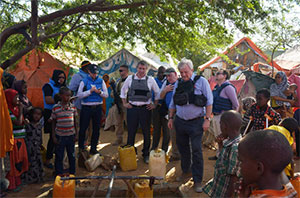 UN Emergency Relief Coordinator Visits Somalia. Credit: UN Photo/Tobin Jones
In recent years, conflicts have broken out across the world with no sign of slowing down or stopping. In times like this, millions of people globally are in dire need of humanitarian aid. Famine, warfare, natural disasters, and economic decline plague a host of nations, including Palestine, Sudan, Chad, Lebanon, and Haiti, to name a few. Humanitarian aid provides millions of people with critical services including healthcare, food, clean drinking water, psychosocial support, housing, and access to education. UN agencies such as the UNDP, UNICEF, the World Food Programme (WFP), UNHCR, UNRWA, and UNEP work with the UN Office for the Coordination of Humanitarian Aid (OCHA) and local organizations to come up with the best possible strategies to support affected communities. At the same time, humanitarian aid and those working on the frontlines are consistently threatened by both actors directly involved in conflict as well as those who are meant to contribute to the international humanitarian regime at large. The near-collapse of United States international aid structures in 2025, including the termination of 83% of USAID’s 6,300 global initiatives, has left millions of people without access to vital humanitarian assistance. 98 million people in 2025, only 65% of people targeted for humanitarian assistance, received the help they needed. In contrast, 123 million people received some form of humanitarian assistance in 2024, and OCHA’s 2026 Global Humanitarian Overview estimates that 239 million people are in need of assistance in 2026. IPS is well-positioned to discuss current initiatives to provide aid and relief through in-depth reporting and opinion content.

The Week with IPS

NEXT STOP - SDGs
Tracking global progress towards a sustainable world
Tracking global progress towards a sustainable world
