Languages
Saturday, September 26, 2026



News and Views from the Global South
Aid

Hunger Rises in Great Britain
The social consequences of austerity economics have been most visible in Europe’s southern periphery. In the UK, the coalition government has brought in sharp cutbacks in welfare state provision in the name of dealing with the financial crisis. Their impact is becoming increasingly visible.Fragile States Show Signs of Progress Toward MDGs
Twenty of the world’s most fragile states, including those currently affected by conflict, have achieved one or more of the development targets outlined under the Millennium Development Goals (MDGs), the World Bank said this week.
U.N. Says Somalia Famine Killed Nearly 260,000
Almost 260,000 people, half of them young children, died of hunger during the last famine in Somalia, according to a U.N. report that admits the world body should have done more to prevent the tragedy.
From Rags to Penury
India’s planners worry about ‘jobless growth’, but perhaps nothing illustrates this phenomenon better than a policy of handing over the collection and disposal of the capital’s refuse to large private corporations, leaving close to 50,000 ragpickers unemployed.
Japan’s Aid Programme Takes a Selfish Turn
As Japan slips from its former top spot as the world’s biggest donor, experts here are worried about long-term changes in the country’s development assistance programme, which has played a crucial role in global poverty reduction efforts.
Monetising Human Waste and 101 (Slightly) Crazy Other Ideas
One, two or more of the 102 newly launched out-of-the box ideas to improve global health could be world-changing breakthroughs.
Activists Fight U.S. Aid to Develop El Salvador’s Pacific Coastline
Community leaders in El Salvador are opposed to the government's plans to use U.S. aid funds to develop the country’s Pacific coastline, on the grounds that it would threaten the environment in a vast area.
Malawi’s Maize Shortage Hits Women
Each night Esnart Phiri, a widow with five children, sleeps outside the gates of the state-run maize trader or Admarc market, in Malawi’s capital Lilongwe, as she waits for days on end to buy maize.
Cell Phones Yes, Toilets No, World Body Laments
Speaking of the widespread sanitation crisis, U.N. Deputy Secretary-General Jan Eliasson was quick to produce staggering numbers: of the world's seven billion people, about six billion have mobile phones but only about 4.5 billion have access to toilets.
Israeli Cloud Hovers Over Green Energy
A quiet diplomatic war is being waged by several European governments against the Israeli authorities, specifically the Israeli Civil Administration which controls the Israeli occupied West Bank.
Tackling Malawi’s Doctor Deficit
In Malawi, where the healthcare system frequently makes headlines for its shortages of drugs and medical workers, a fact that is often overlooked is that two out of four central hospitals do not have a specialist physician in attendance.
Educating Mothers to End South Africa’s Newborn Deaths
A young mother – who only wants to be identified as Karren – beamed as she nursed her newborn baby at the University of Witwatersrand’s Reproductive Health and HIV Institute, in Hillbrow, South Africa.
World Bank Urged to Include Human Rights in Safeguards Review
Backed by the German government and prominent civil society voices, United Nations experts are calling for the World Bank to explicitly incorporate international human right standards into its "safeguards" to minimise negative impacts of bank financing on vulnerable communities and environments.
Learn From the Children
“Recall the face of the poorest and weakest man you have seen, and ask yourself if this step you contemplate is going to be any use to him.”
Insecurity the “Achilles’ Heel of Development” in Latin America
Development experts here are warning that widespread, unchecked violence against citizens in Latin America is posing a threat to the development of the entire region.
World Bank, IMF Link Urbanisation with Development
Two of the world’s largest multilateral institutions have released new data linking greater urbanisation with higher levels of human development, and are announcing that they will place greater priority on issues of urbanisation in coming decades.
Mauritians Unprepared for Effects of Climate Change
Mauritius may be one of the best-prepared countries in the world when it comes to cyclones, but recent heavy rains and flooding due to climate change have brought the country’s readiness for coping with increased rainfall into question.
High Stakes for Engaging Morsi’s Egypt
Women and minorities should be a top priority in U.S. policy toward Egypt and its Muslim Brotherhood government leaders, experts here said on Friday, despite increasingly unfavourable public views towards Egypt.
We Are All Thatcherites Now
The flood of elegiac articles on former British Prime Minister Margaret Thatcher is in itself a good measure of how we have all become Thatcherites without realising it. Only those who are not graced by a young age can see how the world and politics have changed so deeply since her days that it is correct to call her a “great revolutionary”.The Forced Inheritance of DRC’s Military Kids
The children of deceased police and army officers in North Kivu, eastern Democratic Republic of the Congo, are finding themselves forced to adopt their late fathers’careers in the armed services to help their families survive.
Obama’s Budget Lays Out Transformative Change in USAID
Civil society groups here are praising parts of President Barack Obama’s newly unveiled budget proposal, saying it appears to build on momentum gathered in recent years toward a robust overhaul of the U.S. Agency for International Development (USAID), the country’s main foreign aid agency.« Previous Page — Next Page »


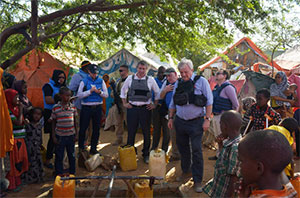 UN Emergency Relief Coordinator Visits Somalia. Credit: UN Photo/Tobin Jones
In recent years, conflicts have broken out across the world with no sign of slowing down or stopping. In times like this, millions of people globally are in dire need of humanitarian aid. Famine, warfare, natural disasters, and economic decline plague a host of nations, including Palestine, Sudan, Chad, Lebanon, and Haiti, to name a few. Humanitarian aid provides millions of people with critical services including healthcare, food, clean drinking water, psychosocial support, housing, and access to education. UN agencies such as the UNDP, UNICEF, the World Food Programme (WFP), UNHCR, UNRWA, and UNEP work with the UN Office for the Coordination of Humanitarian Aid (OCHA) and local organizations to come up with the best possible strategies to support affected communities. At the same time, humanitarian aid and those working on the frontlines are consistently threatened by both actors directly involved in conflict as well as those who are meant to contribute to the international humanitarian regime at large. The near-collapse of United States international aid structures in 2025, including the termination of 83% of USAID’s 6,300 global initiatives, has left millions of people without access to vital humanitarian assistance. 98 million people in 2025, only 65% of people targeted for humanitarian assistance, received the help they needed. In contrast, 123 million people received some form of humanitarian assistance in 2024, and OCHA’s 2026 Global Humanitarian Overview estimates that 239 million people are in need of assistance in 2026. IPS is well-positioned to discuss current initiatives to provide aid and relief through in-depth reporting and opinion content.

The Week with IPS

NEXT STOP - SDGs
Tracking global progress towards a sustainable world
Tracking global progress towards a sustainable world
