Languages
Friday, November 6, 2026



News and Views from the Global South
Education

Côte d’Ivoire Steps Up Public Education to Keep Ebola Count at Zero Amid West Africa’s Worst Outbreak
The whole village of Gueyede in south-west Côte d’Ivoire gathers under the tattered roof of a shelter as the rain drizzles outside, and listens carefully as sub-prefect Kouassi Koffi talks.
East Africa Breaks the Silence on Menstruation to Keep Girls in School
When Peninah Mamayi got her period last January, she was scared, confused and embarrassed. But like thousands of other girls in the developing world who experience menarche having no idea what menstruation is, Mamayi, who lives with her sister-in-law in a village in Tororo, eastern Uganda, kept quiet.
Gender Equality Gains Traction with Pacific Island Leaders
A pledge by political leaders two years ago to accelerate efforts toward closing the gender gap in the Pacific Islands has been boosted with the announcement that three women will take the helm of the regional intergovernmental organisation, the Pacific Islands Forum Secretariat, headquartered in Suva, Fiji.
Putting the Littlest Disaster Victims on the Caribbean’s Climate Agenda
Children are often the forgotten ones when policy-makers map out strategies to deal with climate change, even as they are least capable of fending for themselves in times of trouble.
Youth Suicides Sound Alarm Across the Pacific
Suicide rates in the Pacific Islands are some of the highest in the world and have reached up to 30 per 100,000 in countries such as Samoa, Guam and Micronesia, double the global average, with youth rates even higher.
Kenya’s Own ‘Erin Brokovich’ Changes Lives of Girl Survivors of Sexual Abuse
Surrounded by endless rows of green tea plants, Mary carefully picked a leaf and placed it into a basket next to her. It seemed like an ordinary day at work for the 13-year-old girl from Meru, in central Kenya. After work she escaped to the adjacent farm for privacy, but was instead attacked and raped by a middle aged man.
Egypt’s Poor Easy Victims of Quack Medicine
Magda Ibrahim first learnt that she had endometrial cancer when she went to a clinic to diagnose recurring bladder pain and an abnormal menstrual discharge. Unable to afford the recommended hospital treatment, the uninsured 53-year-old widow turned to what she hoped would be a quicker and cheaper therapy.
Tech Entrepreneur Encourages Rwanda’s Young Women to Venture into ICT
Akaliza Keza Gara is only 27, but she’s achieved much for women in Rwanda’s technology sector in just a short space of time.
OPINION: For Nigerian Girls, Education Is the Key That Opens Doors to Progress
I grew up in Nigeria, in a culture where bearing a son validates a woman and her family, and a male innately holds the superior position in society over a female. At 11 years of age, I escorted my mother to deliver her fifth baby girl, my youngest sister, and watched our mom die in the hands of an unfit doctor.
Child Malnutrition Doesn’t Take Vacation in Spain
It’s two in the afternoon, and María stirs tomato sauce into a huge pot of pasta. School is out for the summer in Spain, but the lunchroom in this public school in the southern city of Málaga is still open, serving meals to more than 100 children from poor families.
More U.S. Diplomas Come with Crushing Debts
Leah Hughes has big dreams of becoming a community organiser in Appalachia. A rising senior at the California-based Scripps College, Hughes is pursuing a dual degree in International Relations and Studio Art, and is incredibly thankful for her higher education experience thus far.
How Farming is Making Côte d’Ivoire’s Prisoners ‘Feel Like Being Human Again’
François Kouamé, prisoner Number 67, proudly shows off a sow and her four piglets. Dressed in his rubber boots, he passes by two new tractors as he happily makes his way to a field where pretty soon cassava and corn plants will start growing. “Look at those sprouts. It is a lot of work!”
Politics Complicates Education in Lebanon’s Refugee Camps
The Shatila Palestinian camp has no library, nor does adjacent Sabra or Ain El-Hilweh in the south. And, after recent statements by Lebanon’s foreign minister, some fear that the thousands of Syrian refugee children within them will soon have even slimmer chances of learning to read and write.
Cash Transfers Drive Human Development in Brazil
Every day, Celina Maria de Souza rises before dawn, and after taking four of her children to the nearby school she climbs down the 180 steps that separate her home on a steep hill from the flat part of this Brazilian city, to go to her job as a domestic. In the evening she makes the long trek back up.
Cameroon’s Muslim Clerics Turn to Education to Shun Boko Haram
Motari Hamissou used to get along well with his pupils at the government primary school in Sabga, an area in Bamenda, the capital of Cameroon’s North West Region. In the past, Hamissou also lived in peace with his neighbours. No one was bothered by his long, thick beard or the veil his wife, Aisha Hamissou, wore, or the religion they followed.
China’s ‘Left-Behind Girls’ Learn Self-Protection
A normally quiet second-grade student, Yuan Yuan* suffers from a mild mental disorder that impacts her ability to learn and communicate. Her father, also mentally disabled, left her several years ago to find work in the city and his family hasn’t heard from him since. Unable to support the family, her mother also left and never returned.
Food – Thou Shall Not Waste
“Only two years ago, the soup kitchen was serving 50 meals a day. Today the number has almost doubled and, what is even more worrying, we have started receiving families with children,” says Donatella Turri, director of the Caritas Diocese of Lucca.
Human Development Report Finds South Asia’s Poor on a Knife’s Edge
Millions still live in poverty and even those who have gained the security of the middle-income bracket could relapse into poverty due to sudden changes to their economic fortunes in South Asia, the latest annual Human Development Report by the United Nations Development Programme (UNDP) revealed.
OPINION: Tackling Human Vulnerabilities, Changing Investment, Policies and Social Norms
As successive Human Development Reports have shown, most people in most countries are doing better in human development. Globalisation, advances in technology and higher incomes all hold promise for longer, healthier, more secure lives.
For Nepal’s Dalits, Struggle Continues Amidst Slow Progress
 With over 41 percent of Nepal's three million Dalits living below the poverty line, and over 90 percent classified as 'landless', the country must reassess its progress on the Millennium Development Goals (MDGs) vis-a-vis its most vulnerable populations.

Indigenous Communities Say Education, Funding Key to Fighting HIV/AIDS
Marama Pala, hailing from Waikanae on the west coast of the North Island of New Zealand, was diagnosed with HIV at 22. The news of her diagnosis spread like wildfire in her tight-knit Maori community.« Previous Page — Next Page »





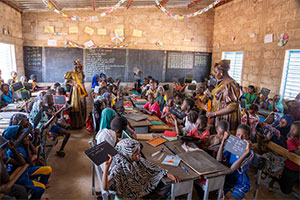 Two teachers work in a classroom in Forces Vives School in Dori, Burkina Faso. Credit: UNICEF/UNI978361
Safe and uninterrupted education is a fundamental right for all children. Education is paramount to global development, as it has been proven that investing in education – especially for girls and children – contributes significantly to economic growth and prosperity. Although more than 1 billion children go to school, many are subjected to conditions that are not conducive to a proper learning environment, including makeshift facilities, a lack of supplies, violence in classrooms, inadequate sanitation, untrained instructors, and widespread school closures. Since 2015, there have been immense gains in education with an increase of 109 million children in school. However, as of 2023, 272 million children are still out of school.
High poverty levels in developing countries also impede children’s access to a proper education. For example, from the early to mid 2000s, Sub-Saharan African nations witnessed a dramatic decline in trained teachers due to inadequate funding in the education sector. Furthermore, major cuts to United States international aid threaten an estimated 23 million additional children's access to education, as USAID‑funded school programmes across Africa and Asia face closure.
Various other factors contribute to the decline of education, notably hunger, which has increased as conflict and climate change interfere with global food production and dissemination. Meanwhile, certain social and cultural practices also impede children’s access to education, with gender inequality, discrimination, child labour, and child marriages preventing millions of children from attending school. Economic conditions such as the inaccessibility of higher education also affect disenfranchised communities across the world. In extreme situations, such as warfare where educational facilities are destroyed in their totality, notably in Gaza and Sudan, entire generations of children might grow up without access to education. Rebuilding educational infrastructure is a long and arduous process, especially when violence persists across generations, and this significantly stunts the development of societal prosperity and stability.
IPS is dedicated to telling the shocking truths about worldwide education through impassioned opinion pieces and comprehensive articles, highlighting global issues that impede worldwide education and the courses of action being taken by organizations such as UNICEF and Education Cannot Wait.

The Week with IPS

NEXT STOP - SDGs
Tracking global progress towards a sustainable world
Tracking global progress towards a sustainable world
