Languages
Thursday, November 19, 2026



News and Views from the Global South
Food and Agriculture
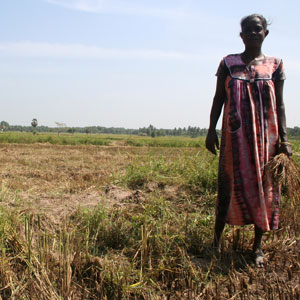
Côte d’Ivoire – New Cassava Varieties Bring Women Autonomy
Women farmers in Côte d'Ivoire are achieving greater autonomy and economic independence thanks to new varieties of cassava.Rural Mexican Communities Rich in Resources, Poor in Capital
The La Ventanilla community in the southern Mexican state of Oaxaca has not given up in the face of devastating hurricanes, but has organised to protect mangroves and animal species like the Olive Ridley sea turtle.
Second Chance For an African Green Revolution
As the world searches desperately for ways to boost food production by at least 70 percent by 2050 to feed an increasingly hungry planet, many are looking to Africa as the place where a large part of this potential can be realised, mainly for its huge portion of arable land.
New Study Claims Popular Herbicide Causes Tumours in Rats
Researchers are warning that RoundUp, a popular herbicide produced by the U.S. agro-giant Monsanto and which is used heavily on U.S. corn and soybeans, cause tumours, liver and kidney failure in rodents.
Money for Salt: How the Country of the Young Is Failing Its Elderly
Carolina Poalo strikes the dry earth over and over with her hoe, her frail body bent almost double. She is determined to begin planting. During the long, dry season in Mozambique, she and her two young grandchildren have eaten little but cassava leaves.EU Cap ‘Only Boosts Biofuels’
The European Commission has announced it will limit the amount of crop-based biofuels used in transport, but its newly proposed measures are not nearly enough to curb the disastrous impact of the EU's biofuel policy around the world. Its effects will only worsen, activists say.Tractors Revolutionise Agriculture in Chad
Chad has more than 400,000 square kilometres of arable land, but poor rainfall and a reliance on basic agricultural techniques have left the country with a grain deficit in the past two years. The government is turning to mechanisation in a bid to improve harvests.
Rio Summit’s Legacy Still a Question Mark
Academics gathered in Washington on Wednesday suggested that the mixed experience at the U.N. Conference on Sustainable Development, held in Rio de Janeiro in June, has increased the importance of citizen engagement and consumer accountability in issues of environment, renewable energy and sustainability.
Laissez-Faire Failing World’s Dwindling Water Resources
Growing water shortages in many countries are a major threat to global security and development and should be a top priority at the U.N. Security Council, a panel of experts said in a new report.Guinea Grows NERICA Rice to Reduce Dependence on Imports
Kafoumba Koné sounds almost smug. "Our first rice harvest is in, and we're getting ready to plant again," he says, surveying his farm in southeastern Guinea. "Other farmers who have not yet tried NERICA are still preparing for their only harvest of the year."Malian Farmers Want Their Land Back
A group of smallholder farmers in Mali have turned to the courts to try to recover land they say they have lost to big private investors. The legal action comes as foreign investors are losing interest in Mali due to political instability and an armed rebellion in the north.
OP-ED: Women and Girls at Heart of the Blue Revolution
World Water Week recently concluded in Stockholm with a special emphasis on the linkages between water and food security.
China Puts Up a Green Shield Against Sandstorms
The setting sun is still streaming in through the poplars along the shelter belts, but Horquin Lianjun is done with farm work for the day. The desert wind has turned bone chilling.
Kenya’s Water Wars Kill Scores
Water scarcity is fuelling deadly inter-ethnic wars that continue to claim lives in Kenya, according to government officials. And if nothing is done to educate communities on how to conserve the valuable resource, the situation will escalate, governance experts and environmentalists warn.Agricultural Activity to Slow Clandestine Emigration from Senegal
"It was Ibrahima Sarr, a friend and fellow fisherman, who got me involved with smuggling people across the seas." Senegalese fisherman Doudou Ndoye speaks with the bittersweet conviction of a man redeemed.Microfinance Brings Hope to Myanmar’s Farmers
After decades of grinding poverty under successive military dictatorships, Myanmar’s rice farmers have a chance at a better future through rural reforms ushered in by the country’s quasi-civilian government. Microfinance is at the root of it.
Losing Land, and Finding a Roof
Asmahan Ramadan and her family have taken thousands of photos on the rooftop of their home. Not of themselves, or of the overcrowded Dheisheh refugee camp they see every day.
Informal Sector Work Survives Economic Boom in Argentina
Behind “yerba mate”, a caffeinated herbal brew that is popular in Argentina and neighbouring countries, lies a shameful reality: the dismal labour and living conditions of the workers who harvest the leaves of the bush used to make the infusion.
U.S. Company Accused of Greenwashing Cameroon ‘Land-Grab’
Environment groups are accusing a New York-based agricultural company, Herakles Farms, of going forward with plans for a 73,000-hectare palm-oil plantation and refinery in southwest Cameroon despite a lack of government authorisation, two court injunctions, and in the face of significant community opposition.
Forcing South Sudan’s Idle Youth into Farming
Police in South Sudan have begun press-ganging every "idle" youth they can find to provide labour on police farms. The State Police Commissioner in Northern Bahr al Gazal state says young men cannot be left to drink tea and play cards all day while food insecurity threatens the country.
Thousands of Senegalese Producers Living off Market Gardening
Thousands of farmers are earning a living growing fruit and vegetables in the Niayes, a strip of fertile land running north along Senegal's western coastline from the outskirts of the capital, Dakar. But land speculation threatens the future of this market gardening.« Previous Page — Next Page »


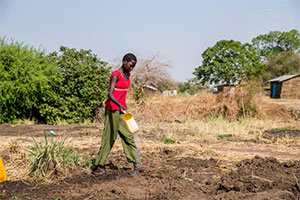 Farming on the Outskirts of Juba. Credit: UN Photo/JC McIlwaine
Promoting human and planetary health is a central focus of the United Nations, as laid out in the 2030 Sustainable Development Goals (SDGs). World hunger and unsustainable farming practices continue to be pressing concerns for the world. According to the 2025 State of Food Security and Nutrition in the World report by the Food and Agriculture Organization (FAO), 673 million people faced hunger in 2024. There are stark regional disparities, with the FAO projecting that 60% of the world population facing hunger will reside in Africa by 2030. Globally, the prevalence of food insecurity has remained consistently higher for women than men.
Sustainable and efficient national food systems are essential in preserving health, education, environmental well-being, peace, economy, and security. However, creating sustainable food systems can be a challenging endeavor, as food production takes a heavy toll on the environment. The agricultural sector accounts for a significant portion of greenhouse gases. Finding safe, sustainable, and ethical strategies to feed the world is crucial in ensuring planetary longevity. A recent initiative from 2023, the EU Regulation on Deforestation-free Products (EUDR), seeks to advocate for sustainable food systems. The main driver of deforestation is the expansion of agricultural land used to produce commodities like cattle, wood, cocoa, coffee, etc. The EUDR is part of the 2020 European Green New Deal and the EU Biodiversity Strategy for 2030 and aims to limit Europe’s consumption of products linked with deforestation by requiring that companies prove that their products are deforestation-free. Despite aiming to achieve major strides in sustainability, policies such as EUDR also raise socioeconomic concerns for targeted countries. Many emerging Latin American economies are impacted by the policy, and have raised the question of how developing countries can grapple with the tensions between economic development and advancing sustainability.
IPS has been at the forefront of providing compelling and insightful stories on communities facing hunger as well as the cost of food production. IPS uses statistics from FAO, the World Food Programme (WFP) and the International Fund for Agricultural Development (IFAD) to bring relevant and hard-hitting facts to readers. This gathering of information and data from such organizations helps bring the best stories from IPS journalists working in the different regions in consultation with experts on the ground.

The Week with IPS

NEXT STOP - SDGs
Tracking global progress towards a sustainable world
Tracking global progress towards a sustainable world