Languages
Sunday, November 29, 2026



News and Views from the Global South
Development & Aid

Maldivian Women Fight for Rights
Maldivian women, long used to taking a backseat in the Muslim-dominated Indian Ocean country, say they are determined to ensure that they are not deprived of their rights under the new regime of President Mohammed Waheed Hassan.When Europe Develops, and Israel Destroys
The European Commission has released a document that lists projects it funded that were destroyed or damaged by the Israel Defence Forces between May 2001 and October 2011.Afghan Women Victims Not Perpetrators of ‘Moral Crimes’
Mursal, a beautiful 19-year-old girl who has run away from home to escape a mentally ill husband, is just one of many Afghan women and girls who are now considered criminals under the country’s laws on ‘morality.’U.S. Praises Myanmar Poll
The administration of U.S. President Barack Obama Monday hailed Sunday's parliamentary by-election in Myanmar, also known as Burma, which the opposition National League for Democracy (NLD) led by Nobel Peace Laureate Aung San Suu Kyi won in a landslide.
More Cell-Phones than People, and No E-Waste Treatment in Guatemala
The lack of adequate management of electronic waste in Guatemala is posing a serious threat to the environment and health, as demand for electronic devices has soared to the point that there are more cell phones than people.
BRICS Ministers Say New Trade Narrative Sinks Development
Trade ministers of the BRICS countries - Brazil, Russia, China, India and South Africa – say that at the G20 trade ministerial summit later this month in Mexico they will try to ensure that attempts by industrialised countries to frame a new trade agenda do not drown development-led trade liberalisation and the World Trade Organization talks.
Liberia’s Government Finding a Way to End FGM
"There were three people. One person was holding me down; one person was holding my hand; and the other person was doing the job. They lay me down, and…" Fatu said of the female genital mutilation she underwent as an eight- year-old in Liberia.
Wind Turbines Bring Relief and Resentment to Pakistan
"I still cannot fathom how electricity can be produced by the wind," said a nonplused Mohammad Ahmed, a 55-year-old local baker, as he gazed up at a row of giant wind turbines.
Payments for Environmental Services Skip Rural Women in Mexico
Despite the key role they play in caring for natural resources in the face of climate change, rural women in Mexico do not benefit from payments for environmental services, say activists and experts.
Amid Global Uncertainties, Barbados Plots a Greener Future
When it comes to developing a "green economy", Barbados is leading its English-speaking Caribbean neighbours.
Jamaica to Galvanise Public on Climate Adaptation
A public awareness project that aims to foster wider understanding among locals about the linkages between the global climate and their social and economic wellbeing is Jamaica's newest adaptation strategy.Suu Kyi as Lawmaker
Following her historic victory in Sunday’s by-elections Aung San Suu Kyi takes on a new role as opposition lawmaker, after a 22-year existence as Myanmar’s most famous political prisoner.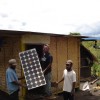
Solar Panels Reflect Bright Future for Rural Papua New Guinea
In Papua New Guinea (PNG), which has no national power grid but large river systems and abundant sunshine, renewable energy has tremendous potential to transform remote rural lives with clean and sustainable electricity.Ecobreves – VENEZUELA: Oil Spill Halts Fishing in Lake Maracaibo
Hundreds of fishermen in southern Lake Maracaibo, in western Venezuela, stopped casting their nets in the last week of March after observing massive numbers of dead fish and crabs along the lakeshore as a result of an oil spill in one of the lake’s tributaries, the Catatumbo River.Ecobreves – HONDURAS: Destruction of Coral Reefs Denounced
The construction of docks for cruise ships off the Caribbean coast of Honduras poses a serious threat to coral reefs, warn environmentalists.Ecobreves – BRAZIL: Solar-Powered Lamp Post Designed
A post that uses the sun’s rays to light LED lamps has been developed by a design student at the Federal University of Pernambuco, in northern Brazil.
Breastfeeding, Not Formula, for South Africa’s HIV-Positive Mothers
South Africa's nine provinces will begin phasing out provision of free formula to HIV-positive mothers and implement a new policy on breast-feeding from Sunday. But despite the clarity of the policy and its supporting data, vocal critics, including respected individuals from leading medical and academic institutions, have decried the choice.
Women Pay for Kashmir’s Water Woes
Naseema Akhtar, 38, worries that her daily treks to collect clean water from the mountain springs around her village of Bonpora, in Kashmir’s Kupwara district, are getting longer. She is already doing more than seven km every day.Caribbean Private Sector Lags in Exploiting EU Trade Pact
When Europe signed an Economic Partnership Agreement (EPA) with the Caribbean Forum countries in 2008, the intention was to boost trade and services between the two regions.
U.S.: Forming Coalitions, Tea Party Continues to Brew
In the three years since its inception, the Tea Party has cemented its place in U.S. politics, routinely making waves in political races of national interest. At the same time, some local Tea Party groups are beginning to build post-partisan coalitions that are both surprising and counterintuitive.
Displaced Guatemalan Peasants Demand Answers
"We want land where we can live and grow food to feed ourselves," said Pedro Ichich, one of several thousand indigenous farmers who marched to the Guatemalan capital to demand solutions to the ageold conflict over land.« Previous Page — Next Page »


 2026 High-level Political Forum on Sustainable Development. Credit: UN Photo/Eskinder Debebe
In 2015, the United Nations and its Member States adopted the Sustainable Development Goals (SDGs) in an effort to make the world a more sustainable and peaceful place for future generations. Progress on the 17 SDGs has been uneven, and inequality persists across the globe. 10 years after adoption, the 2025 UN SDGs Report revealed that only 35% of the SDG targets are on track, with more than half moving too slowly, and 18% moving backwards from the 2015 baseline. Poverty remains one of the world’s most pressing issues, with hunger, violence, and inequality impeding the opportunities for all people to achieve success. In September 2024, the United Nations Summit of the Future introduced a new goal: to eradicate global poverty by 2030, ensure universal rights to basic services, and increase the overall standard of living in terms of industrialization, economic well-being, citizen health, and literacy. Furthermore, recent shifts in United States foreign aid policy – notably, major budget cuts to USAID and the termination of thousands of development programmes– have severely threatened vital lifelines of financial aid to impoverished communities around the world. Additionally, the United States’ withdrawal from the Paris Climate Agreement has undercut international efforts at sustainable development. With the upcoming 2030 deadline, the UN Secretary-General has called for urgent multilateralism across six priority areas: food systems, energy, digital connectivity, education, jobs and social protection, and climate and biodiversity. IPS sheds light on marginalized communities that struggle on a daily basis to survive and have their stories heard and respected.
Updated by Yilan Batista and Shuli Wong August 2026

The Week with IPS

NEXT STOP - SDGs
Tracking global progress towards a sustainable world
