Languages
Thursday, October 22, 2026



News and Views from the Global South
Population

Child Trafficking Rampant in Underdeveloped Indian Villages
In a country where well over half the population lives on less than two dollars a day, it takes a lot to shock people. The sight of desperate families traveling in search of money and food, whole communities defecating in the open, old women performing back-breaking labour, all this is simply part of life in India, home to 1.2 billion people.
Mass Deportations Don’t Squelch Migration Dreams of Hondurans
The clock marks 9 AM when a bus coming from the Mexican city of Tapachula reaches Corinto, on the border between Honduras and Guatemala. It is the first bus of the day, carrying children and their families sent back from a failed attempt at making it across the border into the United States.
Criminalisation of Homelessness in U.S. Criticised by United Nations
A United Nations panel reviewing the U.S. record on racial discrimination has expressed unusually pointed concern over a new pattern of laws it warns is criminalising homelessness.
Afghan “Torn” Women Get Another Chance
"The smell of faeces and urine isolates them completely. Their husbands abandon them and they become stigmatised forever” – Dr Pashtoon Kohistani barely needs two lines to sum up the drama of those women affected by obstetric fistula.
Struggling to Find Water in the Vast Pacific
Pacific Island states are surrounded by the largest ocean in the world, but inadequate fresh water sources, poor infrastructure and climate change are leaving some communities without enough water to meet basic needs.Arab Region Has World’s Fastest Growing HIV Epidemic
At a time when HIV rates have stabilised or declined elsewhere, the epidemic is still advancing in the Arab world, exacerbated by factors such as political unrest, conflict, poverty and lack of awareness due to social taboos.
Growing Calls for Reforms of El Salvador’s Privatised Pension System
Two of the promises made 16 years ago when El Salvador’s pension system was privatised have failed to materialise: There was no expansion of social security coverage and no improvement in pensions. Now pressure is growing for a reform of the system.
The Age of Survival Migration
“Survival migration” is not a reality show, but an accurate description of human mobility fuelled by desperation and fear. How despairing are these migrant contingents? Look at the figures of Central American children travelling alone, which are growing.
IPS at 50, Leads That Don’t Bleed
Tarzie Vittachi, a renowned Sri Lankan newspaper editor and one-time deputy executive director of the U.N. children's agency UNICEF, once recounted the oft-quoted story of an African diplomat who sought his help to get coverage in the U.S. media for his prime minister's address to the General Assembly.
South Sudan’s Hip Hop Artists call for Peace and Reconciliation Through the Unhip Practice of Farming
“What is the benefit when children are crying and people are dying due to hunger? There is no need to cry when you have the potential to dig,” sings Juba-based dancehall reggae group, the Jay Family, in their latest single “Stakal Shedit,” which means “Work Hard” in Arabic.
India: A Race to the Bottom with Antibiotic Overuse
In 2011, the World Health Organisation (WHO) warned: "Combat Drug Resistance - No Action Today, No Cure Tomorrow.” The slogan was coined in honour of World Health Day, urging governments to ensure responsible use of antibiotics in order to prevent drug-resistant viruses and bacteria, or ‘super bugs’.
Climate Policy Goes Hand-in-Hand with Water Policy
Concerned that climate change could lead to an intensification of the global hydrological cycle, Caribbean stakeholders are working to ensure it is included in the region's plans for Integrated Water Resources Management (IWRM).
Civil Society Condemns Immunity for Sitting African Leaders Accused of Serious Crimes
Mary Wacu lived in the Rift Valley region for 10 years prior to the 2007/08 post-election violence that rocked Kenya after a disputed general election.
Nepal Landslide Leaves Women and Children Vulnerable
Living in a makeshift tarpaulin shelter, which barely protects her family from the torrential rainfall or scorching heat of this remote village in southern Nepal, 36-year-old Kamala Pari is under immense stress, worrying about her financial security and children’s safety.
OPINION: Towards a Global Governance Platform
Inter Press Service News Agency has braved severe political assaults and financial tempests since 1964, when Roberto Savio and Pablo Piacentini laid its foundation as a unique and challenging information and communication system.
How Midwives on Sierra Leone’s Almost Untouched Turtle Islands are Improving Women’s Health
Emmanuel is a male midwife. At the age of 26, he lives and works on one of eight islands off the southwest peninsular of Sierra Leone, an hour by speedboat from Mattru Jong, the capital of Bonthe District.
OPINION: Boosting Resilience in the Caribbean Countries
Having lived and worked for more than a decade in four Caribbean countries, I have witnessed firsthand how Small Island Developing States (SIDS) are extremely vulnerable to challenges ranging from debt and unemployment to climate change and sea level rise.
Building Public Trust is a Key Factor in Fighting West Africa’s Worst Ebola Outbreak
The nurse carefully packs the body into a plastic bag and then leaves the isolation tent, rinsing his feet in a bucket of water that contains bleach. Then he carefully takes off his safety glasses, gloves and mask and burns them in a jerry can.
These Children Just Want to Go Back to School
Between government efforts to wipe out insurgents from Pakistan’s northern, mountainous regions, and the Taliban’s own campaign to exercise power over the Federally Administered Tribal Areas (FATA), the real victims of this conflict are often invisible.
U.N. Conference Set to Bypass Climate Change Refugees
An international conference on small island developing states (SIDS), scheduled to take place in Samoa next week, will bypass a politically sensitive issue: a proposal to create a new category of "environmental refugees" fleeing tiny island nations threatened by rising seas.
Breakthroughs and Hurdles in Colombia’s Peace Talks
Three major advances were made over the last week in the peace talks that have been moving forward in Cuba for nearly two years between the Colombian government and the FARC guerrillas, while the decades-old civil war rages on.« Previous Page — Next Page »





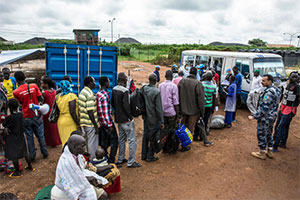 One Thousand Internally Displaced Persons (IDPs) Relocated from Tomping Camp in South Sudan. Credit: UN Photo/Isaac Billy
It took hundreds of thousands of years for the world’s human population to cross one billion in 1804. Approximately 200 years later, the population has multiplied sevenfold. In 2023, the global population crossed 8 billion, and is expected to reach 9 billion before 2050. With the planet more crowded than ever, it is essential to keep track of population trends, urbanization, migration, and reproduction across the world.
Life expectancy has seen significant strides in the past century, largely due to economic development and increased standards of living. On the contrary, trends in global fertility are shifting, with certain regions in Africa and Asia reporting higher rates, while parts of Europe and North America report stagnant or lower rates. This is in part due to differences in sexual and reproductive healthcare, as well as societal and economic conditions around the world. For example, child marriage is prevalent in certain societies, where childbearing is also considered a familial duty. Meanwhile, stagnating economies frequently experience lower marriage and childbearing rates.
The increase in migration and urban development around the world is also linked to global population trends. By 2050, it is expected that approximately 66 percent of all people will live in cities. Furthermore, global crises such as warfare and natural disasters also prompt transnational migration. Transnational migration is linked to a variety of socioeconomic issues in both host and receiving countries: migrants often leave developing countries with less access to educational and economic opportunities and arrive in developed countries where they are frequently the targets of ethnic, racial, and cultural discrimination, and economic exploitation. Recent crises in Europe and the United States demonstrate the importance of advocating for migrants worldwide. As migrants from the Global South are increasingly stripped of their legal and civic rights in unlawful deportations, or targeted in acts of identity-based violence, it is essential to keep track of population trends and protect the human rights of migrant populations. Climate-related disasters are now a major driver of displacement, with nearly half of all new internal displacements in 2025 being disaster-related.
IPS is devoted to covering issues surrounding population trends, migration, and reproduction through its compelling articles, which use both statistics and human stories to provide readers with robust and informative viewpoints.

The Week with IPS

NEXT STOP - SDGs
Tracking global progress towards a sustainable world
Tracking global progress towards a sustainable world
