Languages
Wednesday, October 21, 2026



News and Views from the Global South
Population

Latin America at a Climate Crossroads
World leaders gathered at the Climate Change Summit during the United Nations General Assembly on Sep. 23 will have a crucial opportunity to mobilise political will and advance solutions to climate change.
U.N. Launches Ambitious Humanitarian Plan for Gaza
The UN agency for Palestinian refugees has launched an ambitious recovery plan for Gaza following the 50-day devastating war between Hamas and Israel which has left the coastal territory decimated.
Will the Upcoming Climate Summit Be Another Talkathon?
As the United Nations hosts a Climate Summit Sep. 23, the lingering question is whether the meeting of world leaders will wind up as another talk fest.
World’s Most Unequal Region Sets Example in Fight Against Hunger
Latin America and the Caribbean, the world’s most unequal region, has made the greatest progress towards improving food security and has become the region with the largest number of countries to have reached the first Millennium Development Goal (MDG) of halving the proportion of undernourished people.
Against All the Odds: Maternity and Mortality in Afghanistan
Nasrin Mohamadi, a mother of four, has promised herself never to set foot in an Afghan public hospital again. After her first experience in a maternity ward, she has lost all faith in the state’s healthcare system.
Panama Turns to Biofortification of Crops to Build Food Security
Panama is the first Latin American country to have adopted a national strategy to combat what is known as hidden hunger, with a plan aimed at eliminating micronutrient deficiencies among the most vulnerable segments of the population by means of biofortification of food crops.
For These Asylum Seekers, the Journey Ends Where it Began
"Of course I'm scared, but what else can I possibly do?" asks Ahmed, a middle-aged man seated on the carpeted floor of a hotel located on the southern edge of Afghanistan. He is bound for Iran, but he still has no idea when or how he’ll cross the border.
A Flood of Energy Projects Clash with Mexican Communities
Since January, villagers and townspeople near the Los Pescados river in southeast Mexico have been blocking the construction of a dam, part of a multi-purpose project to supply potable water to Xalapa, the capital of the state of Veracruz.
U.N. Climate Summit: Staged Parade or Reality Show?
The much-ballyhooed one-day Climate Summit next week is being hyped as one of the major political-environmental events at the United Nations this year.
OPINION: Investing in Adolescent Girls for Africa’s Development
Adolescence is a time of transition from childhood to adulthood. It is also a time of change and challenge.
Salvadoran Farmers Stake Their Bets on Sustainable Development
Peasant farmers from one of El Salvador’s most fragile coastal areas are implementing a model of sustainable economic growth that respects the environment and offers people education and security as keys to give the wetland region a boost.
How Niger’s Traditional Leaders are Promoting Maternal Health
It is a long, 14-hour drive from Niger’s capital city Niamey to the village of Bande. And the ride is a dreary one as the roadside is bare. The occasional, lone goat herder is spotted every few kilometres and the sightings become a cause of both confusion and excitement since there aren’t any trees, or watering holes in sight.
Africa’s Dividing Farmlands A Threat To Food Security
When Kiprui Kibet pictures his future as a maize farmer in the fertile Uasin Gishu county in Kenya’s Rift Valley region, all he sees is the ever-decreasing plot of land that he has to farm on.
Global Commission Urges Decriminalisation of Drug Use
A top-level international panel called Tuesday for a major shift in global drug-control policies from prohibition to decriminalisation and regulation.
OPINION: From Schools to Shelters in Iraq
Using schools for shelter was a natural. When the Islamic State drove waves of people from the Sinjar area of Iraq in early August, most of them members of the Yazidi minority group, they fled first to the mountains and then to the relative safety of Iraqi Kurdistan. They camped out in whatever unoccupied structures they could find.
LGBT Visibility in Africa Also Brings Backlash
Eighteen-year-old Gift Makau enjoyed playing and refereeing football games in her neighbourhood in the North West Province of South Africa. She had come out to her parents as a lesbian and had never been heckled by her community, according to her cousin.
U.S. Military Joins Ebola Response in West Africa
The U.S. military over the weekend formally began to support the international response to the Ebola outbreak in West Africa.
Mexico’s Cocopah People Refuse to Disappear
In their language, Cocopah means “river people”. For over 500 years the members of this Amerindian group have lived along the lower Colorado River and delta in the Mexican states of Baja California and Sonora and the U.S. state of Arizona.
War Over but Not Gaza’s Housing Crisis
“When the [Israeli] shelling started, I gathered up my family and headed for what I though was a safe place, like a school, but then that became overcrowded and lacked sanitation, so we ended up in the grounds of the hospital.”
Latin America’s Anti-drug Policies Feed on the Poor
Poor young men, slumdwellers and single mothers are hurt the most by anti-drug policies in Latin America, according to representatives of governments, social organisations and multilateral bodies meeting at the Fifth Latin American Conference on Drug Policies.
Indigenous Peoples Seek Presence in Post-2015 Development Agenda
The world's 370 million indigenous people, who say they were marginalised in the Millennium Development Goals (MDGs), want to play a key role in the U.N.'s post-2015 development agenda, which will be finalised next year.« Previous Page — Next Page »





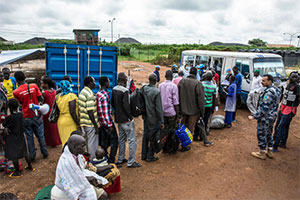 One Thousand Internally Displaced Persons (IDPs) Relocated from Tomping Camp in South Sudan. Credit: UN Photo/Isaac Billy
It took hundreds of thousands of years for the world’s human population to cross one billion in 1804. Approximately 200 years later, the population has multiplied sevenfold. In 2023, the global population crossed 8 billion, and is expected to reach 9 billion before 2050. With the planet more crowded than ever, it is essential to keep track of population trends, urbanization, migration, and reproduction across the world.
Life expectancy has seen significant strides in the past century, largely due to economic development and increased standards of living. On the contrary, trends in global fertility are shifting, with certain regions in Africa and Asia reporting higher rates, while parts of Europe and North America report stagnant or lower rates. This is in part due to differences in sexual and reproductive healthcare, as well as societal and economic conditions around the world. For example, child marriage is prevalent in certain societies, where childbearing is also considered a familial duty. Meanwhile, stagnating economies frequently experience lower marriage and childbearing rates.
The increase in migration and urban development around the world is also linked to global population trends. By 2050, it is expected that approximately 66 percent of all people will live in cities. Furthermore, global crises such as warfare and natural disasters also prompt transnational migration. Transnational migration is linked to a variety of socioeconomic issues in both host and receiving countries: migrants often leave developing countries with less access to educational and economic opportunities and arrive in developed countries where they are frequently the targets of ethnic, racial, and cultural discrimination, and economic exploitation. Recent crises in Europe and the United States demonstrate the importance of advocating for migrants worldwide. As migrants from the Global South are increasingly stripped of their legal and civic rights in unlawful deportations, or targeted in acts of identity-based violence, it is essential to keep track of population trends and protect the human rights of migrant populations. Climate-related disasters are now a major driver of displacement, with nearly half of all new internal displacements in 2025 being disaster-related.
IPS is devoted to covering issues surrounding population trends, migration, and reproduction through its compelling articles, which use both statistics and human stories to provide readers with robust and informative viewpoints.

The Week with IPS

NEXT STOP - SDGs
Tracking global progress towards a sustainable world
Tracking global progress towards a sustainable world
