Languages
Friday, October 16, 2026



News and Views from the Global South
Population

When Ignorance Is Deadly: Pacific Women Dying From Lack of Breast Cancer Awareness
Women now face a better chance of surviving breast cancer in the Solomon Islands, a developing island state in the southwest Pacific Ocean, following the recent acquisition of the country’s first mammogram machine.
Young People in Latin America Face Stigma and Inequality
Young people in Latin America now enjoy greater access to education. But in many cases their future is dim due to the lack of opportunities and the siren call of crime in a region where 167 million people are poor, and 71 million live in extreme poverty.
Developing Nations Write Hopeful New Chapters in a Toxic Legacy
The village of Dong Mai in Vietnam's agricultural heartland had a serious problem.
Not Without Our Daughters: Lambada Women Fight Infanticide and Child Trafficking
At 11 years of age, Banawat Gangotri already has four years of work experience as a farm labourer. The child, a member of the nomadic Lambada community from the village of Bugga Thanda in India’s southern Telangana state, plucked cotton and chillies from nine a.m. until 5 p.m. for about a dollar daily.
Aboriginal Businesses Stimulate Positive Change in Australia
Roy Roger Gibson, an indigenous Kuku Yalanji elder, would watch thousands of tourists and vehicles trampling his pristine land while working on the sugarcane fields in Far North Queensland. His people were suffering and their culture was being eroded. The native wildlife was disappearing. He dreamt of turning this around.
Forced Disappearances Are Humanitarian Crisis in Mexico
The Mexican government will face close scrutiny from the United Nations Committee on Enforced Disappearances – a phenomenon that made international headlines after 43 students from a rural teachers college were killed in September in Iguala, in a case that has not yet been fully clarified.
U.S. May Soon Stand Alone Opposing Children’s Treaty
When the East African nation of Somalia, once described as a "lawless state", ratified the Convention on the Rights of the Child (CRC) early this week, it left two countries in splendid isolation from the rest of the world: South Sudan and the United States.
Fighting Extremism with Schools, Not Guns
As a wave of outrage, crossing Pakistan’s national borders, continues a month after the Dec. 16 attack on a school in the northern Khyber Pakhtunkhwa province, some citizens are turning away from collective expressions of anger, and beginning the hard work of building grassroots alternatives to terrorism and militancy.
From Bullets to Ballots: The Face of Sri Lanka’s Former War Zone
In four months’ time, Sri Lanka will mark the sixth anniversary of the end of its bloody civil conflict. Ever since government armed forces declared victory over the Liberation Tigers of Tamil Eelam (LTTE) on May 19, 2009, the country has savored peace after a generation of war.
Caribbean Youth Ready to Lead on Climate Issues
At 24 years old, Stefan Knights has never been on the side of those who are sceptical about the reality and severity of climate change.
CORRECTION/Sustainable Energy Starts With the Sun
It began with an experiment to install photovoltaic cells over an irrigation canal that forms part of the Sardar Sarovar canal network – a massive hydel power project across the River Narmada that irrigates some 1.8 million hectares of arable land in the western Indian state of Gujarat.
Pacific Islands Call for New Thinking to Implement Post-2015 Development Goals
As the Millennium Development Goals (MDGs), a set of poverty-alleviation targets set by the United Nations, come to a close this year, countries around the world are taking stock of their successes and failures in tackling key developmental issues.
OPINION: A New Era of Hemispheric Cooperation Is Possible
Two decades after the first Summit of the Americas, a lot has changed in the continent and it has been for the good. Today, a renewed hemispheric dialogue without exclusions is possible.
Zimbabwe’s Children Are the Battlefield in War to Contain HIV/AIDS
Fifty-one-year-old Mateline Msipa is living with HIV. Her 17-year-old daughter, born after Msipa was diagnosed with the virus, may also have it, but she has never been tested.
Battle Heats Up Over Legalisation of Sex Work in India
Thirty-six-year-old Chameli Devi, a sex worker operating out of New Delhi's G.B. Road - Asia's largest red-light district, housing an estimated 12,000 of India’s three million sex workers – is an unhappy woman these days.
Children Starving to Death in Pakistan’s Drought-Struck Tharparkar District
 The main entrance to the Civil Hospital in Mithi, headquarters of the Tharparkar district in Pakistan’s southern Sindh Province, is blocked by a couple of men clad in traditional dress and turbans. They are trying to console a woman who is sobbing so heavily she has to gasp for breath.

Humanity’s Future: Below Replacement Fertility?
Is below replacement level fertility the future for humanity? The answer to this seemingly simple question regarding human reproduction is not only of considerable demographic concern, but also has enormous social, economic and environmental consequences for the planet.
Papal Visit Rekindles Hopes in Former War Zone
Jessi Jogeswaran, a 20-year-old woman from Sri Lanka’s northern Jaffna district, waited over six hours with 18 friends in the sweltering heat just to get a glimpse of Pope Francis on Jan. 14.
In the Shadow of Glacial Lakes, Pakistan’s Mountain Communities Look to Climate Adaptation
Khaliq-ul-Zaman, a farmer from the remote Bindo Gol valley in northern Pakistan’s Khyber Pakhtunkhwa province, has long lived under the shadow of disaster.
Anemia in Eastern Cuba Reflects Inequality
Cuba has met the United Nations goal of reducing hunger. But anemia caused by malnutrition is still a problem among infants, small children and pregnant women in this Caribbean island nation, which has been in the grip of an economic crisis for over two decades.
OPINION: For the Good of Humanity – Towards a Culture of Caring
About a week ago my wife was taken to hospital and diagnosed with pneumonia. She was promptly treated with antibiotics and, wonderfully, is now on the mend.« Previous Page — Next Page »





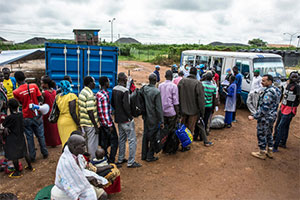 One Thousand Internally Displaced Persons (IDPs) Relocated from Tomping Camp in South Sudan. Credit: UN Photo/Isaac Billy
It took hundreds of thousands of years for the world’s human population to cross one billion in 1804. Approximately 200 years later, the population has multiplied sevenfold. In 2023, the global population crossed 8 billion, and is expected to reach 9 billion before 2050. With the planet more crowded than ever, it is essential to keep track of population trends, urbanization, migration, and reproduction across the world.
Life expectancy has seen significant strides in the past century, largely due to economic development and increased standards of living. On the contrary, trends in global fertility are shifting, with certain regions in Africa and Asia reporting higher rates, while parts of Europe and North America report stagnant or lower rates. This is in part due to differences in sexual and reproductive healthcare, as well as societal and economic conditions around the world. For example, child marriage is prevalent in certain societies, where childbearing is also considered a familial duty. Meanwhile, stagnating economies frequently experience lower marriage and childbearing rates.
The increase in migration and urban development around the world is also linked to global population trends. By 2050, it is expected that approximately 66 percent of all people will live in cities. Furthermore, global crises such as warfare and natural disasters also prompt transnational migration. Transnational migration is linked to a variety of socioeconomic issues in both host and receiving countries: migrants often leave developing countries with less access to educational and economic opportunities and arrive in developed countries where they are frequently the targets of ethnic, racial, and cultural discrimination, and economic exploitation. Recent crises in Europe and the United States demonstrate the importance of advocating for migrants worldwide. As migrants from the Global South are increasingly stripped of their legal and civic rights in unlawful deportations, or targeted in acts of identity-based violence, it is essential to keep track of population trends and protect the human rights of migrant populations. Climate-related disasters are now a major driver of displacement, with nearly half of all new internal displacements in 2025 being disaster-related.
IPS is devoted to covering issues surrounding population trends, migration, and reproduction through its compelling articles, which use both statistics and human stories to provide readers with robust and informative viewpoints.

The Week with IPS

NEXT STOP - SDGs
Tracking global progress towards a sustainable world
Tracking global progress towards a sustainable world
