Languages
Saturday, October 17, 2026



News and Views from the Global South
Population

OPINION: Climate Change and Inequalities: How Will They Impact Women?
Among all the impacts of climate change, from rising sea levels to landslides and flooding, there is one that does not get the attention it deserves: an exacerbation of inequalities, particularly for women.
Climate Change Creates New Geography of Food
The magnitude of the climate changes brought about by global warming and the alterations in rainfall patterns are modifying the geography of food production in the tropics, warned participants at the climate summit in the Peruvian capital.
Afghan Concern Over Western Disengagement
The U.S./NATO International Security Assistance Force Joint Command lowered its flag for the last time in Afghanistan on Dec. 8, after 13 years. The ISAF mission officially ends on Dec. 31, and will be replaced on Jan. 1, 2015 by “Resolute Support”, a new, narrow-mandate mission to train, advise and assist the Afghan National Security Forces.
Pushing for Gender Equity at COP20
Despite international acknowledgement that women are disproportionately affected by climate change, the Lima climate negotiations have been slow to deliver progress on recognising their importance, while threats of pushback loom on the horizon.
Mangrove Conservation Paves the Way to a Sustainable Future
 When the Asian tsunami washed over several Indian Ocean Rim countries on Boxing Day 2004, it left a trail of destruction in its wake, including a death toll that touched 230,000.

OPINION: The Role of the Media and Visibility for Malnutrition Around the World
The vast international and national media impact of the Second International Conference on Nutrition (ICN2), held in Rome from Nov. 19 to 21, demonstrated the growing interest that nutritional problems are arousing worldwide, primarily because the media themselves are increasingly reporting issues related to poverty and exclusion.
Groups Push Obama to Clarify U.S. Abortion Funding for Wartime Rape
Nearly two dozen health, advocacy and faith groups are calling on President Barack Obama to take executive action clarifying that U.S. assistance can be used to fund abortion services for women and girls raped in the context of war and conflict.
Latin America Faces the Novelty and Challenge of Ageing
The eternally young Latin America is also ageing, due to the rise in life expectancy and the drop in birth rates - a demographic revolution that poses new challenges in a region that has begun to move slowly away from its status as the most unequal part of the world.
Starvation Strikes Zimbabwe’s Urban Dwellers
As unemployment deepens across this Southern African nation and as the country battles to achieve the United Nations Millennium Development Goals (MDGs) ahead of the December 2015 deadline, thousands of urban Zimbabweans here are facing starvation.
Marginalised Communities Warn of AIDS/TB “Tragedy” in Eastern Europe and Central Asia
Marginalised communities and civil society groups helping them are warning of a “tragedy” in Eastern Europe and Central Asia (EECA) as international funding for HIV/AIDS and tuberculosis (TB) programmes in the regions is cut back.
OPINION: Women Must Be Partners and Drivers of Climate Change Decision-Making
As leaders from around the world gather in Lima, Peru this week to discuss global cooperation in addressing climate change, a woman in Guatemala will struggle to feed her family from a farm plot that produces less each season.
“Indigenous Peoples Are the Owners of the Land” Say Activists at COP20
The clamor of indigenous peoples for recognition of their ancestral lands resounded among the delegates of 195 countries at the climate summit taking place in the Peruvian capital. “I want my land…that’s where I live and eat, and it’s where my saintly grandparents lie,” Diana Ríos shouted with rage.
U.N.’s 17 Sustainable Development Goals Remain Intact
Secretary-General Ban Ki-moon has refused to jettison any of the 17 Sustainable Development Goals (SDGs) proposed by an Open Working Group of member states: goals aimed at launching the U.N.'s new post-2015 development agenda through 2030.
Football Stars Join ‘Africa United’ Campaign to Stop Spread of Ebola
The Confederation of African Football (CAF) has joined a number of football stars, celebrities, international health organisations and corporations in the ‘Africa United’ global health communications campaign aimed at preventing the spread of Ebola in West Africa.
Native Villagers in Honduras Bet on Food Security – and Win
The town’s dynamic mayor, Sandro Martínez, assumed the commitment of turning the Honduran municipality of Victoria into a model of food and nutritional security and environmental protection by means of municipal public policies based on broad social and community participation and international development aid.
OPINION: Stand in Solidarity with Courageous Women’s Human Rights Defenders
Almost two decades ago, in Beijing, 189 countries made a commitment to achieve equality for women, in practice and in law, so that all women could at last fully enjoy their rights and freedoms as equal human beings.
OPINION: Climate Justice Is the Only Way to Solve Our Climate Crisis
In November, the world's top climate scientists issued their latest warning that the climate crisis is rapidly worsening on a number of fronts, and that we must stop our climate-polluting way of producing energy if we are to stand a chance of avoiding the worst impacts of climate change.
Illegal Logging Wreaking Havoc on Impoverished Rural Communities
Rampant unsustainable logging in the southwest Pacific Island states of Papua New Guinea and Solomon Islands, where the majority of land is covered in tropical rainforest, is worsening hardship, human insecurity and conflict in rural communities.
Only a Few Drops of Water at the Lima Climate Summit
Although it is one of the victims of global warming, water will not be given a place of importance at the COP20 climate change conference to be held Dec. 1-12 in Lima, Peru.
OPINION: People with Disabilities Must Be Counted in the Fight Against HIV
Jane is a young Zambian mother with a physical disability in Lusaka, who uses a wheelchair to get around. She does not let clinics without ramps or without wheelchair accessible toilets and equipment stop her from claiming her right to health care, including HIV prevention services.
Elections Offer Little Solace to Sri Lanka’s Poor
Priyantha Wakvitta is used to seeing his adopted city, Colombo, transform into a landscape of bright sparkling lights and window dressing towards the end of the year.« Previous Page — Next Page »





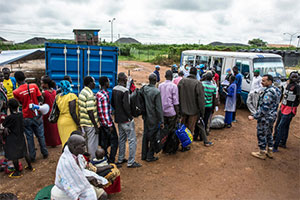 One Thousand Internally Displaced Persons (IDPs) Relocated from Tomping Camp in South Sudan. Credit: UN Photo/Isaac Billy
It took hundreds of thousands of years for the world’s human population to cross one billion in 1804. Approximately 200 years later, the population has multiplied sevenfold. In 2023, the global population crossed 8 billion, and is expected to reach 9 billion before 2050. With the planet more crowded than ever, it is essential to keep track of population trends, urbanization, migration, and reproduction across the world.
Life expectancy has seen significant strides in the past century, largely due to economic development and increased standards of living. On the contrary, trends in global fertility are shifting, with certain regions in Africa and Asia reporting higher rates, while parts of Europe and North America report stagnant or lower rates. This is in part due to differences in sexual and reproductive healthcare, as well as societal and economic conditions around the world. For example, child marriage is prevalent in certain societies, where childbearing is also considered a familial duty. Meanwhile, stagnating economies frequently experience lower marriage and childbearing rates.
The increase in migration and urban development around the world is also linked to global population trends. By 2050, it is expected that approximately 66 percent of all people will live in cities. Furthermore, global crises such as warfare and natural disasters also prompt transnational migration. Transnational migration is linked to a variety of socioeconomic issues in both host and receiving countries: migrants often leave developing countries with less access to educational and economic opportunities and arrive in developed countries where they are frequently the targets of ethnic, racial, and cultural discrimination, and economic exploitation. Recent crises in Europe and the United States demonstrate the importance of advocating for migrants worldwide. As migrants from the Global South are increasingly stripped of their legal and civic rights in unlawful deportations, or targeted in acts of identity-based violence, it is essential to keep track of population trends and protect the human rights of migrant populations. Climate-related disasters are now a major driver of displacement, with nearly half of all new internal displacements in 2025 being disaster-related.
IPS is devoted to covering issues surrounding population trends, migration, and reproduction through its compelling articles, which use both statistics and human stories to provide readers with robust and informative viewpoints.

The Week with IPS

NEXT STOP - SDGs
Tracking global progress towards a sustainable world
Tracking global progress towards a sustainable world
