Languages
Saturday, October 17, 2026



News and Views from the Global South
Population

OPINION: Understanding Education for Global Citizenship
Education for Sustainable Development (ESD) brings together concerns about the environment, economic development and social aspects. Since 1972, when the first U.N. Conference on the Human Environment was held in Stockholm, Sweden, there has been increasing awareness of the intricate link between conserving the environment and human development.
Time to Recognise Indigenous Australians in the Constitution
 Australian Aboriginal and Torres Strait Islanders comprise 2.5 per cent (some 548,370) of Australia’s 24-million strong population, but they are not recognised by the Constitution.

OPINION: We Have So Much to Learn From Cuba
Earlier this month, President Barack Obama announced the restoration of diplomatic relations with Cuba after more than five decades of a misguided policy which my uncle, John F. Kennedy, and my father, Robert F. Kennedy, had been responsible for enforcing after the U.S. embargo against the country was first implemented in October 1960 by the Eisenhower administration.
Climate Change Threatens Quechua and Their Crops in Peru’s Andes
In this town in Peru’s highlands over 3,000 metres above sea level, in the mountains surrounding the Sacred Valley of the Incas, the Quechua Indians who have lived here since time immemorial are worried about threats to their potato crops from alterations in rainfall patterns and temperatures.
SMS for Healthy, AIDS-Free Babies
 In rural Zambia and Malawi, new mums face long delays finding out if they have passed HIV on to their babies.

Small Grants for Big Solutions in Northeast Argentina
Summers in northeast Argentina are hot and humid. At siesta time, the people of this rural municipality like to drink “tereré” (cold yerba mate), which until now they had problems preparing because of lack of clean water or electricity. But sometimes small donations can make a big dent in inequality.
Poverty and Fear Still Rankle, Ten Years After the Tsunami
It took just 30 minutes for the killer waves to leave 350,000 dead and half a million displaced. Less than one hour for 100,000 houses to be destroyed and 200,000 people to be stripped of their livelihoods.
School Dropout Rate Soars for Afghan Refugees
“Our children quitting school is the greatest pain we have suffered during our troublesome lives here,” says Multan Shah, a vegetable-seller in a shantytown of Peshawar, the capital of Khyber Pakhtunkhwa, one of Pakistan's four provinces.
Seeking Closure, Bougainville Confronts Ghosts of Civil War
Thirteen years after the peace agreement which ended a decade-long civil war in Bougainville, an autonomous island region of 300,000 people located east of the Papua New Guinean (PNG) mainland in the southwest Pacific Islands, trauma and grief continue to affect families and communities where the fate of the many missing remains unresolved.
The Soil, Silent Ally Against Hunger in Latin America
Latin America and the Caribbean should use sustainable production techniques to ensure healthy soil, the basic element in agriculture, food production and the fight against hunger.
Silent Suffering: Men, Manhood and HIV
Across Africa, men have lower rates than women for HIV testing, antiretroviral treatment enrollment and adherence, viral load suppression and survival.

Europe Dream Swept Away in Tripoli
It's easy to spot Saani Bubakar in Tripoli´s old town: always dressed in the distinctive orange jumpsuit of the waste collectors, he pushes his cart through the narrow streets on a routine that has been his for the last three years of his life.
Kenya’s Economy Sees Growth at Top But No ‘Trickle-Down’
David Kamau is a small-scale maize farmer in Nyeri, Central Kenya, some 153 kms from the capital Nairobi. He recently diversified into carrot farming but is still not making a profit.
Aboriginal Knowledge Could Unlock Climate Solutions
As a child growing up in Far North Queensland, William Clark Enoch would know the crabs were on the bite when certain trees blossomed, but now, at age 51, he is noticing visible changes in his environment such as frequent storms, soil erosion, salinity in fresh water and ocean acidification.
Cuba’s Reforms Fail to Reduce Growing Inequality
One of the major challenges assumed by President Raúl Castro when he launched a series of reforms in Cuba is improving living standards in a country still suffering from a recession that began over 20 years ago and has undermined the aim of achieving economic and social equality.
OPINION: Give Peace a Chance – Run with Youth
Rambang “Raymond” Tot Deng was 18 and attending his final year of school when fighting erupted in South Sudan’s capital Juba, one year ago. In the ensuing violence, as Raymond’s schoolbooks burned, thousands of South Sudanese were killed, including two of his cousins.
Nigeria Struggles to Care for its Adolescents Living With HIV
HIV among teenagers is devastating families in Nigeria and elsewhere in Africa, where AIDS has become the No. 1 killer of adolescents.

CORRECTION/Filipino Children Make Gains on Paper, But Reality Lags Behind
Mae Baez sees some of the darkest sides of communications technology.
Lima Agrees Deal – but Leaves Major Issues for Paris
After a 25-hour extension, delegates from 195 countries reached agreement on a “bare minimum” of measures to combat climate change, and postponed big decisions on a new treaty until the 21st Conference of the Parties (COP 21), to be held in a year’s time in Paris.
AIDS Response Is Leaving African Men Behind
Mention gender inequality in AIDS and the fact that more women than men live with HIV pops up. But another, rarely spoken about gendered difference is proving lethal to men with HIV.
Glaciers and Fruit Dying in Peru with no Response from COP20
Snow-capped mountains may become a thing of the past in Peru, which has 70 percent of the world’s tropical glaciers. And farmers in these ecosystems are having a hard time adapting to the higher temperatures, while the governments of 195 countries are wrapping up the climate change talks in Lima without addressing this situation facing the host country.« Previous Page — Next Page »





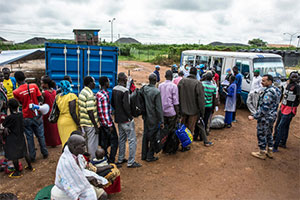 One Thousand Internally Displaced Persons (IDPs) Relocated from Tomping Camp in South Sudan. Credit: UN Photo/Isaac Billy
It took hundreds of thousands of years for the world’s human population to cross one billion in 1804. Approximately 200 years later, the population has multiplied sevenfold. In 2023, the global population crossed 8 billion, and is expected to reach 9 billion before 2050. With the planet more crowded than ever, it is essential to keep track of population trends, urbanization, migration, and reproduction across the world.
Life expectancy has seen significant strides in the past century, largely due to economic development and increased standards of living. On the contrary, trends in global fertility are shifting, with certain regions in Africa and Asia reporting higher rates, while parts of Europe and North America report stagnant or lower rates. This is in part due to differences in sexual and reproductive healthcare, as well as societal and economic conditions around the world. For example, child marriage is prevalent in certain societies, where childbearing is also considered a familial duty. Meanwhile, stagnating economies frequently experience lower marriage and childbearing rates.
The increase in migration and urban development around the world is also linked to global population trends. By 2050, it is expected that approximately 66 percent of all people will live in cities. Furthermore, global crises such as warfare and natural disasters also prompt transnational migration. Transnational migration is linked to a variety of socioeconomic issues in both host and receiving countries: migrants often leave developing countries with less access to educational and economic opportunities and arrive in developed countries where they are frequently the targets of ethnic, racial, and cultural discrimination, and economic exploitation. Recent crises in Europe and the United States demonstrate the importance of advocating for migrants worldwide. As migrants from the Global South are increasingly stripped of their legal and civic rights in unlawful deportations, or targeted in acts of identity-based violence, it is essential to keep track of population trends and protect the human rights of migrant populations. Climate-related disasters are now a major driver of displacement, with nearly half of all new internal displacements in 2025 being disaster-related.
IPS is devoted to covering issues surrounding population trends, migration, and reproduction through its compelling articles, which use both statistics and human stories to provide readers with robust and informative viewpoints.

The Week with IPS

NEXT STOP - SDGs
Tracking global progress towards a sustainable world
Tracking global progress towards a sustainable world
