Languages
Monday, November 9, 2026



News and Views from the Global South
Poverty & SDGs

Time to Close the Gender Gap in Africa with Bold Actions
International Women's Day (IWD) is an important opportunity to celebrate the achievements of women and to be bold in promoting gender parity.
Breaking Barriers for Women Is a Short Cut to Economic Growth and Development
In South Asian societies, as elsewhere, it is all too common for women to be held back, time and again Women's potential remains largely untapped - which is not only morally wrong, but also economically unwise. According to recent projections, harnessing women's full potential throughout South Asia would increase GNP by more than half by 2025. In absolute terms, women could earn countries in South Asia an additional 400 billion dollars in the next ten years! clearly, women hold the key to economic success for South Asia: their empowerment can fuel further development. The Netherlands has invested substantially in the economic empowerment of women in this region. Our successes, achieved in collaboration with many stakeholders, show what can be achieved if we keep up these efforts.
“Women in the Changing World of Work: Planet 50:50 by 2030.”
Yayi Bayam Diouf became the first woman to fish in her small rural fishing village in Senegal despite initially being told by the men in her community that the fish wouldn’t take bait from a menstruating woman. When she started practicing law, Ann Green, CEO of ANZ Lao, was asked to make coffee or pick up dry cleaning (by men and women), simply because she was a young woman. The difficulties faced by Yayi and Ann in entering the labour force and at the workplace are not only unique to them, but sadly is the reality for many women across the globe.
Half a Century of Struggle Against Underdevelopment
The idea of creating Inter Press Service (IPS) arose in the early 1960s in response to awareness that a vacuum existed in the world of journalism, which had two basic aspects.
From El Nino Drought to Floods, Zimbabwe’s Double Trouble
Dairai Churu, 53, sits with his chin cupped in his palms next to mounds of rubble from his destroyed makeshift home in the Caledonia informal settlement approximately 30 kilometers east of Harare, thanks to the floods that have inundated Zimbabwe since the end of last year.
“Women in the UN Working Together to Improve the Lives of Women Worldwide”
This International Women’s Day we celebrate women in the changing world of work, recognizing the need to fully realize women’s working potential in order to achieve Agenda 2030. We know that when women earn money, they spend it on feeding their families and educating their children. It is estimated that if women farmers had the same access to resources as men, the number of hungry people in the world could be reduced by up to 150 million.
Valuing Women’s Unpaid Work
Women’s work remains unaccounted for even though the issue of unpaid work carried out by women is being discussed globally at the policy, academic as well as practitioners’ levels.
A Day to Remember That Every Child Deserves a Chance
The day I met Julija she was playing cheerfully with her baby sister on the floor inside their room in Kragujevac, a small town in southern Serbia. When she saw me – a stranger -- on the doorstep, she smiled widely and stretched out her hands, offering a hug. As I held her, I could hear how difficult it was for her to breathe. I looked at her, she smiled and touched my face with her hands and only then did I see that Julija’s fingers were webbed.
Community Stations Fight for Frequencies in El Salvador
The Izcanal Radio and Television set is simple and austere, but this TV station made history in El Salvador, being the first, and until now the only one, to make the leap from community radio to community TV channel, in 2006.
Maritime Boundary Dispute Masks Need for Economic Diversity in Timor-Leste
Juvinal Dias has first-hand experience of mistreatment at the hands of a foreign power. Born in 1981 in Tutuala, a village in the far east of Timor-Leste, Dias’ family fled into the jungle following the 1975 invasion by Indonesia.
The Peasant Farmer Who Stood Up to the President of Nicaragua
The unequal battle that small farmer Francisca Ramírez is waging against the Nicaraguan government of Daniel Ortega has become so well-known that people are calling for her security and her rights from the political heart of Europe.
Humankind’s Ability to Feed Itself, Now in Jeopardy
Mankind’s future ability to feed itself is in jeopardy due to intensifying pressures on natural resources, mounting inequality, and the fallout from a changing climate, warns a new United Nations’ report.
Shrinking and Darkening, the Plight of Kashmir’s Dying Lakes
Mudasir Ahmad says that two decades ago, his father made a prophecy that the lake would vanish after the fish in its waters started dying. Three years ago, he found dead fish floating on the surface, making him worried about its fate.
Red Tape Snarls Nepal’s Ambitious Poverty-Alleviation Plans
Juna Bhujel of Sindupalchowk District, 85 kilometres northeast of Nepal’s capital Kathmandu, lost her daughter-in-law in the Apr. 25, 2015 earthquake. Fortunately, she managed to rescue her two-year-old grandson, who was trapped between her mother’s body and the rubble.
Alternative Mining Indaba Makes Its Voice Heard
“Comrades, we have arrived. This cherry is eight years awaited. We have made it to this place,” Bishop Jo Seoka told the crowd, pausing to allow for the whistles and cheers.
Expansion of Renewable Energies in Mexico Has Victims, Too
The growing number of wind and solar power projects in the southern Mexican state of Yucatán are part of a positive change in Mexico’s energy mix. But affected communities do not see it in the same way, due to the fact that they are not informed or consulted, and because of how the phenomenon changes their lives.
Improved Cookstoves Boost Health and Forest Cover in the Himalayas
Mountain communities in the Himalayan region are almost entirely dependent on forests for firewood even though this practice has been identified as one of the most significant causes of forest decline and a major source of indoor air pollution.
Energy Access Builds Inclusive Economies and Resilient Communities
Jaipal Hembrum runs three one-man home enterprises - a bicycle repair shop, a tiny food stall and a tailoring unit in Kautuka, a remote village in eastern India. Sewing recycled clothes into mattresses late into the evening, the 38-year-old father of three girls says two light bulbs fed by a solar power system have changed his life.
Authorities Urged to Disclose Anti-Money Laundering Efforts
Bank regulators need to publish much more information about whether banks are doing what’s required by law to stop money laundering, says a major international anti-corruption watchdog.
Worst Drought in Decades Drives Food Price Spike in East Africa
The most severe drought in decades, which has struck parts of Ethiopia and is exacerbated by a particularly strong El Niño effect, has led to successive failed harvests and widespread livestock deaths in some areas, and humanitarian needs have tripled since the beginning of 2015, the United Nations warns.
Togolese to Lead the Fight against Rural Poverty
Gilbert Fossoun Houngbo, former Prime Minister of Togo, has been appointed as the sixth President of the International Fund for Agricultural Development (IFAD), a specialised UN agency and international financial institution that invests in eradicating rural poverty in developing countries around the world.« Previous Page — Next Page »





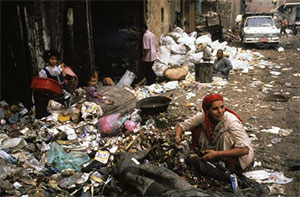 Romani people in Cairo, Egypt, forage through trash. Credit: UN Photo/Armineh Johannes
In 2015, the United Nations adopted the Sustainable Development Goals (SDGs) in an effort to promote “peace and prosperity for people and the planet.” To achieve that goal, it is essential to provide equal opportunities and access to basic services to all people. The 2025 UN SDG Report found that 35% of the 169 SDG targets are on track or making moderate progress, while 18% have reversed compared to the 2025 baseline. One in ten people still live in extreme poverty, one in eleven experience food insecurity, and over 1.1 billion people live in slums without access to clean water and sanitation. It is imperative to acknowledge the societal, technological, economic, and political issues that sustain poverty in countries around the world. Eradicating poverty will require significant frameworks in policy and governance on a national and international scale to ensure that all people will have equal access to basic services and economic opportunities by 2030. Furthermore, a dramatic reduction of United States foreign aid in 2025, including the termination of 83% of USAID programmes, threatens to erode years of fragile development gains.
Throughout the world, violent conflict and natural disasters also contribute to extreme poverty. The complete destruction of infrastructure and blockage of aid has significantly impoverished Palestine since October 7th. The destructive impact of Hurricane Maria in Puerto Rico left $91 billion in damage. An inadequate US government response also revealed significant and enduring questions within the issue of mitigating poverty: how do we rebuild infrastructure after its destruction? How do we restimulate economic development and bring in financial aid after disasters? Similar questions have been raised in the realm of regional cooperation, as devastating floods have wrecked hundreds of thousands of homes across multiple Southeast Asian nations in the past few years. Furthermore, the COVID-19 pandemic has greatly exacerbated the global poverty crisis, particularly in developing countries, setting back the United Nations goal of eradicating poverty by 2030.
IPS is committed to providing comprehensive features that focus on the persisting environmental, sociopolitical, and systemic issues that sustain poverty, and the steps taken worldwide towards poverty eradication.

The Week with IPS

NEXT STOP - SDGs
Tracking global progress towards a sustainable world
Tracking global progress towards a sustainable world

