Languages
Tuesday, October 6, 2026



News and Views from the Global South
Poverty & SDGs

Celebrating 30 Years of Shared Water
We tend to associate rivers and lakes with the countries in which they are located. Yet a little-known fact is that more than half of the world’s freshwater bodies are shared.
‘And of Water We Made Every Living Thing’
This is how the Muslims’ Holy Book - the Quran refers to the most precious element of life.
The Challenges of High Fertility, Rapidly Growing Populations
While most countries in the world have made the transition from high to low rates of deaths and births, many countries, largely in Africa, face the challenges of high fertility rates that are resulting in rapidly growing populations.
Millions Go Hungry– While Billions Worth of Food Go into Landfills
The ominous warnings keep coming non-stop: some of the world’s developing nations, mostly in Africa and Asia, are heading towards mass hunger and starvation. The World Food Programme (WFP) warned last week that as many as 828 million people go to bed hungry every night while the number of those facing acute food insecurity has soared -- from 135 million to 345 million -- since 2019. A total of 50 million people in 45 countries are teetering on the edge of famine.
Starvation Pounds Inflation-Hit Urban Zimbabweans
With inflation at 256.9 percent, 49-year-old Dambudzo Chauruka can no longer afford to buy bread despite working as a civil servant in Zimbabwe.
Yes, Africa’s Informal Sector Has Problems, But the Answer Isn’t to Marginalise It
African leaders are increasingly aspiring to “modernise” their cities. That is to make them “globally competitive” and “smart”. The hope is to strategically position cities in Africa to drive the continent’s much-needed socio-economic transformation.
To Accelerate Social Change, Approach Philanthropy With a Feminist Lens
Feminist movements are powerful, and donors who want to contribute to solving the biggest challenges facing the world today, should fund them deeply, and without restrictions. Research by Htun and Weldon back this up, showing that globally, feminist movements have been some of the biggest drivers of progressive social change.
Global Public Investment: Time to Build the Movement Now
Global Public Investment. A short and simple phrase. But one that means so much. At its most basic, GPI means public money being used to invest in goods and services that are of global benefit. There is no shortage of goods and services that need GPI, whether they be used to prevent or respond to environmental catastrophe, international war and conflict, or the next pandemic.
Rural Systems Mitigate Impact of Overuse of Water in Chile
Local leaders of the Rural Sanitation Services (RSS) warn that the digging of illegal wells by large agro-export companies in Chile is aggravating the effects of drought and threatening drinking water supplies and social peace.
The Hunger Factory (II): The Modern Horsemen of the Apocalypse
While often too quickly attributing -quasi exclusively- the world unprecedented hunger tragedy to the current proxy war in Ukraine, other major causes remain hidden in plain sight.
The Hunger Factory (I): The Miracle of the Sudden Rise and Fall of Food Prices
The benchmark for world food commodity prices declined “significantly” in July, with major cereal and vegetable oil prices recording double-digit percentage declines.
Tragic Irony of Hunger Deaths in Karamoja, Uganda Amidst Plenty of Climate Adaptation Technologies
Hundreds of people have died of famine in Uganda’s Karamoja region, and local leaders say that some people are now eating grass to survive.
UN’s Education Summit: An Opportunity to Create a Bottom-Up Global Governance
The upcoming summit on Education, part of the UN Secretary General’s ambitious agenda, can truly bring accountability and participation to the inevitably new ways education will be imparted in the future.
Infrastructure Growth Threatens Brazilian Amazon with Further Deforestation
The mandatory initial permit granted by Brazil's environmental authority for the repaving of the BR-319 highway, in the heart of the Amazon jungle, intensified the alarm over the possible irreversible destruction of the rainforest.
Of the Far West, the ‘Good Cowboys’… And the ‘Bad Indians’
Nothing --or too little-- has changed since Hollywood started producing its spectacular western movies. Rough men, ranchers, mercenary killers, saloons, cowboys, guns, gold fever, the ‘good sheriff’… and the ‘bad indians”. Those movies were anything but fiction–they were real history.
Indigenous Women at the Forefront of Transformational Change
The International Day of the World’s Indigenous Peoples, commemorated annually on August 9, is a day to celebrate the many contributions of the 476 million Indigenous peoples worldwide.
UN Chief Urges Governments to Tax “Immoral” & Excessive” Oil and Gas Profits
The war in Ukraine continues to have a devastating impact on the people of that country. Civilians are dying in the most tragic circumstances every day. Millions of lives have been destroyed or put on hold.
Technology Helps Traffickers Hunt Their Victims, Enslave Them, Sell Their Organs
Human beings have proved to be capable of producing innumerable practical inventions while much too often making the worst use of them. Take the case, per example, of how criminal groups heavily rely on digital platforms to trap and enslave their victims also for extracting and selling their organs.
A Demographic Snapshot of the Philippines: One Step Forward, a Half Step Back
With the national election and transfer of power in the Philippines from outgoing President Duterte to incoming President Marcos Jr. in July 2022, it seems an appropriate time to briefly take stock of the country’s current demographic situation, as well as recent related developments.
Frugal Innovation is Key to Advancing the UN’s Global Goal for Education
The world needs tens of millions of new teachers by 2030, according to UNESCO – an order of magnitude that requires “frugal innovation.” I’ve studied frugal innovation for more than a decade, and it holds a vital key to this global challenge. A model created by BRAC in Bangladesh deserves special attention in this worldwide pursuit.
Salvadoran Farmers Learn Agricultural Practices to Adapt to Climate Change
With the satisfaction of knowing he was doing something good for himself and the planet, Salvadoran farmer Luis Edgardo Pérez set out to plant a fruit tree on the steepest part of his plot, applying climate change adaptation techniques to retain water.« Previous Page — Next Page »





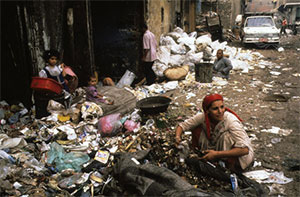 Romani people in Cairo, Egypt, forage through trash. Credit: UN Photo/Armineh Johannes
In 2015, the United Nations adopted the Sustainable Development Goals (SDGs) in an effort to promote “peace and prosperity for people and the planet.” To achieve that goal, it is essential to provide equal opportunities and access to basic services to all people. The 2025 UN SDG Report found that 35% of the 169 SDG targets are on track or making moderate progress, while 18% have reversed compared to the 2025 baseline. One in ten people still live in extreme poverty, one in eleven experience food insecurity, and over 1.1 billion people live in slums without access to clean water and sanitation. It is imperative to acknowledge the societal, technological, economic, and political issues that sustain poverty in countries around the world. Eradicating poverty will require significant frameworks in policy and governance on a national and international scale to ensure that all people will have equal access to basic services and economic opportunities by 2030. Furthermore, a dramatic reduction of United States foreign aid in 2025, including the termination of 83% of USAID programmes, threatens to erode years of fragile development gains.
Throughout the world, violent conflict and natural disasters also contribute to extreme poverty. The complete destruction of infrastructure and blockage of aid has significantly impoverished Palestine since October 7th. The destructive impact of Hurricane Maria in Puerto Rico left $91 billion in damage. An inadequate US government response also revealed significant and enduring questions within the issue of mitigating poverty: how do we rebuild infrastructure after its destruction? How do we restimulate economic development and bring in financial aid after disasters? Similar questions have been raised in the realm of regional cooperation, as devastating floods have wrecked hundreds of thousands of homes across multiple Southeast Asian nations in the past few years. Furthermore, the COVID-19 pandemic has greatly exacerbated the global poverty crisis, particularly in developing countries, setting back the United Nations goal of eradicating poverty by 2030.
IPS is committed to providing comprehensive features that focus on the persisting environmental, sociopolitical, and systemic issues that sustain poverty, and the steps taken worldwide towards poverty eradication.

The Week with IPS

NEXT STOP - SDGs
Tracking global progress towards a sustainable world
Tracking global progress towards a sustainable world

