Languages
Wednesday, October 7, 2026



News and Views from the Global South
Poverty & SDGs

Climate Change is Putting Women & Girls in Malawi at Greater Risk of Sexual Violence
It is often those least responsible for causing climate change that suffer the most from the impacts. And such is the case with women and girls in Malawi - one of the world’s poorest and lowest carbon-emitting countries but ranked fifth in the Global Climate Index 2021 list of nations worst affected by climate-related extreme weather.
Heat Waves and Agricultural Production: In the Race to Mitigate Extreme Heat, We Must not Forget Strengthening Agriculture
Across the U.S., and around the world, particularly Europe, heat records are being shattered. Accompanying these extreme temperatures are fires caused by the heat that are burning both homes and forests. While extreme heat is impacting some areas of the world, flooding is impacting other areas including Colorado and Virginia in the U.S., and in other countries around the world including Brazil and Ecuador.
Pandemic and Poverty Fuel Child Labor in Peru
In the afternoons he draws with chalk on the sidewalk of a downtown street in the Peruvian capital. Passersby drop coins into a small blue jar he has set out. He remains silent in response to questions from IPS, but a nearby ice cream vendor says his name is Pedro, he is 11 years old, and he draws every day on the ground for about four hours.
Canada Lags in Providing for Children, Especially Marginalized Kids
Canada and its major cities consistently appear in Top 10 lists of best places in the world to live. But delve into figures about children’s lives in the northern nation known for ice hockey heroics and you see a different picture.
Historic WTO Deal Could Threaten Subsidies, Lifeline for Jamaican Fishers
In the 21 years it took the World Trade Organisation (WTO) to agree on a historic deal on fishing subsidies, the lives of fisherfolk in Rocky Point, Clarendon, have seen many ups and downs.
Fear Returns to Argentina, Once Again on the Brink
Darío is a locksmith in Flores, a traditional middle-class neighborhood in the Argentine capital, who will have to stop working in the next few days. "Suppliers have suspended the delivery of locks, due to a lack of merchandise or because of prices," he laments. His case is an illustration of an economy gone mad in a country that once again finds itself on the brink of the abyss.
The Tragedy of Pakistan: Feudalism Camouflaged as Democracy
In recent days, as Pakistan’s economic woes have intensified, a veritable cottage industry has developed to suggest ways of putting the country back on track.
Both UK & Congo Think They’re Climate Leaders – COP26’s Fallout Shows How Far Adrift They Are
From the fall-out of the pandemic to the interlocking cost of living and energy security crises currently gripping the world, it has been fascinating to see the world’s richest governments bending over backwards to help fossil fuel companies.
An Integrated Regional Response for the Sahel Crisis
The current Ukraine-Russia conflict is dominating the global media to the point of overshadowing longer protracted crisis that no longer make headlines, but are still rife. Such is the case with the on-going Sahel crisis, one of the world's most neglected ones, where acute poverty, the dramatic effects of climate change and rising armed conflicts have become the norm for more than a decade. A situation further exacerbated by the on-going COVID-19 pandemic.
We’re on the Cusp of the Most Catastrophic Food Crisis in 50 Years: Where Is the Global Response?
A growing mountain of data and analysis points to an unprecedented global crisis in the making, due to the convergence of “Four Cs” (Conflict, Covid, Climate and Costs).
Time for a UN Human Rights Leader
The UN High Commissioner for Human Rights sits at the top of the UN’s human rights system. It’s a crucial role for the victims of violations and the many civil society activists who look to the UN system to set and apply human rights norms, monitor the human rights performance of states and hold rights violators to account.
Amplifying the SDGs Requires Fresh Storytelling Tactics
With the latest United Nations Sustainable Development Goals (SDGs) Report revealing that much progress toward the SDGs has been reversed, the UN has focused on how to amplify the goals and hold member states accountable for tackling them amid current crises.
U.S.-Latin America Immigration Agreement Raises more Questions than Answers
The immigration agreement reached in Los Angeles, California at the end of the Summit of the Americas, hosted by U.S. President Joe Biden, raises more questions than answers and the likelihood that once again there will be more noise than actual benefits for migrants, especially Central Americans.
Digital Record-Keeping Eases the Burden of Mongolian Herders
“My son went after his cow. He will come soon. Our work starts as soon as the sun rises — milking the cows, herding the sheep, rearing the calves, and on it goes. There is nothing more difficult than losing cows and calves on hot summer days," says herder D. Chimiddulam, standing in green grass on one side of a tall wooden fence, looking at dozens of black and white sheep and goats in the enclosure.
Abortion Decision Felt Worldwide
The 24 June decision of United States Supreme Court to overturn the country’s nearly 50-year constitutional right of a woman to an abortion is being felt worldwide.
Xenophobia in Mandiba’s Land: Too Black…Or Just Too Poor?
South Africa, the home land of the late giant fighter against Apartheid, racism and discrimination – Nelson Mandela “Mandiba”, is already ‘on the precipice of explosive xenophobic violence’ against migrants, refugees, asylum seekers - and even citizens perceived as outsiders.
Achieving the SDGs in Extraordinary Times
The start of the “Decade of Action” to achieve the United Nations’ Sustainable Development Goals (SDGs) has also marked the start of an unprecedented period of overlapping crises.
Hundreds of Millions of Human Workers Treated Worse than Robots
While the world’s big private business pours billions of dollars in producing automatic machines and assuring their optimal functioning, bareley no money has been invested in the hundreds of millions of human workers, who are left shockingly unprotected, treated like cheap robots, or even worse.
Food Security: We Are Still Going Backwards
The signs of the last few years indicate a continuous setback towards achieving food security. The Food and Agriculture Organization of the United Nations’ (FAO) annual report, "The State of Food Security and Nutrition in the World (SOFI)”, prepared together with other UN agencies and presented on July 6th leaves no doubt about the dangerous situation in which we find ourselves regarding the real possibilities of eliminating hunger and poverty by 2030, as solemnly proposed by the international community in October 2015 in New York.
BRAC celebrates 50 years: A case for social development founded and led by the Global South
As part of the 2022 United Nations High-Level Political Forum, BRAC, with the Permanent Mission of Bangladesh to the United Nations, and the Permanent Mission of the Republic of Rwanda to the United Nations, hosted a side event this week to discuss development opportunities led by the Global South. The event highlighted the NGO’s achievements over the last five decades in alleviating and eradicating poverty and the interconnectedness between the UN Sustainable Development Goals (SDGs) in their initiatives.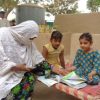
Entrepreneurship Blooms in Villages Bordering Pakistan Desert
Villagers living with a desert at their doorstep in Pakistan’s eastern Punjab province are finding life more bountiful thanks to recent training on how to use their smartphones to buy, sell and gather information.« Previous Page — Next Page »





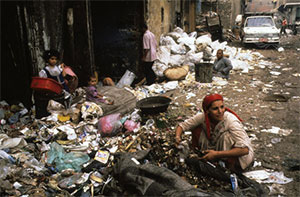 Romani people in Cairo, Egypt, forage through trash. Credit: UN Photo/Armineh Johannes
In 2015, the United Nations adopted the Sustainable Development Goals (SDGs) in an effort to promote “peace and prosperity for people and the planet.” To achieve that goal, it is essential to provide equal opportunities and access to basic services to all people. The 2025 UN SDG Report found that 35% of the 169 SDG targets are on track or making moderate progress, while 18% have reversed compared to the 2025 baseline. One in ten people still live in extreme poverty, one in eleven experience food insecurity, and over 1.1 billion people live in slums without access to clean water and sanitation. It is imperative to acknowledge the societal, technological, economic, and political issues that sustain poverty in countries around the world. Eradicating poverty will require significant frameworks in policy and governance on a national and international scale to ensure that all people will have equal access to basic services and economic opportunities by 2030. Furthermore, a dramatic reduction of United States foreign aid in 2025, including the termination of 83% of USAID programmes, threatens to erode years of fragile development gains.
Throughout the world, violent conflict and natural disasters also contribute to extreme poverty. The complete destruction of infrastructure and blockage of aid has significantly impoverished Palestine since October 7th. The destructive impact of Hurricane Maria in Puerto Rico left $91 billion in damage. An inadequate US government response also revealed significant and enduring questions within the issue of mitigating poverty: how do we rebuild infrastructure after its destruction? How do we restimulate economic development and bring in financial aid after disasters? Similar questions have been raised in the realm of regional cooperation, as devastating floods have wrecked hundreds of thousands of homes across multiple Southeast Asian nations in the past few years. Furthermore, the COVID-19 pandemic has greatly exacerbated the global poverty crisis, particularly in developing countries, setting back the United Nations goal of eradicating poverty by 2030.
IPS is committed to providing comprehensive features that focus on the persisting environmental, sociopolitical, and systemic issues that sustain poverty, and the steps taken worldwide towards poverty eradication.

The Week with IPS

NEXT STOP - SDGs
Tracking global progress towards a sustainable world
Tracking global progress towards a sustainable world

