Languages
Monday, October 5, 2026



News and Views from the Global South
Poverty & SDGs
Why Investing in Water, Sanitation and Hygiene Pays Off
As the devastating images of flooding in Pakistan went round the world and the country declared a state of emergency, some 4,000 miles away in Stockholm, delegates had just arrived for World Water Week – an annual focal point for global water issues.
Innovative Financing to Protect Public Health During a Pandemic
Economic recovery since the COVID-19 pandemic has been uneven amidst a cautious loosening of restrictions. But even at the height of the pandemic, it was business as usual for the tobacco industry.
Inflation Targeting Farce: High Costs, Moot Benefits
Policymakers have become obsessed with achieving low inflation. Many central banks adopt inflation targeting (IT) monetary policy (MP) frameworks in various ways. Some have mandates to keep inflation at 2% over the medium term. Many believe this ensures sustained long-term prosperity.
Full Gender Equality Almost 300 Years Away at Current Rate of Progress
While women in rich societies are paid around 25% less than men for equal jobs, those living in impoverished countries receive by far much lower salaries, if any at all.
Let’s Fight for What Counts to End AIDS, Tuberculosis and Malaria
Next week, taking place alongside the UN General Assembly, President Biden hosts a financing summit in New York of such importance that it will determine if millions of people live, will shape the world around us for years to come and will set the future direction of global health. At least $18 billion is needed to fund the work of the Global Fund to Fight AIDS, Tuberculosis and Malaria.
Pakistan Flooding Shows ‘Adapting’ to Climate Change Can Be a Dangerous Illusion
One third of Pakistan is now under water. The scope of the destruction is difficult to fathom, not just the enormity of the devastation its people are facing today, but also the damage to its infrastructure, its buildings, and its economy that will weigh heavily on the country for months and even years to come.
Unsettled Lives in a Troubled World
Cross-continent vacations seem to be the norm once again with the lessening of COVID-19 while new cities are being built with skyscraping $4M condos shooting up in a matter of months, and just-out-of-University millennials launching into their careers with minimum start-off salaries of $75K.
Building Leadership for Teachers in the Developing World
If we truly want to re-imagine the role education can play in the decades to come, it is going to be indispensable to take drastic measures to elevate the role of teachers in developing countries.
What Does the African Continental Free Trade Agreement Hold for Women?
Agnes Opus sells cereals in Busia, the border town between Kenya and Uganda. This is her lifeline through which she caters for her immediate family’s needs from school fees to housing and medical care and support to her extended family. While she dedicates all her energy and time to this work which she loves, she struggles to meet all her needs. She faces many non-tariff barriers including harassment by officials and unclear and ever-changing information on trade requirements.
What Must COP27 Deliver?
Preparations for COP27 in November are proceeding apace and we are now well past the halfway mark between the preparatory meetings in June in Bonn and the start of the summit in Sharm El-Sheikh, Egypt. The agenda for Sharm El-Sheikh is complex and challenging. Furthermore, the meeting is taking place during a time of international turmoil. So, what are the factors influencing whether Sharm El-Sheikh can be a success? And what, exactly, does COP27 need to deliver?
United We Stand to Achieve Sustainable Development
The world today faces a future that is in peril. Our challenges have become more complex and interconnected, as we see the impacts of the COVID-19 pandemic, an uneven economic recovery, a climate emergency, growing inequalities, and an increase in conflicts globally. This year also marks a grim milestone, with over 100 million people forcibly displaced.
Zambian Parliamentarians Tackle Population Issues to Improve Quality of Life for Citizens
Parliamentarians play a decisive role in addressing population issues, as was demonstrated when the majority voted against a private member motion to end the teaching of comprehensive sexuality education (CSE) in Zambia in 2020.
Hundreds of Millions of Children Sentenced to Ignorance
More than two-thirds of 10-year-olds are unable to read and understand a simple text. This shocking finding should be enough to be alarmed about the horrifying fate of an entire generation. But there is much more.
COVID-19 Forced Ugandan Teachers to Go Digital, Teaching Them Important Lessons
Before the outbreak of COVID-19, an education officer in the district neighbouring Uganda’s capital Kampala decreed that teachers could not take computers, mobile phones, or tablets into classrooms.
Eight International Development Priorities for the new UK Prime Minister
The UK’s new Prime Minister (and former Foreign Secretary), Liz Truss, enters Downing Street with a full and urgent in-tray, dominated by the highest inflation rate for 40 years and concerns across the country about the cost-of-living crisis.
The Right Policies Can Protect the Workers of Asia and the Pacific
Most of the 2.1 billion strong workforce in Asia and the Pacific are denied access to decent jobs, health care and social protection but there is an array polices and tools that governments can use to remedy these deficiencies and ensure that the rights and aspirations of these workers and their families are upheld and that they remain the engine of economic growth for the region.
The Dying Children Divide
The chances of a child dying before reaching age five years have dropped substantially worldwide during the recent past. However, a significant divide remains among countries as well as within regions in the chances of children dying.
Transforming Girls’ Education, Changing The World
As we approach this year’s Transforming Education Summit, global leaders can and must prioritize expertise and mobilize political will to support efforts to ensure inclusive and quality education for all, especially girls. This is at the heart of Sustainable Development Goal 4 in the 2030 Agenda for Sustainable Development, as well as the commitments made in the Charlevoix Declaration and the G7 Declaration on Girls’ Education.
Building Resilience in the Philippines Through Sustainable Livelihoods and Psychosocial Support
Elvie Gallo no longer hangs around her local grocery store, hoping for the odd job to put food on the table. Her hand-to-mouth life has been replaced by a viable chicken rearing and selling business in Iloilo province in the Philippines.
“The Worse, The Better” Doctrine and the Melting Ice
‘There is a prevailing doctrine among the right and far-right political parties who are still in the opposition and are most likely to jump to power in those countries where they are not already ruling. It is the doctrine of “the worse things go, the better for us.”
Yezidis in Armenia: From Reincarnation to Exodus
There are those cows watching the fight in the mud of rusty Soviet cars; there are those tethered dogs that bark next to bathtubs full of rainwater, or those cats that frolic in freedom. This is Armenia, a state of three million deep in the heart of the Caucasus region.« Previous Page — Next Page »


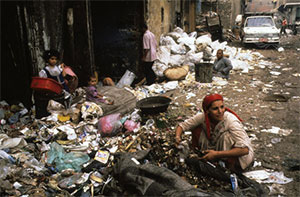 Romani people in Cairo, Egypt, forage through trash. Credit: UN Photo/Armineh Johannes
In 2015, the United Nations adopted the Sustainable Development Goals (SDGs) in an effort to promote “peace and prosperity for people and the planet.” To achieve that goal, it is essential to provide equal opportunities and access to basic services to all people. The 2025 UN SDG Report found that 35% of the 169 SDG targets are on track or making moderate progress, while 18% have reversed compared to the 2025 baseline. One in ten people still live in extreme poverty, one in eleven experience food insecurity, and over 1.1 billion people live in slums without access to clean water and sanitation. It is imperative to acknowledge the societal, technological, economic, and political issues that sustain poverty in countries around the world. Eradicating poverty will require significant frameworks in policy and governance on a national and international scale to ensure that all people will have equal access to basic services and economic opportunities by 2030. Furthermore, a dramatic reduction of United States foreign aid in 2025, including the termination of 83% of USAID programmes, threatens to erode years of fragile development gains.
Throughout the world, violent conflict and natural disasters also contribute to extreme poverty. The complete destruction of infrastructure and blockage of aid has significantly impoverished Palestine since October 7th. The destructive impact of Hurricane Maria in Puerto Rico left $91 billion in damage. An inadequate US government response also revealed significant and enduring questions within the issue of mitigating poverty: how do we rebuild infrastructure after its destruction? How do we restimulate economic development and bring in financial aid after disasters? Similar questions have been raised in the realm of regional cooperation, as devastating floods have wrecked hundreds of thousands of homes across multiple Southeast Asian nations in the past few years. Furthermore, the COVID-19 pandemic has greatly exacerbated the global poverty crisis, particularly in developing countries, setting back the United Nations goal of eradicating poverty by 2030.
IPS is committed to providing comprehensive features that focus on the persisting environmental, sociopolitical, and systemic issues that sustain poverty, and the steps taken worldwide towards poverty eradication.

The Week with IPS

NEXT STOP - SDGs
Tracking global progress towards a sustainable world
Tracking global progress towards a sustainable world

