Languages
Saturday, October 3, 2026



News and Views from the Global South
Green Economy

How to Make COP27 a Success
Each year, low-emitting countries like Bangladesh are the greatest sufferers and, paradoxically, pay the biggest price in losses and damages resulting from climate change.
Mexico’s Electric Mobility, Stuck in Fossil Fuel Traffic
The Mexico City government began testing an elevated route for electric buses with great fanfare on Sept. 11, in a bid to promote more sustainable transport. The initiative is part of an incipient promotion of electromobility in the country, amidst pro-fossil fuel energy policies.
Great Wind and Solar Potential Boosts Green Hydrogen in Northern Brazil
Brazil could become a world leader in the production of green hydrogen, and the northeastern state of Ceará has anticipated this future role by making the port of Pecém, with its export processing zone, a hub for this energy source.
Biomethane, the Energy that Cleans Garbage in Brazil
The increasing productivity with which humankind generates waste has gained at least one sustainable counterpart: the extraction of biogas from landfills, a growing activity in Brazil.
Africa Should Trade its Carbon Credits to Fund Renewable Energy – UNECA
Africa needs to trade in carbon credits to reduce greenhouse gas emissions, finance the transition to renewable energy, and boost economic development, the United Nations Economic Commission for Africa (UNECA) says.
There’s no Stopping Renewable Power in Chile, but Community Energy Is Not Taking Off
Renewable energies, especially solar and wind power, are growing inexorably in Chile, driven by large companies. But community generation of alternative energy is not taking off, despite a law promoting it.
Biofuels Slow Down Electric Vehicles in Brazil
Brazil celebrated 100,000 electric vehicles in circulation in late July, but this is a drop in the ocean compared to the 46 million combustion vehicles registered in the country and in contrast with the pace of the phasing out of oil in the world's automotive industry.
Researchers Embrace Artificial Intelligence to Tackle Banana Disease in Burundi
A group of scientists involved in finding solutions to minimize the impact of a devastating banana virus in Burundi have developed an Artificial Intelligence (AI) tool for monitoring the disease.
Slow food, Accelerating Biodiversity in the Field and On Our Plates
Edward Mukiibi was forced to do agriculture at school as punishment for misbehaviour. Instead of hating the punishment, he loved it, especially when he realised farming was the future of good food, health and wealth.
Biogas Production Awaits Greater Incentives in Cuba
Standing in front of a blue flame on her stove, getting ready to brew coffee, Mayra Rojas says the biodigester built in the backyard of her home in western Cuba has become a key part of her daily life and a pillar of her family's well-being.
Unleashing Mangrove Superpower Through Soft Coastal Engineering
The swish of calm waters followed by unexpectedly high tides and violent waves is now too familiar for the fisher community along Kenya’s 1,420-kilometer Indian Ocean coastline.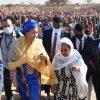
The Africa We Want is Still Within Reach – & a Priority for the United Nations
The “Africa We Want” - as outlined in Agenda 2063 - embodies the African Union’s bold vision of an integrated, prosperous, and peaceful continent.
Smallholder Farmers in Uganda Recruit Black Soldier Fly for Green Fertiliser
The conflict in Ukraine has led to an increase in fertiliser prices in Uganda and neighbouring Kenya. Amidst the shortages, some farmers are shifting to a more sustainable way of enriching their soils using frass from the Black Soldier Fly.
Clean Energies Seek to Overcome Obstacles in Argentina
The multitude of solar panels stands out along a dirt road in an unpopulated area. Although located just an hour's drive from Buenos Aires, the new solar park in the municipality of Escobar is in a place of silence and solitude, symbolic of the difficulties faced by renewable energies in making inroads in Argentina.
“Made in Chile” Electric Buses, Another Stride Towards Electromobility
The manufacture in Chile of an electric bus christened Queltehue, a wading bird native to the country, is another step towards electromobility and in the fight against pollution that triggers frequent environmental crises and smog emergencies in Santiago and other cities.
Narrow Valuation of Nature is Widening Biodiversity Loss
Nature has diverse values for different people, but it is poorly evaluated, and this is driving the global biodiversity crisis, top scientists say in a new report.
Nature-Positive Ventures Crucial for Africa’s future, say experts at Africa Green Economy Conference
Africa’s unique natural capital assets were the center of conversation at the 2022 Africa Green Economy Conference. Held in a hybrid format from June 27 to 30, participants gathered to discuss the value of nature in Africa’s economy and call for more nature-positive ventures in development.
Climate Hypocrisy Ensures Global Warming
Rich country governments claim the high moral ground on climate action. But many deny their far greater responsibility for both historic and contemporary greenhouse gas (GHG) emissions, once acknowledged by the Kyoto Protocol. Climate injustice Worse, responsibility has not been matched by commensurate efforts, especially by the largest rich economies in the G7, which dominates the G20. Its continued control of international economic resources and policymaking blocks progress on climate justice.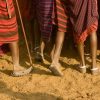
Indigenous Communities Want Stake in New Deal to Protect Nature
In early June 2022, more than 30 people from the Maasai community in the Loliondo division in Tanzania’s northern Ngorongoro District were reportedly injured, and one person died following clashes with security forces over the demarcation of their ancestral lands for a new game reserve.
Frankincense and Myrrh Have New Economic Resonance for Women in Kenya’s Arid North
Clad in traditional regalia and necklaces of richly coloured beads that form magnificent patterns around their necks, an army of women from the pastoral Rendile community that resides at the heart of Marsabit, a county in Kenya’s arid north, is on a mission.
Researchers Strive for Technological Innovations to Achieve Food Security in Africa
A few years ago, after coming up with a project of launching the first-ever unmanned aerial systems (UAS) in Rwanda, entrepreneur Mamy Muziga Ingabire identified the need to provide farmers with information related to their activity – such as the health status of crops.« Previous Page — Next Page »


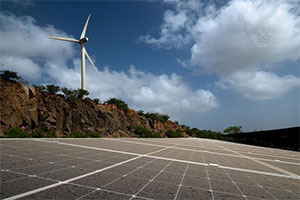 Renewable Energy in Cabo Verde. Credit: UN Photo/Mark Garten
A green economy is an economic model that aims to reduce environmental risks and build a sustainable future. Many of the UN SDGs seek to facilitate a green economy, such as ensuring access to affordable and reliable clean energy, building sustainable cities and communities, and implementing urgent action to combat climate change. Various key negotiations have strived to achieve a green economy, such as the Green New Deal and the Inflation Act of 2022. COP30, held in Belém, Brazil in 2025, agreed to mobilize $1.3 trillion annually for climate action and launched the Belém Mission to 1.5°C. However, the conference was not able to develop a fossil fuel reduction roadmap. Recent years have witnessed a sharp transformation in the geopolitical landscape of international sustainability cooperation. In March 2025, the United States stepped back from formal multilateral support for the SDGs, while China is on the rise as an international leader in renewable energy production. The actions of these global powers may shape shifting alliances on environmental governance. IPS is dedicated to sharing timely news on international developments in building a sustainable future.

The Week with IPS

NEXT STOP - SDGs
Tracking global progress towards a sustainable world
Tracking global progress towards a sustainable world
