Languages
Wednesday, November 11, 2026



News and Views from the Global South
Labour

Management Jobs Elusive for Cuban Women
Despite the progress made by Cuban women in education, where they account for 64 percent of university graduates, they continue to have a limited presence in management positions.
Are Middle Class Protests Fallout from Poverty Alleviation?
The rise of the "global middle class" is widely attributed to the gradual eradication of extreme poverty in the developing world, even as the United Nations says that millions of people in countries such as India, China and Brazil have graduated from the ranks of the indigent.
Community Theatre Confronts Gender Stereotypes
The play opens with a man and his mother waiting impatiently at the dining table in the family home. A woman rushes in after a busy day at the office with takeaway dinner packets, followed by her son and daughter who walk in expecting their mother to serve them a meal.
New EU Rules ‘Fail’ Against Shipbreaking Dangers
Hundreds of European vessels are scrapped under hazardous conditions in South Asia every year. European parliamentarians have approved a new regulation to tackle the problem - but critics say it will have very limited impact.
New Labour Norms Could Hurt Bangladesh
The decisions of the United States and the European Union to demand implementation of controversial labour standards in Bangladesh following the Sawa industrial tragedy pose a serious threat to the rule-based global trading system, says Dr Supachai Panitchpakdi, Secretary-General for United Nations Conference on Trade and Development.
Brazil’s “Other” Protesters
The young people who have been protesting in Brazil over the last few weeks, who say they are apolitical and who have organised over the social networking sites, were not entirely pleased with Thursday’s demonstrations by the country’s trade unions and social and popular movements.Technical Education Competes with University: Study
Technology education programmes are increasingly becoming a viable alternative to the standard four-year undergraduate university programme, according to the OECD, a major international grouping of rich countries.
U.S. Retailers Unveil Contentious Bangladesh Safety Agreement
An alliance of 17 major U.S. brands and retailers, including Walmart and the Gap, has unveiled a five-year agreement aimed at strengthening conditions and worker rights at garment factories in Bangladesh.
War or Peace, Sri Lankan Women Struggle to Survive
It has been four years since the guns fell silent in Sri Lanka’s northern Vanni region, after almost three decades of ethnic violence. Unfortunately peace does not mean the end of hardship for the most vulnerable people here: the women.
Pray Again to St. Precarious
It didn’t take the financial crisis for hundreds of thousands of workers across Europe to protest the new plague of the labour market – precarity. But the financial crisis has only made it worse.
A Floral Touch to Employment in Kashmir
As a little girl, Rubeena Begum had big plans: she would become a doctor and secure a decent income working in one of the 30 hospitals in the Himalayan state of Kashmir in north India.
Fighting Drought, One Pond at a Time
 Bangladesh, a country of 150 million people who depend on rice as their main staple, is gearing up for drought. Already huge areas of the rice-producing regions are on a knife's edge, as elusive rains and hotter temperatures team up on thirsty paddy fields and threaten to disrupt food supply.

Europe’s Youth Count Ten Times Less than Its Banks
At the last summit of European heads of state held in Brussels at the end of June, the main theme was youth unemployment, which has now reached 23 percent of European youth (although it stands at 41 percent in Spain).
Brazil’s Left Is Eager to Lead the “Swarm”
The street marches in Brazil, initially non-party-political, have begun to take on the hues of leftwing political and social groupings, which are now trying to set the course of the movement that emerged from online social networks.
Cyclone-Resistant Construction Materials, Cuban Style
Houses with sturdy masonry walls and reinforced concrete roofs, looking like they could survive any tropical storm or hurricane, are sprouting up on the outskirts of this city in central Cuba, thanks to the development of local production of construction materials.
Living Laboratory for Coping with Drought in Brazil
The first surprise on arriving at Abel Manto's farm is how green it is, in contrast with the dry brown surroundings. His beans and fruit trees seem oblivious to the persistent drought in the semi-arid hinterland of northeast Brazil, the worst in 50 years.
Leasehold Forestry Breathes New Life into Nepal
Over 40 percent of Nepal is covered in thick forest, but most of it has been degraded. Rural communities that have traditionally relied on the forests for survival now live in abject poverty, struggling to secure the food necessary for survival. Most men have migrated to the Gulf in search of employment.
A Latin America With Opportunity for All
Latin America has had a good decade. Over the last 10 years, economic growth averaged 4.2 percent, and 70 million people escaped poverty. Macroeconomic stability, open trade policies and pro-business investment climates have supported and will continue to support strong growth in the years to come.
China Leads Battle Against Poverty, Says U.N.
The United Nations has singled out China - the world's most populous country with over 1.3 billion people - as one of the key success stories in the longstanding battle against poverty.
Latin America Can Feed the World
With its abundant natural resources, productive capacity and rising investment, Latin America looks set to become of the main suppliers to meet the growing, diverse and increasingly sophisticated global demand for food.
Tunisia Now Searches an Economic Spring
Nearly two-and-a-half years since the toppling of the autocratic regime of Zine el-Abidine Ben Ali in the first regime change of the now famous Arab Spring, the high expectations of change to come with the revolution have hardly been met.« Previous Page — Next Page »





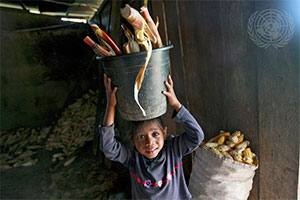 Timorese Girl with Fresh-Picked Corn. Credit: UN Photo/Martine Perret
A global common denominator is the need for a decent job. The economic realities of each country determine just how difficult it is to find one. Despite the labour movement's achievements, serious challenges persist: gender discrimination, child labour, worker migration, the digital divide and AI automation, evaporating pensions, unsafe workplaces, corporate pressure against union organising, negative impacts of trade agreements, and the precariousness of informal employment. The 2025 UN SDG Report identifies jobs and social protections as one of the six priority areas requiring urgent action, with progress either stalled or reversing in many developing nations.
In recent years, the fight to protect labour equality has taken on new dimensions with the rise of Environmental, Social and Governance standards. With the Social aspect aiming to promote equality and human rights, ESG principles have strengthened labour advocacy within corporate and governmental regulatory landscapes. In particular, ESG has become much more institutionalized in emerging economies such as Brazil and China. IPS follows the world’s workers as they confront these challenges - their setbacks and their successes.

The Week with IPS

NEXT STOP - SDGs
Tracking global progress towards a sustainable world
Tracking global progress towards a sustainable world
