Languages
Thursday, November 19, 2026



News and Views from the Global South
Natural Resources

For Dominica, Adaptation Best Option to Combat Climate Change
It has been dubbed the "Nature Isle" of the Caribbean, its craggy and dense rain forests, usually covered with fog, bearing testament to how cool temperatures can be here.
Human Activity and Climate Change Threaten Tourism in Jamaica
Experts here fear that that the impact of climate change on Jamaica's fragile ecosystems will worsen the ravages of human activity and destroy the country's tourism industry.
Politics Heats Up Around Arctic Thaw
The best way to protect the Arctic is for all nations with an interest in the region to participate in its governance - including non-Arctic nations like China, Brazil, and Singapore - suggests a new report.
“Land Is Our Ally, But Its Patience Is Not Eternal”
Land degradation poses a threat to all life on Earth including humanity. To stop the enormous loss of life-giving land, the United Nations Convention to Combat Desertification (UNCCD) is pushing for a sustainable development goal of Zero Net Land Degradation (ZNLD) to be adopted at the upcoming Conference on Sustainable Development, known as Rio+20, in Brazil.
Dam Company in Chile Presses Gov’t for Supportive Policies
Colbún, the electricity generating company that co-owns HidroAysén and its multi-dam project in southern Chile, has recommended suspending the environmental impact assessment for power transmission lines that would connect the hydropower complex to the country's central grid, until the right conditions are in place.
For an Ailing Planet, the Cure Already Exists
The planet's climate recently reached a new milestone of 400 parts per million (ppm) of carbon dioxide in the Arctic.
RIO+20: Canada, Last Holdout, Drops Opposition to Water as Human Right
Canada, in a dramatic political turnaround, has signaled its willingness to recognise water and sanitation as a basic human right.
Activists from Many Nations Condemn Chevron
More than 100 people gathered Wednesday outside the gates of Chevron's sprawling headquarters in upscale San Ramon in the San Francisco Bay area of California, where police and security barred those without passes to the shareholder meeting from entering.Korea Takes the Spotlight with Yeosu Expo
The Yeosu Expo 2012 exemplifies how the Republic of Korea (ROK) has made its debut on the world stage.
Time for a More Sustainable Global Food System
It is vitally important that governments and civil society organisations start transitioning to a more sustainable global food system in order to achieve lasting development.Energy Agency Looks to Natural Gas “Golden Age”
If a series of "golden rules" can be followed, a new report from the International Energy Agency (IEA) suggests, global natural gas usage could grow by more than 50 percent by 2035.
A Future With Food, or No Future At All
The upcoming Rio+20 Conference on Sustainable Development will not succeed if the crises of hunger and malnutrition are not effectively addressed. The issues are so inextricably linked with sustainable development that they have to be part of the agenda, according to a report released Wednesday by the United Nations Food and Agricultural Organisation (FAO) for the upcoming Earth Summit that will take place in Rio de Janeiro from Jun. 20-22.
Q&A: North-South Divide Looms Heavily Over Rio+20 Summit
The 1992 Earth Summit in Rio de Janeiro was to a large extent derailed by a North-South divide: a battle between a coalition of rich industrial nations versus the world's developing countries led by the Group of 77.
Rio+20 is Everyone’s Conference
The United Nations Conference on Sustainable Development, otherwise known as Rio+20, is a once-in-a-generation opportunity.Native Canadians See Way of Life Under Assault
Canada's West Coast First Nations are feeling overwhelmed by crises affecting their land rights, economic well-being and health, prompting warnings in one territorial dispute with a local energy company that the country risks a degeneration of Aboriginal-federal government relations to a level unseen in two decades.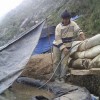
Runaway Gold Prices Spark Major Headaches for Guyana
Fabian George drank and generally used water from jungle rivers near his mountainside home for decades until world market prices for gold began climbing in recent years.
Ikea Products Made From 600-Year-Old Trees
The home furnishing giant Ikea, founded in Sweden in 1943, is facing heavy criticism for the logging and clear-cutting of old-growth forests in the north of Russian Karelia by its wholly owned subsidiary Swedwood.
‘Green Economy’ – New Disguise for Old Tricks?
Though the current global economic and financial crises are undoubtedly devastating much of the world, they present the perfect opportunity for remodeling our economic system, according to participants at the ninth annual Terra Futura (Future Earth) exhibition of ‘good practices’ in social, economic and environmental sustainability held here from May 25-27.
Selling Ethanol Stoves in Mozambique to Generate Carbon Credits
Along a dirt road in Mozambique’s Sofala province, a long line of men on bicycles stretches into the distance, each carrying an impossibly big bag of charcoal strapped to his bike.
Renaissance Rice Rises From the Debris
This April, a small rice paddy field in Minami Sanriku, destroyed by the massive earthquake and tsunami last year in Japan, provided one of its most fertile yields yet - bringing hope and joy to the devastated local community.
ANTIGUA: Mysterious Pest Targets Valuable Palm Trees
Something is decimating the coconut and other palm trees here and no one seems to know exactly what it is.« Previous Page — Next Page »


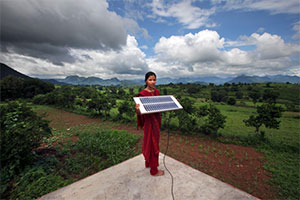 Bringing clean energy to rural India. Credit: Abbie Trayler-Smith / Panos Pictures / Department for International Development
Large reserves of oil, gas and minerals in developing countries generate opulent revenues. They could be used to stimulate economic growth and reduce poverty, but often result in environmental destruction and conflict, benefiting large companies and corrupt governments. Furthermore, competition over natural resources often manifests through geopolitical conflict. For example, before the US-Iraq war, Iraq’s domestic oil industry was nationalized. With US aggression came weakened Iraqi institutions and foreign intervention, thus eventually leading to the privatization of Iraqi oil, leaving the industry now largely dominated by Western companies. As another example, China’s rising investments within the lithium sector in South America are increasing the US-China rivalry across the Western Hemisphere. Notably, Bolivia has the largest reserves of lithium in the world, and the nation’s state-owned lithium extraction firm recently signed a contract with China’s CBC Consortium, while rejecting the entry of Western firms into the nation. In Bolivia’s case, rising Chinese investment in the nation’s lithium sector also raises concerns about environmental sustainability and the sociopolitical rights of Indigenous communities. More broadly, Sub-Saharan Africa holds nearly 30% of global reserves of critical minerals required for low-carbon technologies. Despite this, the region attracts less than 10% of global exploration investment, depicting a critical barrier to both the clean energy transitions and Sub-Saharan Africa’s economic development. Furthermore, resource wealth continues to fuel conflict like Sudan’s civil war, which has led to 9.1 million internally displaced people and is intensely connected to competition over gold, water, and agricultural land. IPS covers news about major oil, gas, and mining projects, their effects on the environment and local communities, and the ideas and actions of the interest groups involved.

The Week with IPS

NEXT STOP - SDGs
Tracking global progress towards a sustainable world
Tracking global progress towards a sustainable world
