Languages
Thursday, November 19, 2026



News and Views from the Global South
Natural Resources

ZIMBABWE: Farmers Tackle Water Problems Fuelled by Climate Change
Beauty Moyo’s desire for access to water has finally been met. The rains that fell in the past week after a long dry patch have awakened this small-holder farmer deep in rural Plumtree, Zimbabwe on the border with Botswana to the reality of sparse rainfall, climate change and how she and her fellow villagers can respond.
PERU: Time to Adapt to Climate Change Impact on Women’s Lives
This year’s unusually rainy season in Peru is having a negative effect on the wellbeing and health of women in rural areas who are forced, for example, to spend three times as much time walking to collect firewood and water. But the authorities continue to turn a blind eye to the problems they face.Dwindling Resources Trigger Global Land Rush
A global scramble for land and mineral resources fuelled by billions of investment dollars is threatening the last remaining wilderness and critical ecosystems, destroying communities and contaminating huge volumes of fresh water, warned environmental groups in London Wednesday.Spanish Cities Far From Sustainable
Though Vitoria-Gasteiz, capital of the Basque Country, was elected the European Green Capital of 2012 – an award presented by the European Union to promote and reward efforts to mitigate climate change – Spain still has a long way to go to earn the label of ‘sustainable’ for others cities around the country.SOUTH AFRICA: Rural School Running on Methane Bio-Gas
Tucked against the rolling hills of South Africa’s Eastern Cape province, a small rural school has been turning its kitchen scraps, and agricultural and human waste into methane gas for cooking, and nutrient-rich fertiliser, and is even recycling its water.
Dwindling Resources Trigger Global Land Rush
A global scramble for land and mineral resources fuelled by billions of investment dollars is threatening the last remaining wilderness and critical ecosystems, destroying communities and contaminating huge volumes of fresh water, warned environmental groups in London Wednesday.GUINEA: Working to Provide Water and Electricity For All
Guinea faces acute problems in the supply of clean water and electricity to its citizens, slowing the country's economic development. A major project to address this is now under way, but some Guineans are sceptical of its promises.Social Unrest on the Rise in Southern Chile
The police have cracked down hard on demonstrators in the southern Chilean region of Aysén, who have been protesting the area's isolation and high local prices of fuel and food for the past two weeks.
Eastern Caribbean Seeks Funds for Green Growth
As developing countries urgently seek new sources of financing to cope with problems linked to climate change, delegates from the nine-nation Organisation of Eastern Caribbean States (OECS) met here last week to evaluate potential funds and outline a more concrete vision of what is required for the subregion.PARAGUAY: Land Conflicts Threaten to Boil Over
A group of landless families occupying rural property claimed by large landowners in eastern Paraguay agreed to move to the Ñacunday National Park, defusing a tense situation.
ARGENTINA: Three-Quarters of “Breadbasket” Is Drylands
How has Argentina managed to maintain its image as one of the world's breadbaskets when a full three-fourths of its territory consists of drylands? This was one of the questions raised by the scientists who decided to create the National Observatory on Land Degradation and Desertification this year.
COTE D’IVOIRE: Illicit Timber Trade Exposes the North to Drought
Environmental groups in Côte d'Ivoire say the illegal logging and sale of wood from the African gum tree is exposing the north of the country to the encroaching desert. The NGOs are calling on the authorities to take firmer action against the illicit timber traders – who allegedly include government officials.VENEZUELA-US: Joined by Black Gold
Venezuela and the United States claim they want to reduce their co-dependence on oil, as supplier and importer, respectively. But their mutually beneficial relationship continues with hardly a hiccup as the years go by, in spite of heated verbal confrontations.INDONESIA: Community Radio Helps Revive Forests
Irman Meilandi unhesitatingly attributes the return of birds, wildlife and the forests around his hilly village of Mandalamekar in West Java province to conservation advice streaming in over community radio.
Palestinians Hear the Water
After a recent Israeli Supreme Court decision allowed Israeli companies to maintain quarrying and mining activities in the occupied West Bank, local human rights groups and activists say the decision has opened the door dangerously to Israel’s pillaging of other Palestinian resources.
Paper Industry Decimating Indonesia’s Tigers
The survival of Sumatra's tigers, elephants, orangutans, rhinos, as well as indigenous communities, is threatened by the "world's fastest deforestation rate", caused by none other than the pulp and paper industry, according to the World Wildlife Fund (WWF).CUBA: Oil Drilling Opens Up New Possibilities
The search for oil in Cuba’s Gulf of Mexico waters, launched by the Spanish firm Repsol, has triggered speculation about future prospects for Cuba and the possibility of this country one day making the transition from importer to exporter of crude.GUATEMALA: “Only the Mayor Will Benefit from the Mine”
"No one will pay for the damages when work at the mine has finished," says María del Rosario Velásquez, who lives in a town near the Oasis mine 100 km southeast of the Guatemalan capital.Oil Brings New Friction to Sudan and South Sudan
As Sudan and South Sudan meet for the latest round of negotiations featuring oil as a key issue this week, four ships loaded by Khartoum with southern crude are carrying their disputed cargoes to unknown buyers.Can Europe Derail the Shale Gas Express?
Following numerous warnings issued by geologists, health scientists and environmental experts throughout the United States, Europe is now well aware of the high ecological and health risks associated with the exploitation of shale gas fields.Caribbean Divided on Malvinas/Falkland Blockade
Thirty years after England and Argentina went to war over ownership of the Malvinas/Falkland Islands, tensions have again been rising. Unlike the 1982 conflict, however, this time the main bone of contention is oil, local legislators claim.« Previous Page — Next Page »


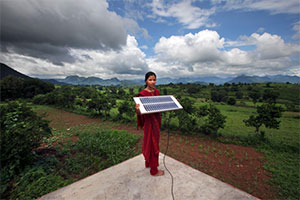 Bringing clean energy to rural India. Credit: Abbie Trayler-Smith / Panos Pictures / Department for International Development
Large reserves of oil, gas and minerals in developing countries generate opulent revenues. They could be used to stimulate economic growth and reduce poverty, but often result in environmental destruction and conflict, benefiting large companies and corrupt governments. Furthermore, competition over natural resources often manifests through geopolitical conflict. For example, before the US-Iraq war, Iraq’s domestic oil industry was nationalized. With US aggression came weakened Iraqi institutions and foreign intervention, thus eventually leading to the privatization of Iraqi oil, leaving the industry now largely dominated by Western companies. As another example, China’s rising investments within the lithium sector in South America are increasing the US-China rivalry across the Western Hemisphere. Notably, Bolivia has the largest reserves of lithium in the world, and the nation’s state-owned lithium extraction firm recently signed a contract with China’s CBC Consortium, while rejecting the entry of Western firms into the nation. In Bolivia’s case, rising Chinese investment in the nation’s lithium sector also raises concerns about environmental sustainability and the sociopolitical rights of Indigenous communities. More broadly, Sub-Saharan Africa holds nearly 30% of global reserves of critical minerals required for low-carbon technologies. Despite this, the region attracts less than 10% of global exploration investment, depicting a critical barrier to both the clean energy transitions and Sub-Saharan Africa’s economic development. Furthermore, resource wealth continues to fuel conflict like Sudan’s civil war, which has led to 9.1 million internally displaced people and is intensely connected to competition over gold, water, and agricultural land. IPS covers news about major oil, gas, and mining projects, their effects on the environment and local communities, and the ideas and actions of the interest groups involved.

The Week with IPS

NEXT STOP - SDGs
Tracking global progress towards a sustainable world
Tracking global progress towards a sustainable world
