Languages
Sunday, November 22, 2026



News and Views from the Global South
Economy & Trade

Blackouts in Argentina Highlight Failings of Privatisation
Record temperatures at the start of the southern hemisphere summer in Argentina have been accompanied by highs on the thermometer of social discontent, as consumption peaks left thousands without electricity and threw into sharp focus the failings of the privatisation of the power industry in the 1990s.
Four Years Later, USAID Funds in Haiti Still Unaccounted For
As the fourth anniversary of the devastating earthquake in Haiti approaches on Jan. 12, development analysts are decrying an ongoing lack of transparency in U.S. foreign aid to the country, even as those assistance streams are drying up.
Gaza Loses an Underground Lifeline
The border between Egypt and the Gaza Strip used to buzz with activity until a few months back as traders brought in an array of Egyptian goods – from food supplies to raw material - through hundreds of tunnels.
Small-scale Organic Farming Gets a Boost in Peru
A new institution set up in Peru will strengthen small-scale organic farming, providing support to some 43,000 exporters of ecological products and another 350,000 who supply the domestic market with environmentally-friendly products.
Eucalyptus Trees Make Way For Food Crops
 A project to reclaim agricultural land lost to eucalyptus plantations is bearing fruit in Cameroon.

Fashion Backward: Cambodian Government Silences Garment Workers
“Cambodian garment workers have two handcuffs and one weapon [against them]. One handcuff is a short-term contract [10 hours a day, six days a week]. Even if they get sick, if they get pregnant they feel they have to get an abortion so they don’t lose their jobs.
Europe’s Leaders Visit Athens to Celebrate Their Failure
The start of Greece’s six-month presidency of the EU was marked by a ceremony Wednesday in the Greek capital attended by the EU commissioners. But protests were banned and there was no in-depth talk about the raging controversy over the bloc’s handling of the Greek debt crisis and the renewed concerns about the vitality of the Eurozone.
Hoodwinked, Jobless, and Back
Ashik Rehman, 47, worked as a labourer in the southern Indian state of Kerala. He left for Saudi Arabia two years ago, hoping to earn enough to buy a house in his native place. Now he is back and staring at a bleak future.
Despite Legal Attacks, Conflict Minerals Ban Gets Stronger
Major manufacturing and business groups on Tuesday urged a court here to roll back a new U.S. regulation that would soon require major manufacturers to ensure that their global supply chains are free of minerals used to fund violence in the Great Lakes region of central Africa.
Christmas Storm Underlines Caribbean’s Vulnerability
Guyanese President Donald Ramotar says the death and destruction caused by intense rainfall in three Caribbean Community (CARICOM) countries over the Christmas holidays is a sign that the region has no time to lose in fortifying its resiliance to climate change.
Sawhoyamaxa Battle for Their Land in Paraguay
The Sawhoyamaxa indigenous community in Paraguay have spent over 20 years fighting to get back their land, which they were pushed off by cattle ranchers.
OP-ED: Arms and Athletes in Bahrain – Al Khalifa’s Deadly Game
A few days ago, Bahraini officials announced that they had “foiled an attempt to smuggle explosives and arms, some made in Iran and Syria, into the country by boat.” Around the same time, the government also contended it had defused a car bomb and seized weapons in different locations in the country.
Bike Paths, BRT Going Strong in Latin American Cities
Sustainable transport grew in the Latin American cities of Buenos Aires, Mexico City and Rio de Janeiro in 2013.
Anti-Poaching Operation Spreads Terror in Tanzania
Ali Nyenge, a resident of Iputi ward in Tanzania's northern Ulanga District, woke up as anti-poaching security officers surrounded his home. He says they accused him of illegal hunting and in front of his 11-year-old son, made him take his clothes off, poured salt water on his body and whipped him with a cane.
Women Farmers in Chile to Teach the Region Agroecology
An organisation that brings together some 10,000 peasant and indigenous women from Chile is launching an agroecology institute for women campesinos, or small farmers, in South America.
More Vehicles in Latin America – More Deaths
The family of Susana Suárez, a 35-year-old Venezuelan dentist, are still in shock over her death in a traffic accident in May. She and a friend were killed on their way back from the beach, and became just two more of the 130,000 victims who died on Latin America’s roads in 2013.
Hospitality, Agriculture Firms Vulnerable to Human Trafficking
Shareholders are calling on 15 U.S.-based multinational corporations to ensure that their global supply chains are not facilitating human rights abuses, particularly labour and sex trafficking.
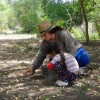
Seedpods Worth More than Gold in Argentina’s Arid North
Tired of the drought driving away their men and killing their livestock, the women of Guanaco Sombriana, a town in northern Argentina, have found a new source of income by using the seedpods of native trees that up to now merely provided shade in this arid landscape.
Keeping the Grass Greener for African Plant Breeders
For the few plant breeders in Africa like Vivian Oduro, working for an international research institution is an obvious choice, with prestige and benefits any agricultural scientist would find hard to decline.
Farm Forecasts Try to Decode a Capricious Climate
In the southwest peninsula of Cedros, one of Trinidad’s driest areas, Jenson Alexander grows the cocoa used for many years by the British chocolate giant Cadbury.
Mexican Communities On Guard Against Thirst for Oil
The Terra 123 oil and gas well in the southeastern Mexican state of Tabasco was in flames since late October, just 1.5 km from a community of 1,500 Oxiacaque indigenous villagers, who were never evacuated.« Previous Page — Next Page »


 UN Commission on International Trade Law Holds Colloquium on Harmonizing Law in Age of Digital Trade and Finance. Credit: UN Photo/Manuel Elías
Trade has historically been a geopolitical tool that can both be used to propel development as well as entrench inequalities. In various nations in East Asia and Latin America, increased trade, as often seen in export booms, has allowed them to achieve influential standings within the global economy. On the other hand, many low-income countries in Sub-Saharan Africa, Asia, and Latin America struggle to maintain a robust trade performance, and oftentimes are subjugated to exploitative trade dynamics through intense extraction of their natural resources. In recent decades, international trade has reached a new era as emerging economies across the world are rising in economic preeminence. Stable international trade is crucial to world peace as global interconnectedness facilitates reliable diplomacy. Nevertheless, significant challenges are on the rise. Notably, a major wave of United States tariff escalations in January 2025 lifted US import taxes to their highest level since the 1930s, changing market dynamics and forcing renegotiations with global trading partners.These articles are aimed at informing readers about the complexities of trade and its varying effects on development, with a special focus on the consequences of the global economic crisis, the potential of fair trade and the gender implications of trade policies.
Updated by Yilan Batista and Shuli Wong August 2026

The Week with IPS

NEXT STOP - SDGs
Tracking global progress towards a sustainable world
Tracking global progress towards a sustainable world
