Languages
Friday, August 28, 2026



News and Views from the Global South
Trade & Investment

Plunging Oil Prices Won’t Kill Vaca Muerta
Despite the precipitous fall in global oil prices, Argentina has continued to follow its strategy of producing unconventional shale oil, although in the short term there could be problems attracting the foreign investment needed to exploit the Vaca Muerta shale deposit.
781 Million People Can’t Read this Story
If you are reading this article, consider yourself one of the lucky ones; lucky enough to have received an education, or to be secure in the knowledge that your child will receive one. Lucky enough to be literate in a world where – more often than not – the ability to read and write can mean the difference between a decent life and abject poverty.
Child Labour on U.S. Tobacco Farms: A Stubborn Problem in a Billion-Dollar Industry
For many young people, the summer is synonymous with free time, relaxation, or family vacations. For less fortunate kids the summer means labour, with scores of youths taking on part-time work to support their families.
Opinion: A Long History of Predatory Practices Against Developing Countries
The world’s attention turned to the practices of vulture funds after the U.S. Supreme Court affirmed a lower court opinion in the NML Capital vs Argentina case, which forbids the country from making payments on its restructured debt.
Obama Prepares for Showdown with Congress Over Iran Deal
Two days after the deadline for reaching a deal over Iran’s nuclear programme had passed, negotiators looked like they would be going home empty handed. But a surprisingly detailed framework was announced Apr. 2 in Lausanne, Switzerland, as well as in Washington, and in the same breath, U.S. President Barack Obama acknowledged the battle he faces on Capitol Hill.
Curbing Tobacco Use – One Step Forward, Two Steps Back
The numbers are in, and there’s not much to celebrate: every year, about six million people die as a result of tobacco use, including 600,000 who succumb to the effects of second-hand smoke.
Opinion: Brazil at the Crossroads
Even moderately well-informed analysts knew that the Brazilian economy was in dire straits as President Dilma Rousseff initiated her second term in office in January.U.N. Water Report Not “Doom And Gloom”, Says Author
The lead author of a United Nations water report has spoken out about media depictions of his findings, denying the report lays out a “doom and gloom” scenario.
A “Year of Eye-Catching Steps Forward” for Renewable Energy
Driven by solar and wind, world investments in renewable energy reversed a two-year dip last year, brushing aside the challenge from sharply lower oil prices and registering a 17 percent leap over the previous year to stand at 270 billion dollars.
Nicaragua’s Future Canal a Threat to the Environment
The new interoceanic canal being built in Nicaragua has brought good and bad news for the scientific community: new species and archeological sites have been found and knowledge of the local ecosystems has grown, but the project poses a huge threat to the environment.
Opinion: Cuba and the European Union – The Thaw Begins
The visit to Cuba of Federica Mogherini, High Representative of the European Union for Foreign Affairs and Security Policy on Mar. 23-24, and the forthcoming visit in May planned by French President François Hollande, have fast-tracked the agenda of relations between the European Union and Cuba.
Opinion: Crisis Resolution and International Debt Workout Mechanisms
Debt restructuring is a component of crisis management and resolution, and needs to be treated in the context of the current economic conjuncture and vulnerabilities.
Afghanistan’s Economic Recovery: A New Horizon for South-South Partnerships?
First the centre of the silk route, then the epicenter of bloody conflicts, Afghanistan’s history can be charted through many diverse chapters, the most recent of which opened with the election of President Ashraf Ghani in September 2014.
Indonesian President Unyielding on Death Penalty
When Indonesia’s law and human rights minister visited one of the country’s prisons in December last year, he met a Nigerian convict on death row for drug trafficking, who performed songs for him before leaving him with a parting gift.
Pacific Islanders Say Climate Finance “Essential” for Paris Agreement
As Pacific Islanders contemplate the scale of devastation wrought by Cyclone Pam this month across four Pacific Island states, including Vanuatu, leaders in the region are calling with renewed urgency for global action on climate finance, which they say is vital for building climate resilience and arresting development losses.
Multi-Drug Resistance Adds to Tuberculosis Epidemic in Papua New Guinea
Rising multi-drug resistance in patients suffering from tuberculosis, a debilitating infectious lung disease which mainly impacts the developing world, has led to a public health emergency in the southwest Pacific Island state of Papua New Guinea, according to state officials.Gates Foundation Slammed for Plan to Privatise African Seed Markets
The Bill and Melinda Gates Foundation (BMGF) has been attacked by activists over alleged support of a plan to privatise African agricultural markets.
Salvadoran Maquila Plants Use Gang Members to Break Unions
Textile companies that make clothing for transnational brands in El Salvador are accused of forging alliances with gang members to make death threats against workers and break up their unions, according to employees who talked to IPS and to international organisations.
Four Fast Facts to Debunk Myths About Rural Women
We are lucky to live in a country that has long since abandoned the image of the damsel in distress. Even Disney princesses now save themselves and send unsuitable “saviours” packing. But despite the great strides being made in gender equality, we are still failing rural women, particularly women farmers.
High-Tech to the Rescue of Southern Africa’s Smallholder Farmers
Agriculture is the major employer and a backbone of the economies of Southern Africa.
Development and Taxes, a Vital Piece of the Post-2015 Puzzle
Public funds are vitally important to achieving the Sustainable Development Goals (SDGs), making corporate tax avoidance trends a pressing issue for post-2015 Financing for Development discussions.« Previous Page — Next Page »


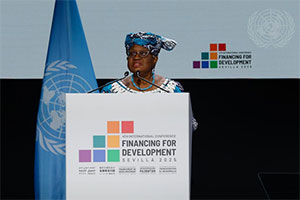 Opening of 4th International Conference on Financing for Development. Credit: UN Photo/Mariscal
International trade and investment are crucial elements of the world economy. While they can be powerful stimulators of development, they can also lead to global imbalances and dynamics of exploitation. In 2025, international trade entered a period of immense disruption, driven in part by a new wave of United States tariffs that reshaped global supply chains and investment flows. The increase in the US tariff rate, the highest since the 1930s, has forced bilateral renegotiations with global trading partners. Furthermore, the debt crisis in developing nations has accelerated while Official Development Assistance (ODA) has substantially dropped 7.3% in 2024.
In the 21st century, advancements in economic diversification in formerly colonized nations have propelled them into more central roles in the global economy. For example, both China and Mexico were able to develop their manufacturing sector and channel this development into booming export flows, thus advancing into the position of emerging economies. Foreign investment also plays an essential role in providing capital for developing countries, although they are oftentimes accompanied by social and environmental exploitation. For example, rising Chinese investments in natural resources in Latin America have often been met with tension as these investment projects fail to properly mitigate environmental risks and protect workers’ rights. In a more multifaceted vein, Sino-African relations have led to infrastructure development in Sub-Saharan Africa while also heightening the region’s economic dependency on China. IPS reports on global news in trade and investment, while shining a light on the nuanced nature of these endeavors.

The Week with IPS

NEXT STOP - SDGs
Tracking global progress towards a sustainable world
Tracking global progress towards a sustainable world
