Languages
Thursday, August 27, 2026



News and Views from the Global South
Trade & Investment

Indonesia Still a Long Way from Closing the Wealth Gap
Every afternoon, Wahyu sets up his wooden food cart by the side of a busy road in Central Jakarta to sell sweet buns, known as ‘bakpao’, to people passing by. In a good month, the street vendor can make around 800,000 rupiah, which amounts to roughly 62 dollars.
Farmers Fight Real Estate Developers for Kenya’s Most Prized Asset: Land
Vegetables grown in the lush soil of this quiet agricultural community in central Kenya’s fertile wetlands not only feed the farmers who tend the crops, but also make their way into the marketplaces of Nairobi, the country’s capital, some 150 km south.
Farmers Fight Real Estate Developers for Kenya’s Most Prized Asset: Land
 Vegetables grown in the lush soil of this quiet agricultural community in central Kenya’s fertile wetlands not only feed the farmers who tend the crops, but also make their way into the marketplaces of Nairobi, the country’s capital, some 150 km south.

Opinion: A Development Fairytale or a Global Land Rush?
In our work at Greenpeace and the Oakland Institute around access and control over natural resources, we face constant accusations of being anti-development or “Northern NGOs who care more for the trees”, despite working with communities around the world, from Cameroon, to China, to the Czech Republic.
The Biggest Lessons Nepal Will Take Away From This Tragedy
There has never been any doubt that Nepal is sitting on one of the most seismically active areas in South Asia. The fact that, when the big one struck, damages and deaths would be catastrophic has been known for years.
Opinion: South-South Cooperation Vital for Sustainable Development
Sustainable development is central to a range of key discussions at the United Nations and elsewhere at the moment.
Living the Indigenous Way, from the Jungles to the Mountains
In the course of human history many tens of thousands of communities have survived and thrived for hundreds, even thousands, of years. Scores of these largely self-sustaining traditional communities continue to this day in remote jungles, forests, mountains, deserts, and in the icy regions of the North. A few remain completely isolated from modern society.
Unifying Transmission from North to South Means Cheaper Energy in Chile
Chile expects to have a more efficient and stable electricity market, with a more steady - and above all, less expensive – supply, when the country’s two major power grids are interconnected over a distance of more than 3,000 km.
Falling Oil Prices Trigger Initial Economic Gains for Pacific Islanders
The recent dramatic fall in world oil prices, with Brent crude plummeting from a high of 115 dollars per barrel in June last year to around 47 dollars in January 2015, is beginning to benefit Pacific Islanders who are seeing lower prices for fuel and energy.
Q&A: “People Need to Be at the Centre of Development”
In a populous archipelago nation like Indonesia, where 250 million live spread across some 17,500 islands, speaking over 300 languages, the question of development is a tricky one.
Opinion: Lack of Trade Finance a Barrier for Developing Countries
Up to 80 percent of global trade is supported by some form of financing or credit insurance. Yet in many countries there is a lack of capacity in the financial sector to support trade, and also a lack of access to the international financial system. Therefore the ability of these countries to use simple instruments such as letters of credit is limited.
Watch What Happens When Tribal Women Manage India’s Forests
Kama Pradhan, a 35-year-old tribal woman, her eyes intent on the glowing screen of a hand-held GPS device, moves quickly between the trees. Ahead of her, a group of men hastens to clear away the brambles from stone pillars that stand at scattered intervals throughout this dense forest in the Nayagarh district of India’s eastern Odisha state.
Cash-Strapped Latin American Countries Turn to China for Credit
Angolans are generally grateful for China’s participation in the reconstruction of their central African country, in spite of the fact that some of the roads and buildings built by Chinese firms are of poor quality, and mainly Chinese labourers have been hired rather than local workers.
Kenyan Pastoralists Protest Wanton Destruction of Indigenous Forest
Armed with twigs and placards, enraged residents from a semi-pastoral community 360 km north of Kenya’s capital, Nairobi, protested this week against wanton destruction of indigenous forest – their alternative source of livelihood.
Planned Mega-Port in Brazil Threatens Rich Ecological Region
Activists and local residents have brought legal action aimed at blocking the construction of a nearly 50 sq km port terminal in the Northeast Brazilian state of Bahia because of the huge environmental and social impacts it will have.Corruption in Southeast Asia Said to Threaten Economic Integration
Rampant corruption across Southeast Asia threatens to derail plans for greater economic integration, according to Transparency International, the global coalition against corruption.
Rights Abuses Still Rampant in Bangladesh’s Garment Sector
Some say they were beaten with iron bars. Others confess their families have been threatened with death. One pregnant woman was assaulted with metal curtain rods.
From Slavery to Self Reliance: A Story of Dalit Women in South India
HuligeAmma, a Dalit woman in her mid-forties, bends over a sewing machine, carefully running the needle over the hem of a shirt. Sitting nearby is Roopa, her 22-year-old daughter, who reads an amusing message on her cell phone and laughs heartily.
Investigation Tears Veil Off World Bank’s “Promise” to Eradicate Poverty
An expose published Thursday by the International Consortium of Investigative Journalists (ICIJ) and its media partners has revealed that in the course of a single decade, 3.4 million people were evicted from their homes, torn away from their lands or otherwise displaced by projects funded by the World Bank.
Opinion: Two Winners and One Loser at the Summit of the Americas
U.S. President Barack Obama has earned a place in history for taking the first steps towards rectifying a policy that has lasted over half a century without ever achieving its primary goal of ending the Castro regime in Cuba.
Nepal: A Trailblazer in Biodiversity Conservation
At dusk, when the early evening sun casts its rays over the lush landscape, the Chitwan National Park, a UNESCO World Heritage Site about 200 km south of Nepal’s capital, Kathmandu, is a place of the utmost tranquility.« Previous Page — Next Page »


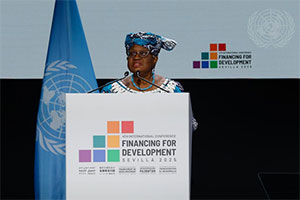 Opening of 4th International Conference on Financing for Development. Credit: UN Photo/Mariscal
International trade and investment are crucial elements of the world economy. While they can be powerful stimulators of development, they can also lead to global imbalances and dynamics of exploitation. In 2025, international trade entered a period of immense disruption, driven in part by a new wave of United States tariffs that reshaped global supply chains and investment flows. The increase in the US tariff rate, the highest since the 1930s, has forced bilateral renegotiations with global trading partners. Furthermore, the debt crisis in developing nations has accelerated while Official Development Assistance (ODA) has substantially dropped 7.3% in 2024.
In the 21st century, advancements in economic diversification in formerly colonized nations have propelled them into more central roles in the global economy. For example, both China and Mexico were able to develop their manufacturing sector and channel this development into booming export flows, thus advancing into the position of emerging economies. Foreign investment also plays an essential role in providing capital for developing countries, although they are oftentimes accompanied by social and environmental exploitation. For example, rising Chinese investments in natural resources in Latin America have often been met with tension as these investment projects fail to properly mitigate environmental risks and protect workers’ rights. In a more multifaceted vein, Sino-African relations have led to infrastructure development in Sub-Saharan Africa while also heightening the region’s economic dependency on China. IPS reports on global news in trade and investment, while shining a light on the nuanced nature of these endeavors.

The Week with IPS

NEXT STOP - SDGs
Tracking global progress towards a sustainable world
Tracking global progress towards a sustainable world
