Languages
Wednesday, November 11, 2026



News and Views from the Global South
Aid

Peacekeepers Greenlighted for CAR, but Mission Will Take Months
Amid alarming reports of ethnic cleansing in the Central African Republic, the U.N. Security Council voted unanimously Thursday to send an official peacekeeping mission to the conflict-torn country where the minority Muslim population has all but disappeared in much its Western half.
Kenya’s Pastoralists Show their Green Thumbs
For more than a decade Dima Wario from Rupa, a village in Merti division, northern Kenya, escaped death and watched helplessly as many in his community died in a spate of fatal clashes over receding resources.
New Treatments May Defuse Viral Time Bomb
Mohamed Ibrahim first learned he had hepatitis C when he tried to donate blood. Weeks later he received a letter from the blood clinic telling him he carried antibodies of the hepatitis C virus (HCV). He most likely acquired the disease from a blood transfusion he received during surgery when he was a child.IFC-Negotiated Privately Run Hospital Sapping Lesotho Budget
The world’s first hospital to be built and run in a developing country under a public-private partnership is taking up more than half of the health budget in Lesotho, according to new estimates, diverting resources from populations outside of the capital.
Biofortified Beans to Fight ‘Hidden Hunger’ in Rwanda
Joane Nkuliye considers herself an activist. She is part of a select group of farmers producing biofortified crops on a commercial scale in Rwanda.
Getting into CAR, When so Many Want to Get Out
In a country suffering from what the U.N. has called “ethno-religious cleansing”, a “disappeared” state structure and “unacceptable sectarian brutality,” gaining access to the population of the Central African Republic has proven a difficult and sometimes deadly task for humanitarian workers.
Tanzania’s Farming Cooperatives Struggle to Bear Fruit
John Daffi climbs to the top of a hill overlooking a scenic Rift Valley wall and the Ngorongoro forest, where wildlife migrates between the world famous Ngorongoro crater and Tanzania’s Lake Manyara. Daffi, 59, looks down upon his family’s farm below and reminisces about the time his father first brought him here as a boy.
Africa’s Youth Not Lured by Unglamorous Farming
Ketsela Negatu is the son of an Ethiopian goat farmer living close to the country’s capital, Addis Ababa, who refuses to follow in his father’s footsteps. The 19-year-old has negative perceptions about the family profession after seeing the dim prospects a farming livelihood has offered his father.
Donors Repeatedly Postpone Major Aid Effectiveness Report
Major foreign assistance donors have once again delayed the release of a report meant to measure transparency, accountability and cooperation of aid effectiveness.
IPCC Climate Report Warns of “Growing Adaptation Deficit”
The latest update of the world’s scientific consensus on climate change finds not only that impacts are already being felt on every continent, but also that adaptation investments are dangerously lagging.
Commonwealth Works to Raise Climate Resilience on Global Agenda
As they fine-tune preparations for the Small Island Developing States (SIDS) Conference in Samoa and the United Nations post-2015 development framework meeting in September, Commonwealth states are focusing on getting the international community to pay more attention to the challenges they face.
Fighting Now Brings Disease
For just that moment, the refugees in Yarmouk camp in Damascus made news. After months of facing starvation and death in the shadows of the Syrian civil war came packets of food and aid in January - with cameras in tow.
Sahel Food Crisis Overshadowed by Regional Conflict
Still not enough is being done to improve the food emergency in Africa’s Sahel Region as conflict and instability continue to exacerbate any response towards aiding a region where one in eight people suffer from food insecurity.
OP-ED: Egypt’s Death Sentences Test U.S. Resolve
The summary mass trial and sentencing of 529 Egyptians to death this week is yet another example of Egypt’s descent into lawlessness and blatant miscarriage of justice.
To Spy To Live
“If you want to live and receive medical treatment, you have my number, so you can call me and agree to my request. You will then get medical help, and survive.” The request, the patient said, was from an Israeli intelligence officer looking to recruit him in exchange for treatment.
A Honduran Paradise that Doesn’t Want to Anger the Sea Again
At the mouth of the Aguán river on the Caribbean coast of Honduras, a Garífuna community living in a natural paradise that was devastated 15 years ago by Hurricane Mitch has set an example of adaptation to climate change.Pacific Islands At Sea Over Land Rights
For many Pacific Islanders, customary land is the source of life, identity and social security. However, most island states are developing countries, and governments claim land reform is needed to improve infrastructure and economic development. Registration of customary land, the predominant tenure system, with more options for leasing to the state and developers is being promoted as the way forward.
Increased Instability Predicted for Egypt
International human rights groups have strongly denounced Monday’s sentencing by an Egyptian court of 529 Islamists to death for a riot in which one policeman was killed.
Putting Climate Polluters in the Dock
Can Caribbean governments take legal action against other countries that they believe are warming the planet with devastating consequences?
Sri Lanka Prepares for Geneva Showdown
As Sri Lanka steadfastly refuses any external inquiry into human rights abuses allegedly committed when the government pushed a military victory over Tamil rebels in its decades-long sectarian conflict, right groups say the global community is left with no option but to push for an international investigation.
Port Development Brings Progress to Brazil – At a Price
“We are victims of progress,”complained Osmar Santos Coelho, known as Santico. His fishing community has disappeared, displaced to make way for a port complex on São Marcos bay, to the west of São Luis, the capital of the state of Maranhão in Brazil’s northeast.« Previous Page — Next Page »





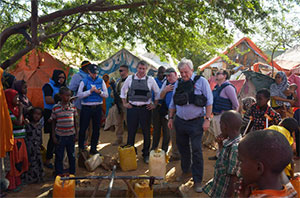 UN Emergency Relief Coordinator Visits Somalia. Credit: UN Photo/Tobin Jones
In recent years, conflicts have broken out across the world with no sign of slowing down or stopping. In times like this, millions of people globally are in dire need of humanitarian aid. Famine, warfare, natural disasters, and economic decline plague a host of nations, including Palestine, Sudan, Chad, Lebanon, and Haiti, to name a few. Humanitarian aid provides millions of people with critical services including healthcare, food, clean drinking water, psychosocial support, housing, and access to education. UN agencies such as the UNDP, UNICEF, the World Food Programme (WFP), UNHCR, UNRWA, and UNEP work with the UN Office for the Coordination of Humanitarian Aid (OCHA) and local organizations to come up with the best possible strategies to support affected communities. At the same time, humanitarian aid and those working on the frontlines are consistently threatened by both actors directly involved in conflict as well as those who are meant to contribute to the international humanitarian regime at large. The near-collapse of United States international aid structures in 2025, including the termination of 83% of USAID’s 6,300 global initiatives, has left millions of people without access to vital humanitarian assistance. 98 million people in 2025, only 65% of people targeted for humanitarian assistance, received the help they needed. In contrast, 123 million people received some form of humanitarian assistance in 2024, and OCHA’s 2026 Global Humanitarian Overview estimates that 239 million people are in need of assistance in 2026. IPS is well-positioned to discuss current initiatives to provide aid and relief through in-depth reporting and opinion content.

The Week with IPS

NEXT STOP - SDGs
Tracking global progress towards a sustainable world
Tracking global progress towards a sustainable world
