Languages
Thursday, October 15, 2026



News and Views from the Global South
Conferences

Curbing the Illegal Wildlife Trade Crucial to Preserving Biodiversity
For over five years, 33-year-old Maheshwar Basumatary, a member of the indigenous Bodo community, made a living by killing wild animals in the protected forests of the Manas National Park, a tiger reserve, elephant sanctuary and UNESCO World Heritage Site that lies on the India-Bhutan border.
Marine Litter: Plunging Deep, Spreading Wide
Imagine a black-footed albatross feeding its chick plastic pellets, a baby seal in the North Pole helplessly struggling with an open-ended plastic bag wrapped tight around its neck, or a fishing vessel stranded mid-sea, a length of discarded nylon net entangled in its propeller. Multiply these scenarios a thousand-fold, and you get a glimpse of the state of the world’s oceans.
Family Farmers Don’t Need Climate-Smart Agriculture
Small farmers can look to options like agroecological intensification and innovation, without necessarily turning to climate-smart agriculture, which is promoted by the United Nations but has awakened doubts among global experts meeting in this Italian city.
A Billion Tons of Food Wasted Yearly While Millions Still Go Hungry
In his parody of the Michael Jackson hit “Beat It”, the American satirist and singer Weird Al Yankovic has a parent urging his son to eat the food on his plate, warning that “other kids are starving in Japan”.
Financing for Biodiversity: A Simple Matter of Keeping Promises
With governments, activists and scientists tearing their hair out over the world’s impending crisis in biodiversity, the outgoing president of the Convention on Biological Diversity (CBD) delivered a simple message to participants at the 12th Conference of the Parties to the CBD (COP12) currently underway in the Republic of Korea’s northern Pyeongchang county: honour the promises you made last year.
Humanity Failing the Earth’s Ecosystems
In pure numbers, the past few decades have been marked by destruction: over the last 40 years, Earth has lost 52 percent of its wild animals; nearly 17 percent of the world’s forests have been felled in the last half-century; freshwater ecosystems have witnessed a 75-percent decline in animal populations since 1970; and nearly 95 percent of coral reefs are today threatened by pollution, coastal development and overfishing.Azerbaijan Pursues Drones, New Security Options
Heightened tensions with longtime foe Armenia over breakaway Nagorno Karabakh and mediator Russia’s Ukrainian adventure appear to be pushing Caspian-Sea energy power Azerbaijan ever more strongly toward a military strategy of self-reliance.
Q&A: “The Battle Continues”
The Programme of Action adopted at the landmark 1994 International Conference on Population and Development (ICPD) included chapters that defined concrete actions covering some 44 dimensions of population and development, including the need to provide for women and girls during times of conflict, the urgency of investments in young people’s capabilities, and the importance of women’s political participation and representation.
Outgunned by Rich Polluters, Africa to Bring United Front to Climate Talks
As climate change interest groups raise their voices across Africa to call for action at the COP20 climate meeting in December and the crucial COP21 in Paris in 2015, many worry that the continent may never have fair representation at the talks.Zero Nuclear Weapons: A Never-Ending Journey Ahead
When the United Nations commemorated its first ever "international day for the total elimination of nuclear weapons," the lingering question in the minds of most anti-nuclear activists was: are we anywhere closer to abolishing the deadly weapons or are we moving further and further away from their complete destruction?
Water: A Defining Issue for Post-2015
A gift of nature, or a valuable commodity? A human right, or a luxury for the privileged few? Will the agricultural sector or industrial sector be the main consumer of this precious resource? Whatever the answers to these and many more questions, one thing is clear: that water will be one of the defining issues of the coming decade.
U.N. High-Level Summits Ignore World’s Political Crises
As the 69th session of the General Assembly took off with the usual political pageantry, the United Nations will be hosting as many as seven "high-level meetings", "summits" and "special sessions" compressed into a single week - the largest number in living memory.
Environmental Funding Bypasses Indigenous Communities
When she talks about the forests in her native Kalimantan, the Indonesian part of the island of Borneo, Maridiana Deren’s facial expression changes. The calm, almost shy person is transformed into an emotionally charged woman, her fists clench and she stares wide-eyed at whoever is listening to her.
U.N. Urged to Reaffirm Reproductive Rights in Post-2015 Agenda
The U.N.'s post-2015 development agenda has been described as the most far-reaching and comprehensive development-related endeavour ever undertaken by the world body.
OPINION: Step Up Efforts Against Hunger
At the 1996 World Food Summit (WFS), heads of government and the international community committed themselves to reducing the number of hungry people in the world by half. Five years later, the Millennium Development Goals (MDGs) lowered this level of ambition by only seeking to halve the proportion of the hungry.
Will the Upcoming Climate Summit Be Another Talkathon?
As the United Nations hosts a Climate Summit Sep. 23, the lingering question is whether the meeting of world leaders will wind up as another talk fest.
OPINION: A Climate Summit to Spark Action
On Sep. 23, I have invited world leaders from government, business, finance and civil society to a Climate Summit in New York so they can show the world how they will advance action on climate change and move towards a meaningful universal new agreement next year at the December climate negotiations in Paris.
U.N. Climate Summit: Staged Parade or Reality Show?
The much-ballyhooed one-day Climate Summit next week is being hyped as one of the major political-environmental events at the United Nations this year.
Indigenous Peoples Seek Presence in Post-2015 Development Agenda
The world's 370 million indigenous people, who say they were marginalised in the Millennium Development Goals (MDGs), want to play a key role in the U.N.'s post-2015 development agenda, which will be finalised next year.
Struggling to Find Water in the Vast Pacific
Pacific Island states are surrounded by the largest ocean in the world, but inadequate fresh water sources, poor infrastructure and climate change are leaving some communities without enough water to meet basic needs.
Civil Society Condemns Immunity for Sitting African Leaders Accused of Serious Crimes
Mary Wacu lived in the Rift Valley region for 10 years prior to the 2007/08 post-election violence that rocked Kenya after a disputed general election.« Previous Page — Next Page »





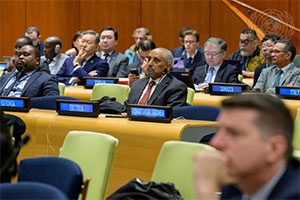 General Assembly Meets to Hear Briefing on UN80 Initiative. Credit: UN Photo/Manuel Elías
Global development conferences are continuing to produce critical frameworks for South-South cooperation and multilateral reform. In January of 2024, the 3rd Global South Nexus (GSN) International Conference was held in Odisha, India, with its theme being “Creating Responsible Professionals for Advancing SDGs: Inputs from Global North and South.” The 2025 UN SDG Report provided a midpoint assessment of the 2030 Agenda, with only 35% of targets on track and 18% having reversed. The 2025 UN Climate Change Conference (COP30) in Belém, Brazil, agreed to mobilize $1.3 trillion annually for climate action by 2035, operationalize the loss and damage fund, triple adaptation finance, and launched the Belém Mission to 1.5°C. In 2025, the Partnership for Economic Policy (PEP) convened its annual Policy Conference in Nairobi, Kenya, addressing the issue of “Financing and Inclusivity in Green Energy Transition in the Global South.” As the Global South advocates increasingly for a South-South framework alongside North-South cooperation, international conferences on sustainability aim to bridge economic and social divides between developed and developing countries in achieving the UN SDGs. Furthermore, to mark the UN’s 80th anniversary, the UN80 Initiative was launched to reshape how the UN system works so that every mandate, dollar, and decision creates greater impact for the global system.

The Week with IPS

NEXT STOP - SDGs
Tracking global progress towards a sustainable world
Tracking global progress towards a sustainable world
