Languages
Thursday, November 26, 2026



News and Views from the Global South
Food and Agriculture

Zimbabwe Sails Close to Economic Rocks
For President Robert Mugabe to defeat the opposition in the Jul. 31 election by hook or by crook may have been a walk in the park, but beating the economic crisis will be another matter. The stock market fell 11 percent the day he was sworn in, the biggest fall in a day since 2009.
New Initiative Aims to Integrate Agriculture and Conservation
It took Brazil four decades to overcome food insecurity and earn a place as a major global food supplier. Now its experiences will contribute to the evidence base for a new initiative that seeks to reconcile agriculture and the conservation of biological diversity.
GM Seeks New Pastures in Pakistan
After a string of setbacks in India in recent years, the genetically modified seed industry is now targeting Pakistan as its next frontier, say activists.
OP-ED: Rising Temperature, Rising Food Prices
Agriculture as it exists today developed over 11,000 years of rather remarkable climate stability. It has evolved to maximize production within that climate system. Now, suddenly, the climate is changing. With each passing year, the agricultural system is becoming more out of sync with the climate system.
When Disaster Rains, Talk
Gulam Rasul, chief meteorologist at the Pakistan Meteorological Department, was sure early this month that the second leg of the annual monsoon due in the latter half of the month was going to be bad. “Normally it peaks towards late August,” Rasul told IPS.
Sustainable Technologies Safeguard the Soil in Cuba
The furrows are hard to make out in fields of the Finca de Semillas, a farm on Havana’s outskirts, because its administrators, Esmilda Sánchez and Raúl Aguilar, protect every centimetre of soil with mulch.
Caribbean Economies Battered by Storms
The Caribbean is in danger of becoming “a region of serial defaulters” with respect to international debt obligations, according to one expert, and this may partly be due to its economies suffering frequent shocks from natural disasters.
Ecological Cuban Recipes Boost Sustainable Agriculture
Vilda Figueroa and her husband, José Lama, live in Marianao on the outskirts of Havana, where they share hundreds of recipes based on Cuban-grown foods and sun-drying, along with other ecological food preservation methods.
The Role of the State in Developing Countries under Attack from New FTAs
Two new trade agreements involving the two economic giants, the United States and the European Union, are leading a charge against the role of the state in the economy of developing countries.
One Recipe for the Homeless
Following the death of his parents when he was just four, Samlain Chey, now 22, found himself living on the streets along the river near the Royal Palace in Phnom Penh. Until he met a social worker from Mith Samlanh.
Kashmiri Farmers Unprepared for Drought
Zareena Bano has had to skip school 17 times this year to help out on her family’s farm in Tangchekh village in the northern Indian state of Kashmir.
Building the Future Enterprise by Enterprise in Rural Peru
Women and young people are central players in dozens of small businesses and environmental protection plans that are changing the lives of poor rural families in the Andes highlands of southern Peru.
Study Finds Many “Bee-Friendly” Plants Laced with Pesticide
Major U.S. retailers are selling garden plants that are billed as “bee-friendly” but laced with pesticides known to be toxic to bees, according to a preliminary study, the first on the issue, released Wednesday.
Push for Legal Production of Hemp in Mexico
Marijuana and the closely related hemp can provide medicinal, food and textile industrial materials that could attract substantial investment and development in Mexico if cannabis were legalised and its cultivation and sale regulated, experts say.
Haitian Farmers Lauded for Food Sovereignty Work
Work by the Group of 4 (G4) union of Haitian peasant organisations, along with assistance from the Dessalines Brigade - South American peasant leaders and agroecology experts supported by La Via Campesina - has been singled out for promoting “good farming practices and advocat[ing] for peasant farmers” in Haiti.
Q&A: “When the String of the Inequality Gap Snaps, You Have Political Crisis”
"There is no development without peace. It should be understood that, for there to be development in a country, there must be an internal peace process,” says Kanayo Nwanze, president of the International Fund for Agricultural Development (IFAD).
India and China Oil Palms Dangerously
When there is feasting in India, Pakistan and Bangladesh, there could just be a connection between the celebrations and the fires on Indonesia’s Sumatra Island that trigger frequent transboundary smog.
Slum Farmers Rise Above the Sewers
Tucked deep in Kenya’s sprawling Kibera slum is the shanty that Alice Atieno calls home. It is just one among many small, badly-lit shacks built close together in this crowded slum where an estimated one million people live on about 400 hectares.
Cameroonians See REDD
Uncertainty over property rights and access to forest land is potentially a major stumbling block for implementing the United Nations collaborative initiative on Reducing Emissions from Deforestation and forest Degradation in Cameroon.
Ancient Kings Fight Climate Change
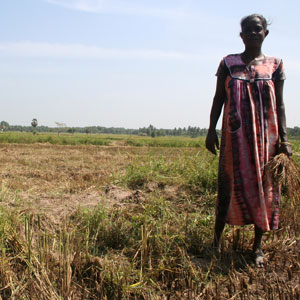
Life for a widow with young children in Sri Lanka’s poor agrarian areas can be harsh. Families in remote areas like Anuradhapura in the North Central Province barely eke out a living through paddy cultivation or through vegetable and other crops planted in cleared jungle shrub - Chena cultivation as it is called.
Tapping Rural Culture for Development Potential
“I was a hunter. I killed many animals,” said Rosalino Ortiz, a representative of Mashiramo, a campesino organisation that monitors biodiversity in Colombia’s Massif range in the southern department of Huila.« Previous Page — Next Page »


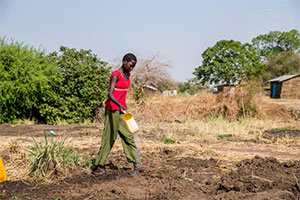 Farming on the Outskirts of Juba. Credit: UN Photo/JC McIlwaine
Promoting human and planetary health is a central focus of the United Nations, as laid out in the 2030 Sustainable Development Goals (SDGs). World hunger and unsustainable farming practices continue to be pressing concerns for the world. According to the 2025 State of Food Security and Nutrition in the World report by the Food and Agriculture Organization (FAO), 673 million people faced hunger in 2024. There are stark regional disparities, with the FAO projecting that 60% of the world population facing hunger will reside in Africa by 2030. Globally, the prevalence of food insecurity has remained consistently higher for women than men.
Sustainable and efficient national food systems are essential in preserving health, education, environmental well-being, peace, economy, and security. However, creating sustainable food systems can be a challenging endeavor, as food production takes a heavy toll on the environment. The agricultural sector accounts for a significant portion of greenhouse gases. Finding safe, sustainable, and ethical strategies to feed the world is crucial in ensuring planetary longevity. A recent initiative from 2023, the EU Regulation on Deforestation-free Products (EUDR), seeks to advocate for sustainable food systems. The main driver of deforestation is the expansion of agricultural land used to produce commodities like cattle, wood, cocoa, coffee, etc. The EUDR is part of the 2020 European Green New Deal and the EU Biodiversity Strategy for 2030 and aims to limit Europe’s consumption of products linked with deforestation by requiring that companies prove that their products are deforestation-free. Despite aiming to achieve major strides in sustainability, policies such as EUDR also raise socioeconomic concerns for targeted countries. Many emerging Latin American economies are impacted by the policy, and have raised the question of how developing countries can grapple with the tensions between economic development and advancing sustainability.
IPS has been at the forefront of providing compelling and insightful stories on communities facing hunger as well as the cost of food production. IPS uses statistics from FAO, the World Food Programme (WFP) and the International Fund for Agricultural Development (IFAD) to bring relevant and hard-hitting facts to readers. This gathering of information and data from such organizations helps bring the best stories from IPS journalists working in the different regions in consultation with experts on the ground.

The Week with IPS

NEXT STOP - SDGs
Tracking global progress towards a sustainable world